

ARTICLE AD BOX
ADVERTISEMENT
By supporting practical STEM education, BMW Group is opening new pathways of learning and aspiration for girls in Jharkhand, where It Matters Most.
By Rusen Kumar
RANCHI (Jharkhand): At a time when learning gaps in mathematics and science continue to limit opportunities for students in underserved communities, BMW Group and UNICEF are working to strengthen STEM education where it matters most. Through Project BRIDGE, the partnership is bringing hands-on, activity-based learning to government schools in Jharkhand and other states, helping girls move beyond textbooks to understand science through practice, curiosity, and confidence. In classrooms where access has long been a challenge, the initiative is beginning to turn STEM education into a pathway for aspiration, empowerment, and long-term change.
Inside a Kasturba Gandhi Balika Vidyalaya (KGBV) on the outskirts of Jharkhand’s capital, a group of girls gather around a makeshift science model—a balloon-powered car assembled using a plastic bottle and straws. As it shoots forward, the room breaks into laughter. But what follows is more telling. One of the students steps in to explain the concept of air pressure—confidently, without referring to a textbook.
It is a small but revealing moment—one that captures a larger shift underway under Project BRIDGE, a partnership between BMW Group and UNICEF aimed at strengthening STEM education in underserved government schools.
The need for such interventions is stark. Jharkhand continues to struggle with low learning outcomes—only 9% of Grade 9 students demonstrate proficiency in mathematics, while just 35.1% complete Class 12. Against this backdrop, classrooms under the programme are moving away from rote memorisation to hands-on learning. Students are building circuits, experimenting with light and motion, and using everyday materials to understand scientific concepts—an approach that is beginning to improve engagement and conceptual clarity.
Speaking during a recent field visit, Saadhna Panday, Chief of Education, UNICEF India, said the challenge goes beyond access to education. “Math and science are critical for students to participate in a digital and increasingly AI-driven economy. While India has made progress in foundational learning, this is not translating into strong performance in secondary-level STEM. Through this partnership, we are working with state governments to improve participation—especially among girls—and transform how these subjects are taught,” she said, adding that the next phase will focus on strengthening teaching content to improve actual learning outcomes.
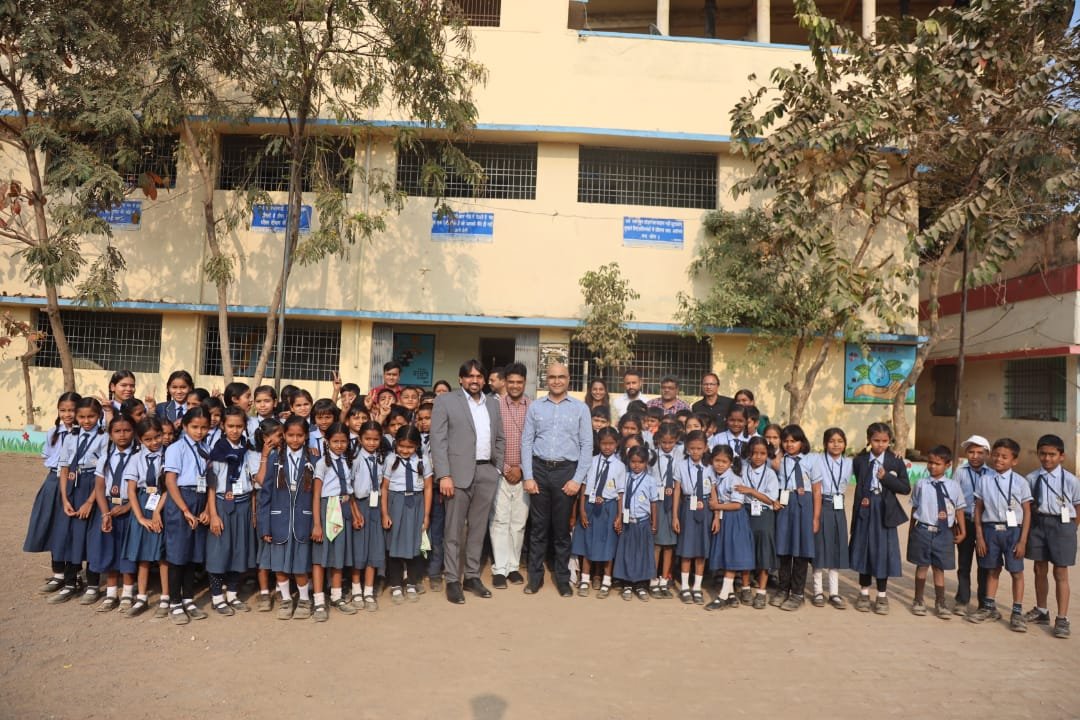
The programme, launched in 2023 and planned through 2030, currently spans five states and combines low-cost maker spaces with teacher training. In Jharkhand alone, it covers 82 residential schools, reaching over 36,000 students, most of them from tribal and economically disadvantaged communities.
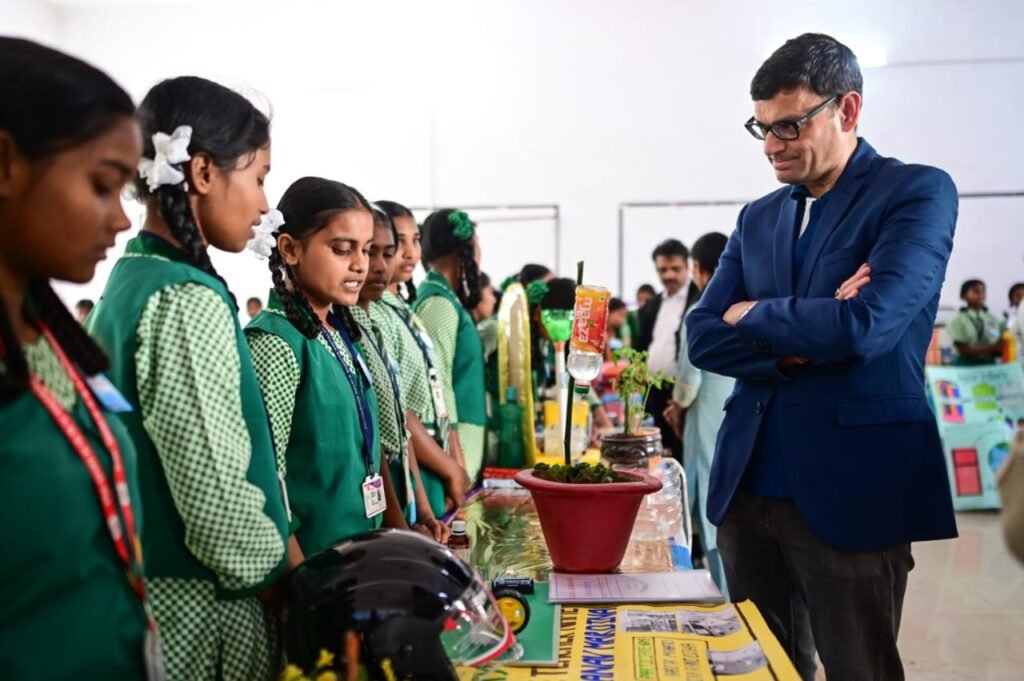 Vinod Pandey, Director, BMW Group India, at the STEM Fair in Jharkhand.
 Reviewing the programme on the ground, Vinod Pandey, Director, BMW Group India, emphasised the company’s long-term approach. “BMW Group sees itself as a responsible stakeholder in society. Project BRIDGE is designed to create tangible, long-term impact by using education as a catalyst for empowerment and progress,” he said.
He further added, “The programme involves working closely with the state governments in addressing structural challenges to strengthen science and mathematics education in India, particularly for girls. Through innovative low-cost maker spaces with impetus on teacher training, it promotes engaging, hands-on and real-world learning experience. The initial results are highly encouraging with clear demonstration of improved conceptual understanding. We will continue to focus on enhancing content and pedagogy to drive better student outcomes in STEM subjects.”
Even as early signs of change are visible, both partners acknowledge that the real test lies ahead. “The goal is not just innovation in classrooms, but improved learning outcomes in science and mathematics,” Panday noted, pointing to the need for stronger teacher capacity. More than 4,000 educators have already been trained, but gaps in subject knowledge and pedagogy persist. For BMW, the role remains catalytic—demonstrating what works and enabling government systems to scale it sustainably.
For students, however, the shift is already personal. “Earlier, we used to just learn from books. Now we understand by doing,” said a Class 8 student. Another, standing beside her model, added that she now wants to become an engineer—an ambition that, until recently, felt out of reach.
Rusen Kumar, Editor of India CSR, is a renowned thought leader in the field of Corporate Sustainability and Corporate Social Responsibility (CSR). He regularly writes insightful articles and conducts interviews with industry leaders, policymakers, and development practitioners, promoting dialogue on responsible business and sustainable development.
ADVERTISEMENT
ADVERTISEMENT

ADVERTISEMENT

ADVERTISEMENT
ADVERTISEMENT






 English (US) ·