

 1 day ago
7
1 day ago
7
ARTICLE AD BOX

With barely two weeks left for the financial year to end on March 31, investors have one last chance to review their portfolios and manage their capital gains tax liability. The recent correction in stock market, though unsettling for many investors, can actually provide a useful window for tax planning.Equities may be down, but gold and silver have delivered spectacular gains. Instead of worrying about temporary losses in their portfolios, investors can use the downturn strategically to optimise taxes through capital gains management.Use Losses To Offset GainsIf you have booked profits on assets such as gold, silver or debt-oriented mutual funds during the year or are sitting on hefty gains, you can reduce the tax liability by offsetting those gains with losses from equities or equity mutual funds.
Short-term capital losses can be adjusted against both short-term and longterm capital gains. Your losses from stocks can also be adjusted against gains from investments in equity funds. This strategy, often referred to as tax-loss harvesting, allows investors to convert market declines into a tax advantage.
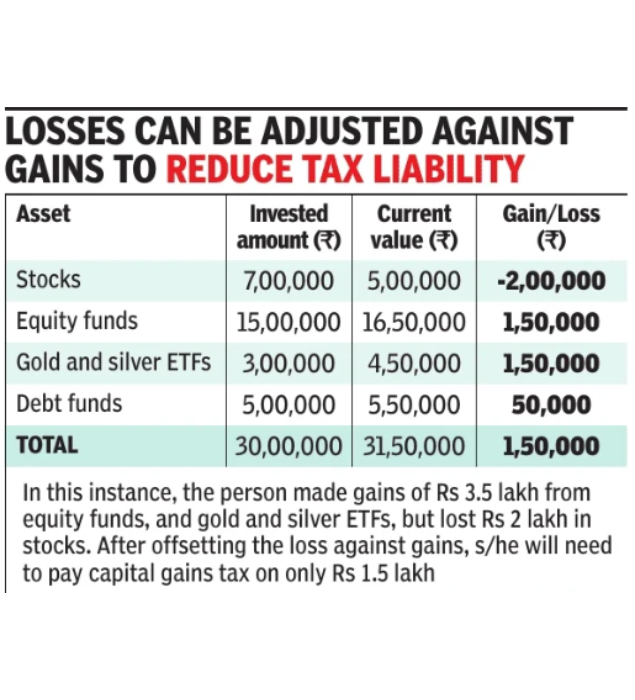
In the example here ( see table ), the gains from gold and silver ETFs and debt funds would have been taxed at the slab rate applicable to the individual.
But the losses from stocks can be adjusted against those gains.Even if the losses booked this year exceed your capital gains, they are not wasted. Tax laws allow investors to carry forward capital losses for up to eight financial years. These losses can then be used to offset capital gains in the future, reducing tax liability when markets recover and profits are realised. However, to carry forward losses, the income tax return must be filed before the due date.Harvest Long-Term GainsInvestors should also consider harvesting long-term capital gains before the financial year ends. Under current tax rules, longterm capital gains of up to Rs 1.25 lakh from listed equities and equity-oriented mutual funds are tax-free in a financial year. In the example above, the investor can reduce capital gains to zero by selling units to generate gains within the Rs 1.25 lakh tax free limit before March 31.If they wish to remain invested for the long term, they can simply buy back the same stock or fund the next day.
This resets the purchase price and reduces future tax liability by raising the average purchase price.Combine Gains And LossesInvestors who have large gains in some holdings and losses in others should take a combined view of their portfolio. For instance, if gains from certain stocks or equity funds exceed the tax-free threshold of Rs 1.25 lakh, the taxable portion can be reduced by simultaneously selling investments that are currently in losses.
The losses can then be used to offset the taxable gains.This approach helps reduce the overall tax burden while cleaning up underperforming holdings in the portfolio.Review Your PortfolioThe final weeks of the financial year are a good time to review investments — not only from a tax perspective but also from a portfolio discipline standpoint.Tax-loss harvesting can help investors remove weak holdings while strengthening positions in better-performing assets.However, tax considerations should not be the sole driver of investment decisions. Any buy or sell decision should also align with long-term asset allocation and investment goals.Used carefully, these strategies can help investors turn a volatile market phase into a useful opportunity for tax optimisation before the financial year closes.The writer is a chartered accountant and managing partner, Saturn Consulting Group









 English (US) ·