

 6 days ago
9
6 days ago
9
ARTICLE AD BOX
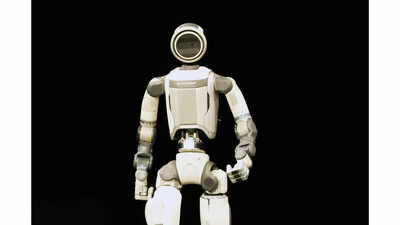
Boston Dynamics has shared new details about how it prepared its Atlas humanoid robot for its first appearance at a FIFA World Cup match. The company revealed that engineers had to retrain the robot to handle grass surfaces before its halftime debut at the Brazil vs Norway Round of 16 match at New York/New Jersey Stadium.
According to the company, the appearance was part of a development effort that spanned five years. One of the biggest engineering challenges was preparing Atlas to move reliably on natural grass instead of the controlled surfaces it is typically trained on, Boston Dynamics said. In a statement to Fortune, Alberto Rodriguez, Boston Dynamics’ director of robot behaviour, said, “Grass has that interesting property where sometimes you slip, but sometimes your feet can get caught on it. We’ve had to change the training regime for how Atlas learns to walk and run to make sure that it can do it well on concrete, but also on complex surfaces like grass.”During the halftime ceremony, Atlas walked onto the pitch, performed goal celebrations inspired by footballers Harry Kane, Erling Haaland, Matheus Cunha and Son Heung-min, and handed the match ball to the referee before the match started.
Atlas learns through training instead of fixed programming: Boston Dynamics
Boston Dynamics said Atlas is no longer controlled through fixed programming but instead learns behaviours through training.
Rodriguez explained that the robot now develops actions by learning to adapt to different situations, rather than following a predetermined sequence of instructions.“It used to be programmed. Now it’s no longer programmed—it’s learned," Rodriguez said.To prepare for the football demonstration, Atlas first analysed videos of professional footballers performing drills and movements. Engineers also supplied motion-capture recordings of human demonstrations, including Boston Dynamics employees performing the required actions.The collected data was then used in physics-based simulations running on cloud GPUs, allowing Atlas to repeat the same tasks millions of times under different conditions. According to the company, this enabled the robot to develop behaviours that could adapt to changing environments within about 24 hours.During training, engineers intentionally introduced unpredictable variables. Surface friction changed without warning, the football was placed in different positions, and Atlas was made to assume its feet were different sizes.
The objective was to help the robot learn to complete tasks despite unexpected conditions.Rodriguez described the outcome as a form of "muscle memory," where frequently practised movements can be executed without relying on real-time calculations.“We’ve shown that this brand-new humanoid hardware can perform in the most extreme environments, operating reliably in record high temperatures, performing exciting and engaging athletic feats. The more the public sees robotics doing things they never thought possible, in person, the more prepared they will be as these robots become more and more a part of our daily lives," he said.Hyundai Motor Company, which owns Boston Dynamics, said the World Cup appearance was intended to introduce Atlas to a global audience. Hyundai has been a FIFA sponsor for 27 years.“By placing Atlas at the heart of football’s most sacred ritual, we made a statement no commercial ever could. The ball delivery is the moment Atlas enters public consciousness for the first time—the beginning of that journey toward becoming a partner that supports people in meaningful ways," Sungwon Jee, Hyundai Motor Company’s executive vice president and global chief marketing officer, told Fortune.Hyundai acquired a controlling stake in Boston Dynamics from SoftBank in 2021 and has since expanded its robotics plans. The company has announced a $26 billion investment in the US over four years, including a robotics manufacturing facility near Savannah, Georgia, that is expected to produce up to 30,000 Atlas robots annually by 2028. Atlas is also being evaluated for industrial tasks such as part sequencing inside Hyundai manufacturing facilities.“We see robotics not as a side venture, but as a strategic capability that will shape how we compete. Mobility isn’t just about cars anymore. It’s about autonomous systems, robotics, and smart infrastructure," Jee said. “The World Cup marks a pivot point where we move from internal exploration to public demonstration,” Jee said.





 English (US) ·