

 14 hours ago
3
14 hours ago
3
ARTICLE AD BOX
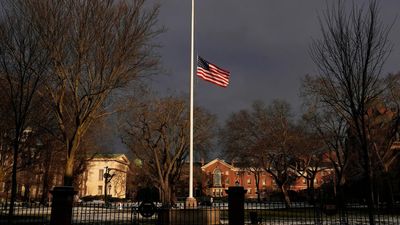
The December 13 shooting at Brown University killed two students and injured nine. Image: AP
The December 13 shooting at Brown University in Providence, Rhode Island, has pushed one of America’s most elite campuses into a grim national statistic. Two students were killed and nine others injured when gunfire erupted inside the Barus and Holley engineering building during a study session ahead of final examinations.
The suspect remains at large, and federal and local authorities continue to seek public assistance.The aftermath on campus has been marked by confusion, fear and sharp questions from students about how existing safety systems failed to prevent or contain the attack. The university cancelled remaining exams and academic work for the semester as students grappled not just with loss, but with gaps in alerts, surveillance and response mechanisms.Brown’s shock lies not only in the violence itself, but in where it occurred. Ivy League campuses still occupy a mental category of “protected spaces” in the American imagination. The data suggests that category no longer holds.
Why Brown University shooting matters beyond Rhode Island
Brown University also carries symbolic weight. A CNN database notes that Rhode Island had recorded no school shootings since at least 2008 before this incident. Brown therefore became the state’s first entry in nearly two decades.
That rarity amplified the shock, but it also reinforced a broader truth: Low historical incidence does not equate to immunity.Elite status, geographic location and academic prestige do not meaningfully alter risk in a system where firearms are widely accessible and campuses remain structurally open. What Brown demonstrates is not an anomaly, but the brittleness of assumptions that have long shaped how universities think about safety.
A year of violence: How 2025 unfolded on US campuses
The Brown shooting did not occur in isolation. Across 2025, gun violence intersected with schools and universities in ways that were geographically scattered but structurally similar.In September, a shooting at Evergreen High School in Colorado injured multiple people, adding to a growing list of K–12 incidents that Education Week has tracked throughout the year. In August, gunfire at a Catholic school in Minneapolis left several wounded, underscoring how even smaller, community-based institutions are not insulated.
On the higher-education side, a fatal shooting at a university event involving conservative activist Charlie Kirk in Utah Valley University earlier this year drew national attention to the security risks around high-profile campus events.
Brown, coming late in the year, became one of the deadliest university shootings of 2025.What connects these incidents is not motive or location, but setting. Classrooms, exam halls, school grounds and campus events — spaces designed for routine academic life — repeatedly became sites of lethal disruption.
School shootings in the US: A broader trend
Measured at scale, 2025 stands out as another high-volume year for school-linked gun violence in the United States. According to CNN’s school shootings database, which reviews incidents reported by the Gun Violence Archive, Education Week and Everytown for Gun Safety, there were at least 75 school shootings in the US in 2025 as of December 13. Of these, 43 occurred on college or university campuses, while 32 took place on K–12 school grounds.
CNN’s analysis shows that these incidents left at least 31 people dead and more than 100 injured.CNN defines a school shooting as any incident on school property — including buildings, parking lots, stadiums and buses — in which at least one person is shot, excluding the shooter. Accidental discharges are included if someone other than the shooter is injured. The database has tracked such incidents consistently since 2008.A narrower lens produces different numbers, particularly when the focus is on deaths. Education Week’s school shooting tracker, which counts only K–12 incidents that result in injuries or fatalities and excludes suicides, reported 17 such shootings in 2025 up to mid-December, with seven people killed and 43 injured.The discrepancy is not an error, it is methodological. One dataset captures the breadth of gunfire touching educational spaces, including higher education.
The other captures the most severe outcomes within K–12 schools alone. Together, they reveal two parallel realities: shootings linked to schools are frequent, while fatal outcomes, though less common, remain persistent.Brown sits at the intersection of these datasets — a higher-education campus contributing to a national death toll that no longer belongs only to schools serving children.
The structural problem with “campus safety” in the US
The question students at Brown are asking — how did this happen here — is the same question raised after almost every campus shooting.
The answer, increasingly, lies not in individual failures but in structural design.Open campuses as a default, not a risk choiceMost US universities are built on openness. Academic buildings are accessible, movement is fluid, and campuses function as semi-public spaces. This is not accidental, it is cultural. Universities are meant to feel permeable, not fortified. The problem is that openness, once treated as a value, now functions as a vulnerability — one that security systems struggle to offset without fundamentally changing how campuses operate.Security that is uneven, not absentPost-incident reviews frequently reveal that campuses are not unmonitored, but unevenly monitored. Cameras may be plentiful at entrances and main thoroughfares, yet sparse inside older academic buildings or secondary corridors. In Brown’s case, AP reported that while the university is “dotted with cameras”, there were few inside the Barus and Holley building, sharpening scrutiny of how investigators reconstruct movements when interior surveillance is limited.
With gaps inside the building, the investigation has leaned more heavily on what can be pieced together from exterior footage and public inputs — a familiar dependence in campus cases where infrastructure was built for openness and retrofitted for security, not designed for it.Alert systems that multiply faster than clarityUniversities today operate layered alert systems: Institutional notifications, local police updates, city alerts and federal advisories.
In theory, redundancy improves safety. In practice, it often fragments information. Students receive partial updates at different times, on different platforms, with little sense of sequence. During a crisis, this delay and disjunction can be as destabilising as the event itself.Events that change the risk profile overnightCampuses are no longer only educational spaces; they are venues. Public lectures, political appearances and large gatherings import external risk into academic settings.
The Charlie Kirk shooting earlier this year illustrated how quickly a university environment can shift from routine academic life to high-stakes security terrain. Most campus safety frameworks are not designed for that pivot.
The uncomfortable conclusion
The US has spent years refining how it responds to campus shootings — lockdowns, alerts, counselling, investigations — without meaningfully reducing their occurrence. The data compiled by CNN and Education Week shows a system managing consequences rather than preventing conditions.Brown’s shooting will eventually recede from headlines. The questions it raised will not. As long as campuses remain open by design, unevenly secured by infrastructure, and reactive by protocol, shootings will continue to appear in the data as isolated tragedies that collectively form a pattern. Brown did not fall outside the numbers. It became part of them — quietly, conclusively, and at the cost of lives.









 English (US) ·