

 1 day ago
4
1 day ago
4
ARTICLE AD BOX
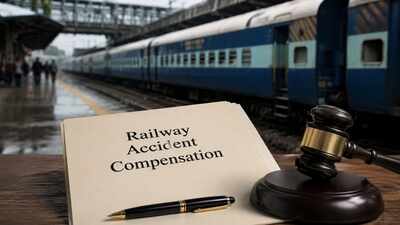
The Calcutta High Court has set aside an order of the Railway Claims Tribunal rejecting compensation to the family of a man who died after falling from a running train. (AI image)
The Calcutta High Court has awarded compensation to the family of a railway accident victim after holding that a claimant need not produce an eyewitness or the railway ticket in every case to establish a claim under Section 124A of the Railways Act.
Setting aside the Railway Claims Tribunal's order, the Court held that the police investigation and surrounding circumstances sufficiently established that the deceased was a bona fide passenger who died in an untoward incident.The Calcutta High Court has set aside an order of the Railway Claims Tribunal rejecting compensation to the family of a man who died after falling from a running train, holding that the Tribunal failed to properly appreciate the evidence collected during the police investigation.Justice Biswaroop Chowdhury allowed the appeal filed by the widow and other legal heirs of the deceased, observing that the materials on record established that the victim was travelling with a valid railway ticket and that his death fell within the ambit of an "untoward incident" under Section 124A of the Railways Act, 1989. The Court awarded compensation of ₹8 lakh with interest at 6% per annum from the date of filing of the claim petition.
BackgroundAccording to the appellants, the deceased had purchased a return journey ticket from Baidyabati to Belur on 01.10.2018. After completing his work at Belur, he boarded a Bandel local train for his return journey. While the train was passing between Rishra and Serampore stations, he fell from the compartment and sustained fatal injuries.Following information received from the Station Master, the Government Railway Police registered an unnatural death case and conducted an inquiry under Section 174 of the Code of Criminal Procedure.
During the inquiry, the investigating officer recorded that a railway journey ticket had been recovered from the deceased's pocket and seized under a seizure list before the body was sent for post-mortem.The Railway Administration, however, disputed the claim and argued that no railway ticket had been recovered from the deceased and, therefore, he could not be treated as a bona fide passenger. Accepting this argument, the Railway Claims Tribunal dismissed the compensation claim, prompting the present appeal.Before the High Court, the appellants argued that they had discharged the initial burden of proving that the deceased was travelling with a valid ticket. They relied upon the police investigation records, the seizure list and the widow's testimony to establish that the deceased had boarded the train after completing his work.The Railway Administration, on the other hand, relied upon an internal report prepared by the Railway Protection Force stating that no railway ticket had been found from the deceased's possession.
It also questioned the reliability of the seizure list by referring to the statement of one of the seizure witnesses, who claimed that he had signed a blank document.The High Court observed that in claims arising out of railway accidents, the realities surrounding such incidents cannot be ignored. Victims often travel alone and accidents occur away from their homes, making it virtually impossible for family members to produce eyewitnesses.Referring to the decision in Smt. Yellamma v. Union of India, the Court observed:"It is not possible for the claimants to examine a person as eye witness to the incident... What the Railway authorities could do and ought to perform... cannot be expected from the claimants."The Bench emphasised that statutory duties cast upon the Railway Administration during investigation cannot later be shifted onto the dependants seeking compensation. The principal issue before the High Court was whether the deceased could be treated as a bona fide passenger despite the Railway Administration disputing recovery of the journey ticket. The Court noted that while the Railway's inquiry report recorded that no railway ticket had been found from the deceased, the police investigation painted an entirely different picture.The Bench observed that the report submitted by the police under Section 174 CrPC specifically recorded that a railway ticket had been recovered from the deceased's pocket during the inquest and seized under a seizure list.The Court also examined the evidence of the widow, who had deposed that her husband had informed her that he would return home after completing his work at Baidyabati and Belur. During cross-examination, nothing could be elicited to discredit her testimony regarding the deceased's intended journey or the information she received from the Government Railway Police after the accident.Additionally, the Railway Administration challenged the seizure by relying on the testimony of a Railway Protection Force official, who claimed that he had signed the seizure list when it was blank.The High Court found the argument unconvincing.It noted that during cross-examination, the same witness admitted his signature on the investigation report but attempted to explain it by stating that certain contents were written in Bengali, which he could not understand. However, the Court found that the investigation report contained no such Bengali writing.The Bench also attached significance to the fact that the seizure list bore the left thumb impression of Kartick Dom, from whom the journey ticket had been seized.According to the Court, once the police conducted an investigation in accordance with law and prepared the seizure list during the inquest, those official records could not simply be discarded in the absence of any evidence demonstrating that they were fabricated or unreliable.The Court observed:"When an investigation is carried out by Police Authority in accordance with law and seizure list is prepared during investigation, the said investigation report and seizure list cannot be discarded without examination of the Investigating Officer."The Bench noted that the Railway Administration had not examined the Investigating Officer to discredit the seizure list or the inquest records. In those circumstances, the police documents carried greater evidentiary value than the Railway's internal inquiry report.Mere Absence Of Ticket Is Not Sufficient To Reject ClaimThe High Court also relied upon the Supreme Court's decision in Union of India v. Rina Devi, which clarified the legal position regarding proof of bona fide travel under Section 124A of the Railways Act.Quoting the decision, the Court observed:"Mere absence of ticket with such injured or deceased will not negative the claim that he was a bona fide passenger. Initial burden will be on the claimant... and burden will then shift on the Railways."The Bench finally held that the appellants had discharged their initial burden through the widow's testimony, the police investigation, the seizure list and the surrounding circumstances of the accident.
Once that burden stood discharged, it was for the Railway Administration to establish that the deceased was not travelling with a valid ticket. The material placed on record, however, was insufficient to rebut the evidence produced by the claimants.The Court, therefore, concluded that the deceased was a bona fide passenger and that his death was the result of an "untoward incident" within the meaning of Section 124A of the Railways Act.Therefore, setting aside the judgment of the Railway Claims Tribunal, the High Court allowed the appeal and held the deceased's legal heirs entitled to compensation. The Railway Administration was directed to deposit Rs.8 lakh along with interest at 6% per annum from the date of filing of the claim petition within eight weeks. The appellants were permitted to withdraw the amount upon completion of the necessary formalities.F.M.A. 1315 of 2025 Rumpa Mallick & Ors. Vs UOIFor the appellant: Mr. Sujay Sinha, Adv.For the Union of India: Mr. Kalyan Kr. Chakraborty, Adv. Mr. Subrata Santra, Adv.Date of Decision: 30.06.2026(The author of this article, Vatsal Chandra is a Delhi-based Advocate practicing before the courts of Delhi NCR.)







 English (US) ·