

 1 hour ago
4
1 hour ago
4
ARTICLE AD BOX
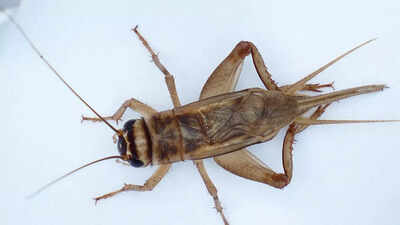
Can crickets really tell the temperature (Image source: Canva)
On a warm summer night, when everything else grows quiet, the air begins to buzz with a steady rhythm. Crickets chirp from the bushes, from tree branches, from somewhere you can’t quite see.
It feels like background noise until you realise those chirps are doing more than filling the silence.They’re measuring the temperature.More than a century ago, an American physicist named Amos Emerson Dolbear discovered something remarkable: the rate at which certain crickets chirp changes depending on the air temperature. The warmer it is, the faster they chirp. The cooler it gets, the slower they sing. His discovery became known as Dolbear’s Law, and it remains one of the simplest and most charming examples of science hiding in plain sight.
The 1897 discovery that turned crickets into thermometers
In 1897, Dolbear published a short paper titled “The Cricket as a Thermometer” in The American Naturalist. According to his research, the chirping rate of crickets increases in direct relation to temperature. He wasn’t studying insects for curiosity alone; he noticed a clear pattern during warm and cool evenings and decided to measure it.According to Dolbear’s Law, Dolbear observed that crickets chirped more frequently on warm nights and slowed down as the air cooled.
He then worked out a simple formula to estimate temperature from chirp counts.His original formula was straightforward:Count the number of chirps in 15 seconds and add 40. The result equals the temperature in degrees Fahrenheit.For example, if you count 30 chirps in 15 seconds:30 + 40 = 70°FFor the late 19th century, this was an elegant and surprisingly accurate field method long before smartphones, digital thermometers, or weather apps.
Why crickets respond to temperature
The reason this works has nothing to do with magic and everything to do with biology.Crickets are ectotherms, meaning their body temperature depends on the temperature around them. Unlike humans, they cannot regulate their internal heat. When the air warms up, their metabolism speeds up. Their muscles move faster. That includes the wing movements they use to create chirping sounds, a process called stridulation, where they rub parts of their wings together.According to biological explanations, warmer temperatures increase the speed of these muscle contractions, which increases chirp frequency.
Cooler temperatures slow everything down.In simple terms: warm air equals faster wing movement equals more chirps.
Not all crickets qualify as a reliable thermometer
Here’s where many people get it wrong: not every cricket species works as a reliable thermometer.The Snowy Tree Cricket (Oecanthus fultoni) is the species that is most closely linked to Dolbear's Law today. These crickets are light green to almost white and can be found in trees and shrubs all over the eastern and central parts of the United States.Their chirps are clear, rhythmic, and spaced out evenly, like a clock ticking. That is what makes them great for figuring out the temperature. Other types of crickets make uneven trills or patterns that change, which makes counting hard and not always accurate.Recent improvements to Dolbear's formula have been focused on the Snowy Tree Cricket because its chirp rhythm is so reliable.
The modern version of Dolbear’s Law
Scientists later refined Dolbear’s formula for better accuracy. One commonly used version for Snowy Tree Crickets is:Count the chirps in 15 seconds and add 40 = temperature in °FAnother method sometimes cited is:Count chirps in 14 seconds and add 40Both variations produce results accurate within a few degrees under ideal conditions.The US National Weather Service has even referenced Dolbear’s Law in educational material explaining how insect behaviour relates to weather patterns. Based on this idea, some local weather offices have made online chirp-to-temperature converters.
Cricket: A small creature, a big scientific lesson
Dolbear's Law isn't just a fun trick for camping. It shows something deeper: how closely living things are connected to their surroundings. It also shows that careful observation, even of something as simple as a cricket's song, can lead to scientific knowledge that can be measured.Dolbear's work is still one of the best examples of how animals act based on their surroundings. It connects physics, biology, and meteorology in a way that seems almost poetic.
Try it yourself
The next time you’re outside on a warm evening, pause and listen. If you hear a steady, evenly spaced chirp, not a long trill, take out a watch.Count the chirps for 15 seconds.Add 40.You might be surprised how close you are to the real temperature.Long before digital assistants and weather apps, a small green cricket was already doing the math.And it still is.








 English (US) ·