

 52 minutes ago
6
52 minutes ago
6
ARTICLE AD BOX
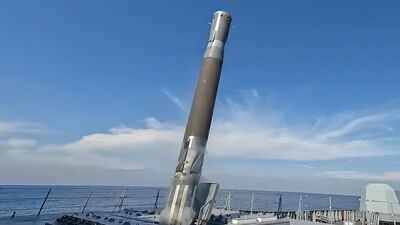
Photo credit: Russian MOD
Russia has intensified its aerial assault on Ukraine, carrying out several large-scale missile and drone strikes on Kyiv over the past week that have killed more than 50 people this month.The attacks come as both sides have significantly escalated their long-range strike campaigns, with Ukraine also launching large-scale drone attacks against Russian military bases, defence-industrial facilities and critical infrastructure deep inside Russian territory.While the attacks have reignited concerns over Ukraine's dwindling stock of Patriot interceptor missiles, they have also put the spotlight on the 3M22 Zircon.According to the Ukrainian Air Force, none of the Zircon high-speed missiles launched during the latest Russian barrage were intercepted.While Kyiv acknowledges that the Zircon poses a major challenge because of its speed and manoeuvrability, Ukrainian officials maintain that the missile is not invincible.According to the Ukrainian air force, Patriot systems can intercept the Zircon during its terminal phase, although interceptor shortages have increasingly limited that capability in recent large-scale Russian attacks.
ZirconThe 3M22 Zircon (Tsirkon) is Russia's next-generation hypersonic cruise missile, designed by NPO Mashinostroyeniya primarily to destroy high-value naval targets such as aircraft carriers, destroyers and other heavily defended warships.It is one of the six "next-generation strategic weapons" unveiled by Russian President Vladimir Putin in 2018–19 and officially entered service with the Russian Navy in January 2023.Although originally conceived as an anti-ship weapon, the Zircon has gradually evolved into a dual-role missile capable of striking both maritime and land targets.During the Russia-Ukraine war, Moscow has increasingly employed the missile against military infrastructure in Ukraine, marking a shift from its original naval role to a broader strategic strike capability.Unlike a ballistic missile, which follows a predictable high-arching trajectory after launch, the Zircon is a scramjet-powered hypersonic cruise missile that remains powered throughout much of its flight.The missile is first accelerated by a solid-fuel booster, which pushes it to supersonic speed. Once sufficient velocity is reached, its scramjet (Supersonic Combustion Ramjet) engine ignites, allowing the missile to sustain hypersonic speeds while flying within the atmosphere.This propulsion system enables the Zircon to cover hundreds of kilometres in just a few minutes while maintaining high speed for most of its flight.
It is designed to perform manoeuvres during flight, making its trajectory more difficult to predict.Russia claims the missile can reach speeds of up to Mach 9, significantly reducing an adversary's reaction time. the Zircon has a maximum range of up to 1,000 kilometres, although independent analysts note that the effective range depends on the flight profile.The Zircon is believed to employ a combination of inertial navigation, satellite navigation (GLONASS) and an active radar seeker during the terminal phase for precision targeting.The missile can be launched from Admiral Gorshkov-class frigates, Yasen-class nuclear-powered submarines, and other vessels equipped with Russia's 3S14 vertical launch system.According to Ukraine's defence intelligence (GUR), Russia has adapted the Bastion-M coastal defence system to launch 3M22 Zircon hypersonic missiles, and these launchers have been used in strikes against Ukraine.As Russia continues to expand its use of long-range precision weapons, the Zircon appears to be transitioning from a niche naval missile into a regular component of Moscow's strike campaign against Ukraine.Its combination of hypersonic speed, manoeuvrability and dual anti-ship and land-attack capability makes it one of Russia's most sophisticated missile systems.








 English (US) ·