

 6 days ago
7
6 days ago
7
ARTICLE AD BOX
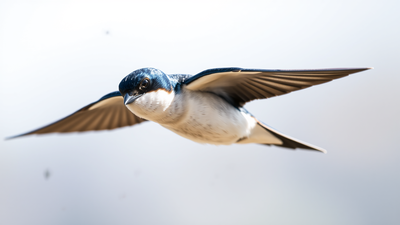
A Tree Swallow in mid-flight, wings outstretched, eyes wide with a desperate search for prey against a hazy, empty sky. Image Credit: TIL Creatives
More than 60 per cent of Canada’s flying insects have disappeared from a single site over the last four decades, starting in the late 1970s, and the effects can be seen among the birds that rely upon them for sustenance, according to a newly peer-reviewed study published in the Proceedings of the National Academy of Sciences (PNAS). Tree swallows in Ontario’s Long Point Bird Observatory are getting smaller and producing fewer offspring due to the decrease in insect numbers.This University of Michigan study suggests that biodiversity loss plays a bigger role than previously thought. While climate change is still a very powerful driving force behind changes in ecology, it is necessary to examine the loss of both species and their food sources.Birds are suffering due to declining insect populationsTree swallows are aerial insectivores, meaning they depend largely on flying insects such as midges and mosquitoes. For their successful breeding, it is important that they have a sufficient amount of food during the breeding time.
The PNAS study found that flying insects at the Long Point Bird Observatory declined by more than 60 percent from 1977 to 2011. At the same time, it became evident that tree swallows reduced in terms of their body mass and produced fewer offspring than before.According to lead author Charlotte Probst, a doctoral researcher at the University of Michigan School for Environment and Sustainability, the connection is clear: fewer insects mean fewer resources for bird reproduction and feeding.
The research results were published in Proceedings of the National Academy of Sciences.But climate change is only one factorMany experts have warned for decades about the potential creation of a phenological mismatch by climate change. This mismatch happens when seasonal events no longer occur at the same time as they once did. The problem with tree swallows is that they breed in accordance with the seasonal peak of flying insects. Warmer winters are causing insects to emerge earlier in spring, but tree swallows cannot shift their breeding quickly enough to keep pace.According to the scientists, the gap between the two processes has widened by more than three days per decade since 1977. However, the negative impact of the mismatch declined during the study period. That does not necessarily mean the birds adapted. Instead, insects became so few that the seasonal peak of their presence is much lower than it used to be.Brian Weeks, senior author of the study and an associate professor at the University of Michigan, said the study suggests that climate change cannot be studied independently of biodiversity loss.Could pesticide use also be a factor?While the research could not identify a single cause for the population drop, the scientists noted that the largest declines occurred in the 1990s, when neonicotinoid use increased.The authors insist that their research is not conclusive on the matter as far as the effects of these pesticides go. Nevertheless, several studies have found harmful effects from these pesticides, even at very low concentrations, on aquatic insects.
Because many insects eaten by tree swallows develop in wetlands, this hypothesis cannot be ruled out.
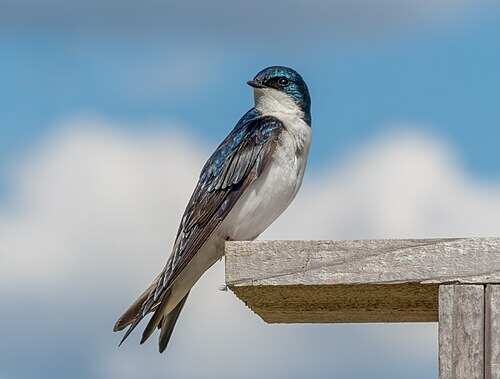
A tree swallow. Image Credit: Wikipedia
Long-term observation led to the discoveryA key strength of the research was its use of one of North America's longest-running ecological databases. The Long Point Bird Observatory, which is situated on the north shore of Lake Erie in Ontario, has been conducting bird counts since the 1960s. Scientists were able to study tree swallow data collected from 1969 to 2024, as well as insect observations from 1977 to 2011.
The researchers said the long-term data allowed them to separate the effects of climate change from changes in food availability, something a shorter database could not do.Why does it matter?Tree swallows are one of many aerial insectivore bird species that have been showing population decline over North America. Conservation organizations have pointed out that their population decline can be attributed to factors such as habitat loss, climate change, and insect declines.However, the latest study contributes additional support to the idea that the loss of biodiversity is now emerging as an essential driver of change. In particular, the authors note that while global climate change cannot be dealt with locally, some factors behind insects' extinction may actually be addressed via restoring habitats, protecting wetlands, and regulating pesticides. Instead of looking at climate change alone, the researchers say protecting wildlife requires addressing several environmental problems at once.
For the tree swallow, it may be as important to preserve healthy insects as it is to cut greenhouse gas emissions.









 English (US) ·