

 2 hours ago
6
2 hours ago
6
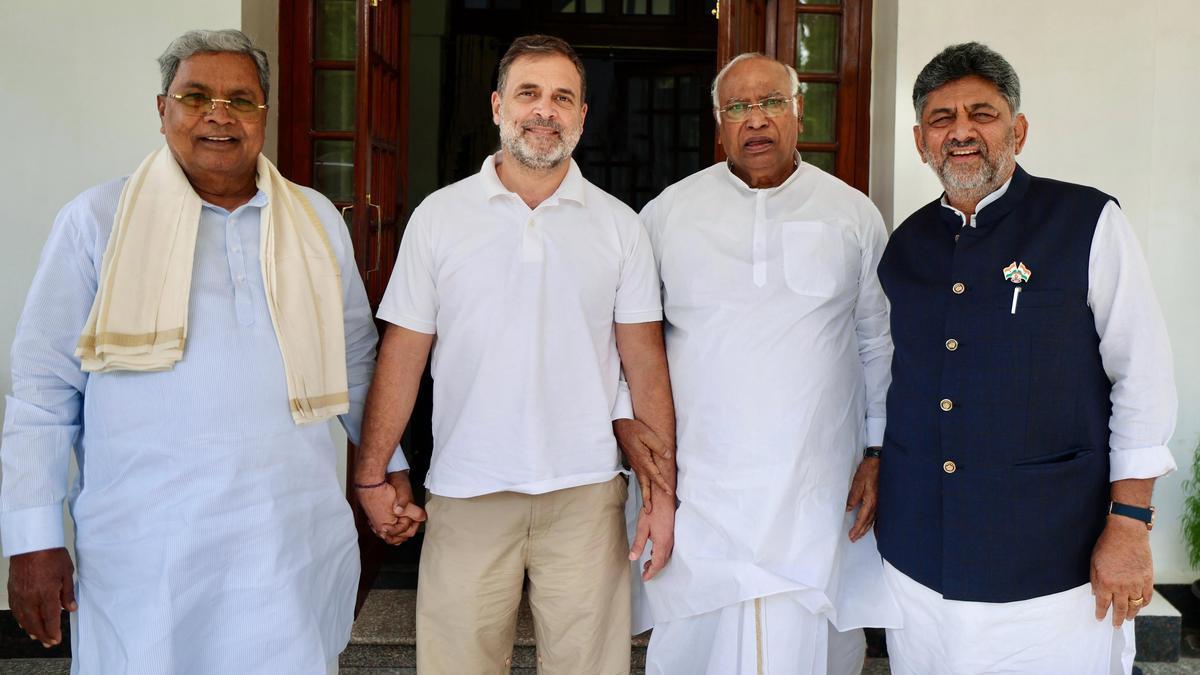
The most prominent face of the Congress in Karnataka, D.K. Shivakumar, is set to realise his long-held ambition of becoming Chief Minister on June 3. By passing the baton from Karnataka’s longest-serving Chief Minister, Siddaramaiah, to Mr. Shivakumar, the Congress appears to have resolved a grievance among his supporters, who believed that he deserved the post when the party returned to power in 2023 after leading its poll campaign as State unit president. Evidently, the Congress national leadership appears to have managed the transition in Karnataka better than it did in Rajasthan and Punjab in 2020-21, where its decisions — retaining Ashok Gehlot despite Sachin Pilot’s rebellion (2020) and replacing Amarinder Singh with Charanjit Singh Channi (2021) — failed to yield dividends in the Assembly elections. The Congress high command has also carried out the change of guard in Karnataka with an eye on the 2028 Assembly elections. There are symptoms of anti-incumbency sentiment acquiring more strength. As the Congress has chosen Mr. Shivakumar, a Vokkaliga, to succeed Mr Siddaramaiah, the BJP-Janata Dal (Secular) alliance is likely to face the poll together, as otherwise, the two parties gain little politically. Besides, the JD(S)’s top leaders belong to the Vokkaliga community and Mr. Shivakumar has been engaged in a decades-long contest with them for influence over the community, especially in the Old Mysuru region.
If the Congress and Mr. Shivakumar play their cards well, they could break Karnataka’s 35-year record of voting out incumbent governments. Having successfully handled political crises, Mr. Shivakumar should by now have a plan for winning in 2028. He must also carry all sections of the party with him and adopt a consultative approach to major policy decisions. Despite implementing several welfare and populist schemes, Karnataka has maintained fiscal discipline under the Congress government. In the just concluded FY2025-26, revenue deficit, at about ₹19,500 crore, is the lowest among similarly placed southern States. While this offers some consolation, Karnataka’s total revenue receipts grew by a modest 6.3%. Reducing stark inter-regional disparities should be a priority. In 2024-25, Bengaluru Urban district contributed about 40% of Karnataka’s GSDP, while Dakshina Kannada and Belagavi accounted for 5.3% and 3.9%, respectively. Uneven regional development can be seen in the Human Development Index too — Bengaluru Urban with 0.738, while Yadgir (0.538), Kalaburagi (0.539), and Raichur (0.562) are at the bottom. At a time when States, especially those under non-BJP parties, are facing shrinking fiscal and development space, their Chief Ministers should focus on addressing the chronic issues that affect the underprivileged. Mr. Shivakumar’s experience can help him fulfil this responsibility.






 English (US) ·