

 53 minutes ago
2
53 minutes ago
2
ARTICLE AD BOX
Under the sprawling canopy of a century-old elm in Washington Square Park of New York sits Marcel Anderson, a cigarette on his lip and a queen in his hand. “The edges (of the chess piece) are coming off, gosh I need to buy a new set!” he mutters to himself. And then quietly he wisecracks: “You lose the queen, you lose the battle, on the board and in your life.”
Anderson, aka Marty, is one of the dozen chess hustlers in the Washington Square Park, or merely chess park, making a living out of playing and teaching chess. A crash course costs $30 an hour; a blitz game comes at $10. “You beat me, you get $10, you lose, I get the money,” says Anderson, who has an Instagram profile with 10k followers. “It’s tough to beat me,” he says with the swagger of a veteran, which he is. “(Playing for) thirty years, buddy. You beat me thrice and I give you this chair,” he chuckles, sitting on one of those wide berth NY City iconic benches.
On a good day, he makes around $1000 dollars, on a bad day, which are most, gets in the range of $200-300. “The pandemic was bad man, people started playing online and stopped coming out. The tourists also declined, and we are reduced to the regulars,” says the 61-year-old.
He points his index at a chair in the far west corner, soaking in the sun. “That’s where Magnus (Carlsen) sat and played.” The one on the south east was Hikaru’s (Nakamura) favourite. “Look there, you see a stone bench, that is where Bobby (Fischer) used to sit.”
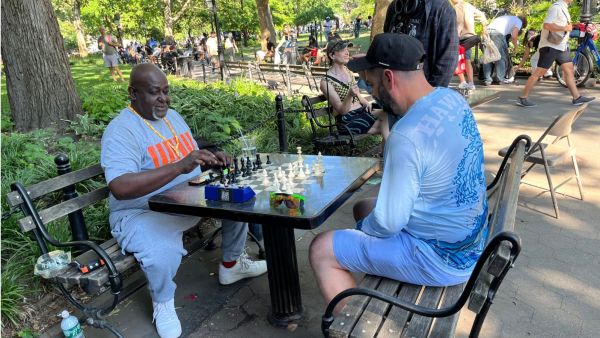 Players playing chess at Washington Square Park in New York. (Express photo)
Fischer never hustled but the historic park was his favourite haunt and is only three blocks down the street from Marshall Chess Club, his alma mater. “Maybe, one day I can sit down and have a game with Pragg (R Praggnanandhaa).” The Indian Grandmaster is his favourite player on the circuit. “Mine is Gukesh,” intervenes Joseph, from the adjacent table. Though they are not professionals, they hawkishly follow the games. “I have been a cocaine addict, and I tell chess is more addictive,’ Anderson says.
Dropping by the park, which has also been a gathering place for LGBTQIA+ community for more than a century, is a ritual for professionals and amateurs in the country. Its popularity soared after the 1993 movie Searching for Bobby Fischer.
The hustling culture, though, began in the 1970s. Its founding father in the city is widely credited to be a man named Bobby Haywood, who no one knows where he came from, or when he vanished. The story goes that one day he set up a chess board on top of a garbage can and he solicited passers-by to play a game of chess with, for 10 cents. At first people thought he was mad, but people kept showing up to play him and the idea soon caught on. “That was the time when it really caught on, the 70s. Cold war, Fischer, the Russian Grandmasters,” Joseph says.
Story continues below this ad
One of the regulars was director Stanley Kubrick, when he was in his teenage. He grew up in New York’s Bronx and became hooked onto chess after his father gifted him a chess set. He hustled at the Park to find his early photography gigs, and the game was a leitmotif through his filmography – 2001: A Space Odyssey to The Killing and Lolita as well as A Clockwork Orange.
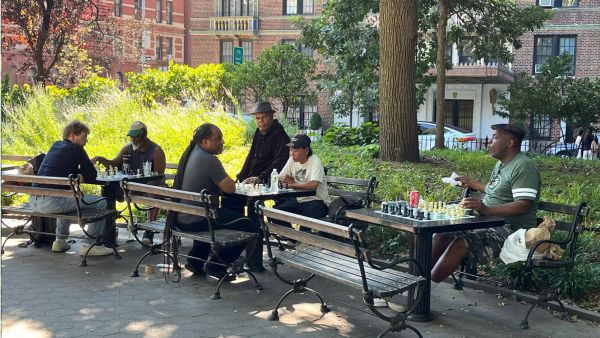 Anderson, with others, is playing Chess at Washington Square in New York. (Express photo)
“Yeah, I have heard this story,” Joseph says.
A sardonic smile flickers across Anderson when the celebrity list is unveiled. The meaning goes without saying: “No one listens to the hustlers’ stories.” They are just like the pieces on the board, failing and succeeding the moves of their lives. He was born in Baltimore in Maryland. Raised by a single mother, one among her eight children, he was good at academics and got an admission at the Milford Mill Academy in Baltimore. His life took a turn there when he protested against the institute’s treatment of black students. “We got old and worn out books, the white teachers never gave us good grades, and we were always made to sit at the back. So a group of us protested and got chucked out.,” he says.
The school eventually reinstated him, and he enrolled at the University of Baltimore. He joined the culinary arts school. Life was going smoothly before he started selling drugs to meet his ends. In months, he became a cocaine addict. “I went to rehab, got myself back and began to work as a cook in a hotel,” he says.
Story continues below this ad
But unlike the moves on a chess board, he has little control over the shifts of destiny. After his mother died, he moved to New York wanting to be an actor. He couldn’t as he fell in love with a girl and got married. He took up a teaching job, but his wife divorced him and filed a case of sexual harassment. He lost his savings and served a term in prison.
His resurrection began in Washington Square, where he drowned all his griefs. He soon found himself a job as a counsellor for drug addicts and served for nearly three decades. “I loved my job, but I wanted to retire at the first chance, because I can play here all day long, and make money,” he says. “Tax free money!” he emphasises.
Just then he sketches on a potential client, and shouts in booming baritone: “See what you have got man… I think you can beat me.” The man pulls the chair and he hurriedly sets the clock, as the evening descends over Washington Square Park and its squares of 64.






 English (US) ·