

 1 day ago
5
1 day ago
5
ARTICLE AD BOX
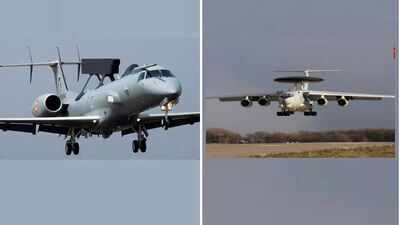
NEW DELHI: India's indigenous airborne surveillance programme reached a major milestone on Thursday as the Indian Air Force's Netra Airborne Early Warning and Control (AEW&C) system received Final Operational Clearance (FOC), paving the way for expanded deployment of the homegrown "eye in the sky".
The milestone also highlights why the IAF is pursuing two different airborne surveillance platforms: the tactical Netra AEW&C and larger Airborne Warning and Control System (AWACS) aircraft that serve as flying command centres.In a conversation with The Times of India, Srijan Pal Singh, author, former Advisor for Policy and Technology to Dr APJ Abdul Kalam said, India needs two different airborne early warning systems because they serve different operational roles."India needs two different airborne early warning and control (AEW&C) systems because they serve different roles. One is designed to provide broad coverage over large distances, while the other is intended for more flexible and routine operations. The Netra AEW&C is built on a smaller aircraft. It is well-suited for tactical missions, border surveillance and supporting fighter aircraft during day-to-day operations.
It is more economical to operate and can be deployed quickly. India is also developing a larger Netra Mk2 based on the Airbus A321 platform. A bigger aircraft can carry a more powerful radar, remain airborne for longer, operate at higher altitudes and monitor a much larger area. It can also accommodate more mission operators and advanced communication systems."
The FOC was handed over to the IAF during a ceremony in Bengaluru attended by senior serving and retired military officials, DRDO scientists and industry partners.Calling it a landmark achievement, Air Marshal Awadhesh Kumar Bharti, Deputy Chief of the Air Staff, said the clearance marked much more than the completion of a defence programme.“It’s a proud moment to declare AEW&C’s Final Operational Clearance. This isn’t merely the culmination of an indigenous technology programme, but a celebration of the unique partnership between the IAF and the scientific community in fulfilling India’s quest for Atmanirbharta.”Bharti said the programme overcame major technological challenges through sustained collaboration between the IAF and DRDO. Unlike a conventional procurement, the Air Force remained involved throughout the design, development, integration, testing and operationalisation phases.
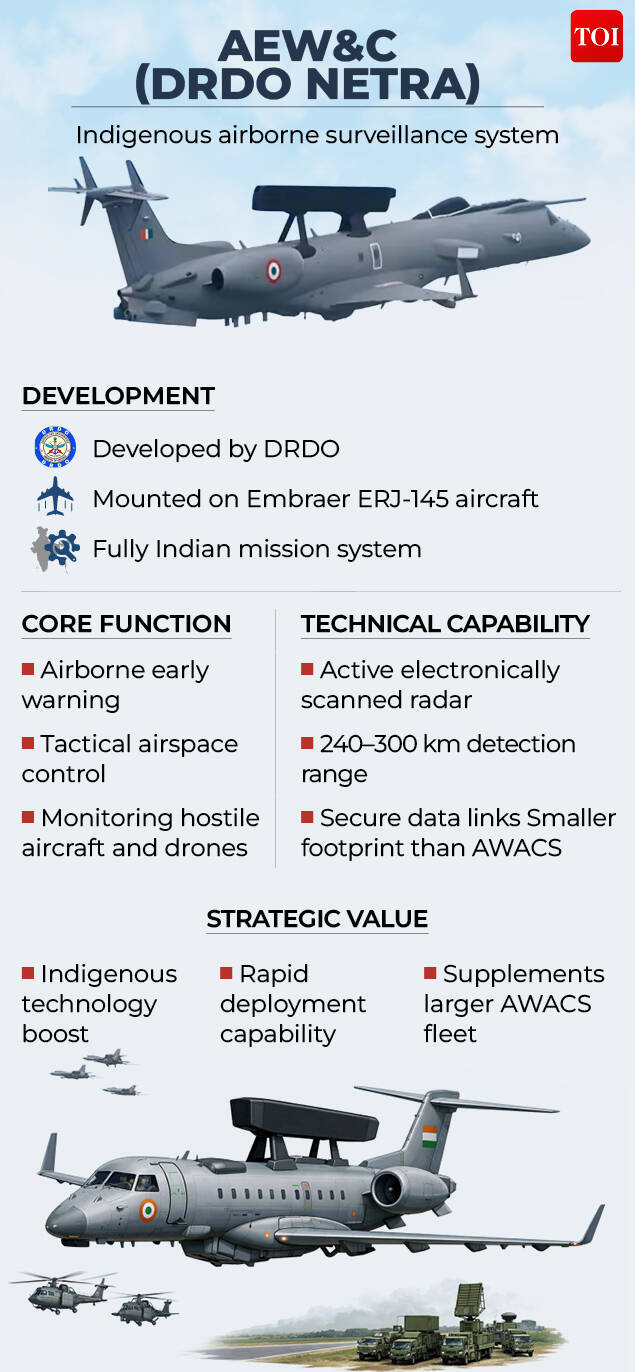
“Perhaps the greatest testimony to the faith that the IAF had in this indigenous programme was our decision to induct the platform operationally even before the final operational clearance.”He added that indigenous systems allow the armed forces to introduce upgrades quickly to meet evolving operational requirements, citing the platform's role during the Balakot air strikes and Operation Sindoor.Developed by DRDO's Centre for Airborne Systems (CABS), Netra is among India's most sophisticated indigenous airborne surveillance projects. Mounted on the Embraer ERJ-145 aircraft, it significantly improves the IAF's ability to detect, track and manage aerial threats while supporting battle management and network-centric warfare.In a video message, Air Marshal Ashutosh Dixit, Chief of Integrated Defence Staff, said the achievement assumes greater significance amid a rapidly changing geopolitical environment. Recalling the programme's journey since receiving Cabinet Committee on Security approval in October 2004, he praised the collaboration between DRDO, the IAF, certification agencies and industry partners. He also welcomed plans to induct six additional Netra aircraft.DRDO described the FOC as a technological and strategic milestone that strengthens India's self-reliance in advanced aerospace technologies while enhancing airborne command-and-control capabilities.
Netra and AWACS serve different missions
Although both platforms perform airborne surveillance, they are designed for different levels of warfare.Netra is a tactical AEW&C platform built on the Embraer ERJ-145 regional jet. Equipped with a 240-degree Active Electronically Scanned Array (AESA) radar, it is optimised for border surveillance, fighter control, tracking low-flying cruise missiles and managing sector-specific air operations.
Its relatively small size makes it cheaper to operate and ideal for routine deployments along India's borders.AWACS aircraft, by contrast, are strategic assets. They are mounted on much larger aircraft such as the Ilyushin Il-76 carrying Israeli Phalcon radar systems and, in future, modified Airbus platforms. Their 360-degree radar coverage, larger mission crews, extensive communication suites and higher endurance allow them to function as airborne command centres capable of coordinating entire air campaigns across multiple fronts.Explaining how the two aircraft complement each other in combat, Singh said:"A two-front conflict would require the Indian Air Force to monitor a vast airspace continuously. No single type of aircraft can do that efficiently. This is why the IAF needs both smaller AEW&C aircraft and larger AWACS platforms. The Netra AEW&C is expected to support tactical operations. It can monitor specific sectors, guide fighter aircraft, detect incoming threats and provide battlefield awareness close to the frontline.
Netra has already demonstrated its operational value during the Balakot air strikes and Operation Sindoor, where it provided airborne surveillance and command-and-control support. Larger platforms like the upcoming Netra Mk2 play a different role. They can stay airborne longer, carry more powerful radars and monitor a much larger area. They act as airborne command centres, coordinating multiple fighter squadrons, surface-based air defences and other military assets over long distances."
Why the IAF needs both
The IAF currently operates three Phalcon AWACS mounted on Il-76 aircraft and two Netra AEW&C systems based on the Embraer ERJ-145. Defence planners have long argued that these numbers are insufficient for a country facing simultaneous threats along the borders with Pakistan and China while also monitoring the Indian Ocean region.Heavy AWACS aircraft are expensive and limited in number. Using them for routine border patrols would neither be economical nor operationally efficient.
Netra fills this gap by undertaking tactical surveillance missions, freeing the larger AWACS fleet for high-end operations requiring theatre-wide command and control.The combination also strengthens India's network-centric warfare capability by linking fighter aircraft, ground-based air defence systems, naval assets and military headquarters into a common operational picture.On whether the current fleet is adequate, Singh said:"The Indian Air Force currently operates just six airborne early warning platforms: three Israeli Phalcon AWACS and three indigenous Netra AEW&C aircraft.
While these platforms have significantly strengthened India's air defence network, six aircraft are not enough for a country of India's size and security challenges. To maintain continuous surveillance over both the western and northern fronts, the IAF needs a much larger fleet.
This is why India is expanding both its AEW&C and AWACS capability through two indigenous programmes. The first is the Netra Mk1A, an upgraded version of the current Netra system based on the Embraer ERJ-145 platform.
It will feature improved electronic warfare systems, longer-range radars capable of detecting drones and low-observable targets, and deeper integration with the IAF's Integrated Air Command and Control System (IACCS). The second is the Netra Mk2, a much larger airborne warning system based on the Airbus A321 platform. It will carry a more powerful radar, stay airborne for longer and monitor a much larger area.
Together, the Netra Mk1A and Mk2 will give the IAF a layered airborne surveillance capability, significantly improving its ability to detect threats early, coordinate fighter operations and sustain air operations during a prolonged conflict."
The evolution of India's airborne surveillance
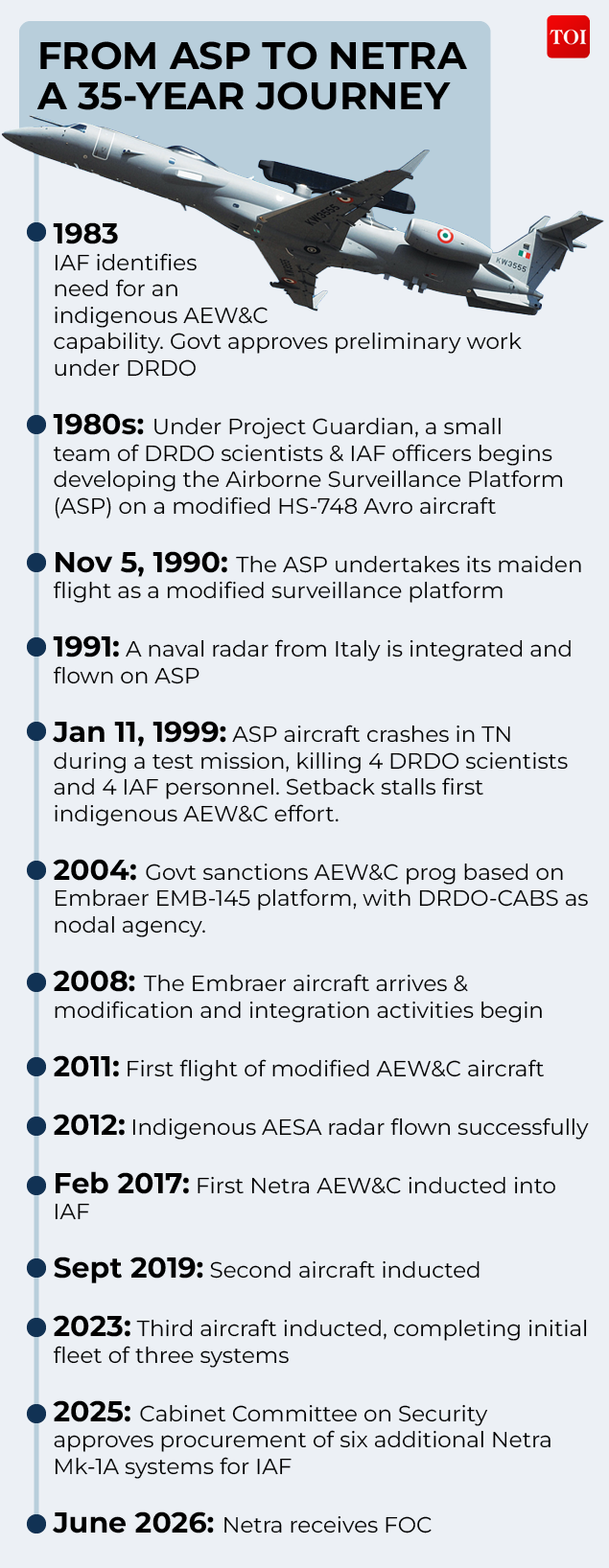
India inducted its first three Phalcon AWACS between 2009 and 2011 under a trilateral arrangement involving India, Israel and Russia. The aircraft provide 360-degree surveillance, electronic intelligence, communications intelligence and airborne command-and-control capabilities over vast areas.To complement these high-value assets, DRDO launched the indigenous Netra programme, aimed at developing critical technologies such as AESA radar, mission computers, secure data links and mission management software within India. The first operational aircraft entered service in 2017, providing the IAF with a homegrown airborne surveillance capability.The next phase involves expanding the fleet with six larger indigenous AEW&C Mk-2 aircraft based on Airbus platforms.
These aircraft are expected to offer greater endurance, higher altitude performance and enhanced radar coverage, bridging much of the capability gap between Netra and traditional heavy AWACS.Singh said the upcoming Mk-2 platform would significantly reduce India's dependence on imported systems."The Netra programme is a major step towards India's goal of self-reliance in airborne surveillance. Until recently, the Indian Air Force depended largely on imported AWACS platforms.
With Netra, India has demonstrated that it can design, integrate and operate its own airborne early warning system. The platform has also proven its operational value during the Balakot air strikes and Operation Sindoor. However, the current Netra is a tactical AEW&C platform.
This means it is smaller, has lower endurance and covers a smaller area than a full-fledged AWACS. This is the capability gap that the Netra Mk-2 is designed to fill.
The Netra Mk-2 programme was cleared by the Cabinet Committee on Security (CCS) in 2025 at an estimated cost of Rs 19,000 crore. Based on six Airbus A321 aircraft acquired from Air India, it will carry a much more powerful indigenous radar with a detection range of over 500 km, additional radar arrays for wider coverage, greater endurance and significantly higher onboard processing capability. These features will bring it much closer to the capabilities of dedicated AWACS platforms.
Together, the two systems will provide the Indian Air Force with a layered airborne surveillance network and will reduce India's dependence on imported systems and significantly strengthen its ability to monitor and manage the battlespace."
Why numbers matter
Military planners regard airborne warning aircraft as force multipliers because they dramatically improve the effectiveness of every other combat platform. They detect threats earlier, direct fighter interceptions, coordinate strike missions and provide commanders with real-time situational awareness.Given India's 15,000-km land border, more than 7,500 km coastline and expanding strategic interests in the Indo-Pacific, experts have repeatedly argued that the current fleet remains too small for sustained round-the-clock coverage across multiple theatres.The IAF's long-term strategy is therefore not to replace one platform with another but to build a layered airborne surveillance network. Netra provides affordable tactical coverage close to operational areas, while AWACS platforms oversee wider theatres and coordinate complex air operations.Together, they give India the ability to detect earlier, respond faster and fight as an integrated network, while advancing the country's long-term goal of developing indigenous airborne surveillance technologies.








 English (US) ·