

 13 hours ago
6
13 hours ago
6
ARTICLE AD BOX
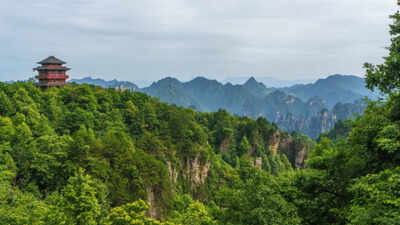
If one had to pick a few things to know China by, the Great Wall of China would probably top the list, along with the delectable Chinese cuisine and more. After all, who doesn't know the Great Wall of China – the longest man-made structure globally, spanning over a staggering 20K km across northern China!But now, another great wall of China is stealing the attention of the world — and it’s not the same old wall of bricks and stones. This time, it’s the great green wall!
China’s great green wall: What are we talking about?
Per Live Science, back in the late 1970s (1978, to be exact), China decided to take on a monumental environmental experiment, planting trees in a desperate attempt to fight back the growing deserts, dust storms, and land degradation plaguing its north.
That experiment became the ‘Great Green Wall’, a reforestation effort to slow the march of the Gobi and Taklamakan deserts, fix damaged ecosystems, and build a living barrier against desertification.Fast forward more than 40 years, and China’s project has ballooned into the largest afforestation drive on the planet. Since 1978, the country says it’s planted somewhere near 66 billion trees, transforming once barren stretches into green belts and young forests. The plan rolls on, and by 2050, China could have planted as many as 100 billion new trees, stretching across thousands of kilometers!What’s even more intriguing is that now, scientists have uncovered something odd: these planted forests are actually growing faster than natural forests nearby. The finding, published in Geophysical Research Letters, shows that China’s new forests are increasing their leaf area about 66% faster than natural forests under similar conditions.
Even accounting for differences like age and climate, the planted areas still outpaced natural forests by about 4.6%.How? Why?To figure all this out, researchers pored over satellite data and used machine learning to track leaf growth, which is a key marker, since leaves absorb carbon and are a direct gauge of how much a forest is growing.
Why exactly are these human-made forests surging ahead?
Turns out, part of it’s just down to the simple rule of age. Most of the trees China has planted are still young, and like all young forests, they grow fast because every year is a race to put on leaves, branches, and trunk.
Older forests slow down a lot as they mature, but they keep storing massive amounts of carbon.Another big factor is the choice of trees. China’s often gone with fast-growing species (think poplar, eucalyptus, and others) that outpace native trees in biomass accumulation. Plus, these forests get more hands-on care: fertilizers, irrigation, even weeding to cut down on competition, all of which boost their growth rates.There might be a third explanation here: more carbon dioxide in the air. As the planet’s CO₂ levels climb, plants can use it to photosynthesize more efficiently, effectively “fertilizing” their growth. This “CO₂ fertilization effect” could be hitting young, intensively managed forests hardest, but scientists still need more evidence to be certain of exactly how these factors mix.At first glance, all this seems like fantastic news for the climate fight.
Fast-growing forests soak up carbon more quickly, which helps offset emissions. China’s Great Green Wall has already slowed desertification in some regions, boosted the vegetation cover, and even helped reduce dust storms in a few areas.
A word of caution
However, scientists warn not to get carried away. Fast growth isn’t everything, and in some ways, it can be misleading.They’ve found that plantation forests in China hit their growth peak after 30 to 40 years, then slow down.
By contrast, natural forests usually grow at a more even pace for centuries and host much richer biodiversity and healthier ecosystems. Over the long haul, natural forests often pull more carbon out of the air because their stability lasts far longer.And then, there’s the biodiversity problem. Large plantations stocked with a couple of tree species are not substitutes for diverse natural forests. Monocultures can be vulnerable to pests, diseases, and drought, and don’t encourage the jumble of birds, insects, and animals you find in old forests.
In fact, some stretches of China’s Great Green Wall have lost vast swaths of trees all at once when disease swept through.So researchers are treading carefully — after all, growth speed isn’t the real sign of long-term ecological health.
Are plantations better than natural forests?
Scientists insist that planted forests and natural forests offer different kinds of value. Plantations are great at quickly restoring land, stopping erosion, or locking up fast carbon, especially during those early years.
But if you want ecosystems that last for centuries, shelter wildlife, and keep storing carbon safely, nothing beats nature’s own forests.For climate modeling, these findings matter. Many current models still treat forests all the same, but that misses big differences in how plantations and natural woodlands grow, how they’re managed, and how they absorb carbon.Sure, the Great Green Wall of China remains a bold bet on the planet’s future, aimed at halting deserts, protecting farmland, and helping both people and the climate. However, the success of the greens won’t be measured by numbers alone. As scientists underline, true reforestation isn’t just about growing trees the fastest — it’s about creating forests that endure, nurture life, and keep supporting the planet for generations.









 English (US) ·