

 1 hour ago
4
1 hour ago
4
ARTICLE AD BOX
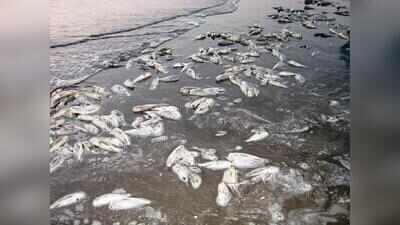
The open-mouth condition of dead fish is consistent with symptoms commonly observed during hypoxic conditions
Visakhapatnam: The preliminary investigation into the thousands of dead fish washed up on the Boyapadu coastline under Nakkapalli mandal in Anakapalle district on June 20 this year has revealed high densities of Trichodesmium cells in the water samples collected.The Visakhapatnam Regional Centre of the Central Marine Fisheries Research Institute (CMFRI), in its preliminary report, observed that a large-scale fish mortality event occurred along the Boyapadu coastline, primarily affecting Leiognathus. The incident coincided with the presence of a near-shore algal bloom and signs suggestive of oxygen stress in the affected fish.While local fishermen suspect industrial effluent influence, the current observations and laboratory findings are insufficient to establish a definitive cause.
The water samples showed high densities of Trichodesmium cells. Comprehensive water quality, toxicological and phytoplankton investigations are required to determine the exact mechanism responsible for the mortality event over a continuous period.Trichodesmium erythraeum is a species of marine cyanobacteria responsible for the characteristic name of the Red Sea. Though typically blue-green, under optimal conditions these cyanobacteria undergo massive population explosions (blooms).
When these blooms die off and decay, they release a red pigment (phycoerythrin), staining the water a reddish-brown, said Dr Joe K Kizhakudan, principal scientist and head at the Visakhapatnam Regional Centre of the Central Marine Fisheries Research Institute (CMFRI).The CMFRI team visited the Boyapadu coast and observed a large aggregation of dead fish along the shoreline (1,500 mts in length and 5 metres in width).
The report says that nearly 94 per cent of the dead fish belonged to Leiognathus (pony fish), which are commonly distributed in shallow coastal waters, estuaries and tidal creek ecosystems.Based on field observations, interactions with fishermen, laboratory examination and environmental studies, the CMFRI team’s preliminary assessment says that the mortality incident predominantly affected Leiognathus, indicating species-specific vulnerability or exposure.
The presence of large numbers of Trichodesmium in phytoplankton analysis and a froth-like appearance near the shore area can be attributed to hypoxic conditions in the sea, leading to fish kills.The open-mouth condition of dead fish is consistent with symptoms commonly observed during hypoxic (low dissolved oxygen) conditions. Fishermen’s observations regarding potential industrial effluent discharge warrant detailed investigation.Intermittent rains during the days have probably created a stratified zones for temperature, salinity and sudden temperature rise has probably created a sudden bloom of the Trichodesmium bloom and the excess biomass when receded to bottom at decay will create a deficit oxygen levels and release of some toxins which will create neurological and asphyxia related disorders in the benthic fish and sediment fauna in the nearshore waters particularly during the high tides when the anoxic water get flushed to the shore brining the benthic fishes in a traumatized state and unable to swim.The team also observed that the local outlets and discharge points of several industries and ETPs, and the footfalls in the zone must be studied regularly for the assessment of the phosphates, iron, and Nitrogen supplements into the coastal waters, if any, to relate to the sudden eutrophication incidences in the zone and leading to oxygen dead zones at the bottom.








 English (US) ·