

 2 hours ago
4
2 hours ago
4
ARTICLE AD BOX
The Congress on Monday strongly objected to the bill on replacing MGNREGA, saying erasing Mahatma Gandhi’s name shows how “hollow and hypocritical” Prime Minister Narendra Modi’s gestures of paying homage to the Father of the Nation are.
The opposition party alleged that the Viksit Bharat Guarantee for Rozgar and Ajeevika Mission (Gramin) (VB-G RAM G) Bill, 2025, “attacks the soul” of rights-based guarantee by replacing it with a scheme “stacked against” the states and workers and defies the ideals of Mahatama Gandhi.
Congress MP Shashi Tharoor questioned the renaming of the scheme, saying the concept of Gram Swaraj and the ideal of Ram Rajya were never competing forces but they were the twin pillars of Gandhi’s consciousness, and replacing the Mahatma’s name in a scheme for the rural poor ignores this profound symbiosis.
Congress president Mallikarjun Kharge said this is not just about changing the name of the Mahatma Gandhi National Rural Employment Guarantee Act (MGNREGA), but is a “conspiracy by the BJP-RSS to dismantle MGNREGA”.
“Erasing Gandhi’s name on the centenary of the RSS shows how hollow and hypocritical Modi’s gestures of paying homage to Bapu on foreign soil truly are,” Kharge said in a post in Hindi on X.
“Only a government that resents the rights of the poor would attack MGNREGA. The Congress party will strongly oppose any decision by this arrogant government that is anti-poor and anti-labour, both in Parliament and on the streets,” he said.
“We will not allow the rights of millions of poor people, labourers, and workers to be snatched away by this government,” Kharge said.
Story continues below this ad
Tharoor, whose stand has been at variance with that of his party on some occasions recently, said the controversy over renaming MGNREGA in the government’s proposed new G-RAM-G Bill is unfortunate.
“His (Gandhi’s) final breath was a testament to ‘Ram’; let us not dishonour his legacy by creating a division where none existed,” the Thiruvananthapuram MP said on X.
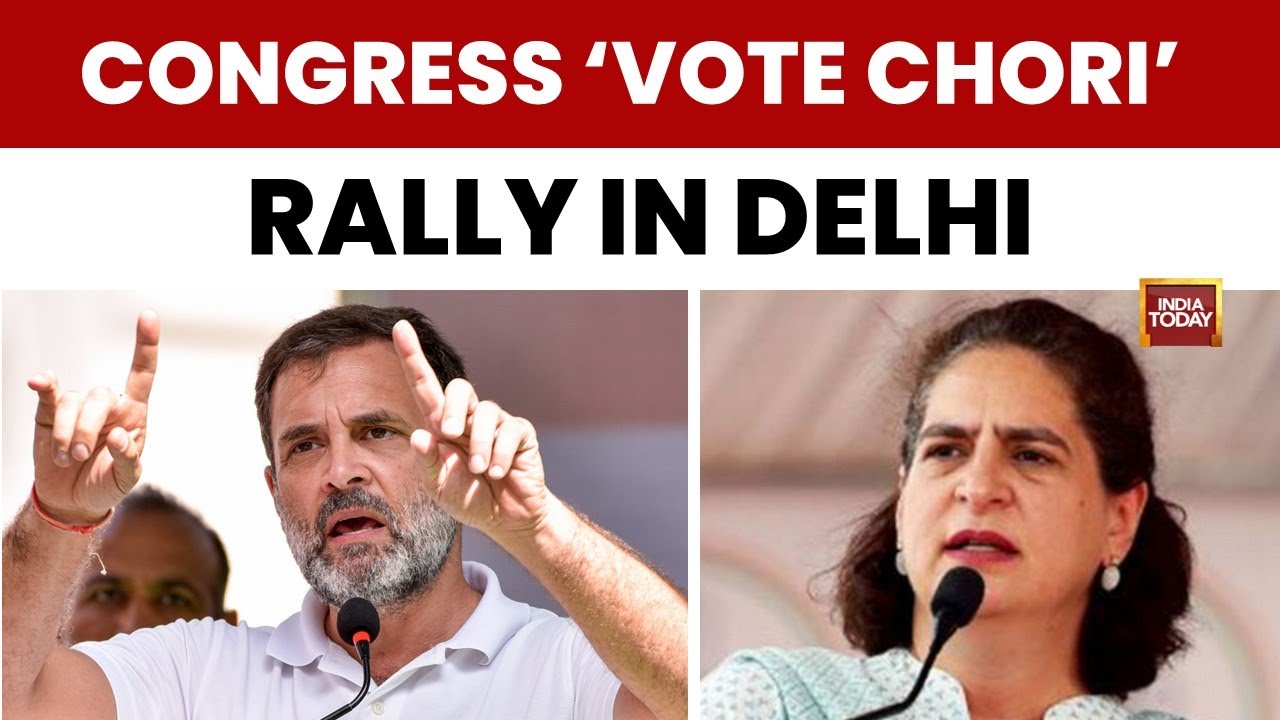
When a user asked whether he was objecting to the renaming or the controversy over it, Tharoor replied, “It’s pretty clear that I am objecting to replacing the Mahatma’s name…” Congress leader Priyanka Gandhi Vadra also slammed the government over its move to change the name of MGNREGA, asking what the government’s intention was behind removing the name of Mahatma Gandhi, who is the tallest leader not just in India but in the world.
Asked about the government’s move, Priyanka Gandhi said, “Whenever the name of a scheme is changed, there are so many changes that have to be made in offices, stationery… for which money is spent. So, what is the benefit? Why is it being done?” “Why is Mahatma Gandhi’s name being removed. Mahatma Gandhi is considered the tallest leader not just in the country but in the world, so removing his name, I really don’t understand what the objective is. What is their intention?” she told reporters in the Parliament House complex.
Story continues below this ad
“Even when we are debating, it is on other issues, not the real issues of the people. Time is being wasted, money is being wasted, they are disrupting themselves,” Priyanka Gandhi added.
Congress General Secretary in-charge (Communications) Jairam Ramesh said the entire opposition is demanding that the three far-reaching bills — Higher Education Commission Bill, Atomic Energy Bill and G-RAM-G Bill — be referred to the Standing Committees concerned.
“We are hopeful that in keeping with the best of Parliamentary traditions and practices, this demand will be agreed to by the Government. The Bills require deep study and wide consultations,” Ramesh said.
The Bill is set to be introduced in the Lok Sabha during the ongoing Winter session of Parliament.
Story continues below this ad
According to a copy of the Bill, it will provide a statutory guarantee of 125 days of wage employment in every financial year to every rural household whose adult members volunteer to undertake unskilled manual work.
Within six months from the date of commencement of the VB-G RAM G Act, states will have to make a scheme consistent with the provisions of the new law.
The financial liability would be shared between the Centre and the state governments. It would be 90:10 for the Northeastern states and Himalayan states and 60:40 for all other states and Union territories with legislature. For the UTs without a legislature, the whole cost would be borne by the Centre.
The MGNREGS was a 100 per cent centrally sponsored scheme.
“The scheme, which will now be known as the Viksit Bharat Guarantee For Rozgar And Ajeevika Mission (Grameen), attacks the soul of a rights-based guarantee and replaces it with a conditional, centrally controlled scheme stacked against the states and workers.
“The same MGNREGA that became a lifeline for rural workers and strengthened the rural economy is being systematically destroyed; in fact, it’s demolishing the right to work itself,” the Congress said on X, adding the scheme will “now defy the very ideals of the Father of the Nation”.
Story continues below this ad
While MGNREGS was a demand-driven scheme with the Union government bound to allocate more money if demand for work was there, under the proposed scheme, the Centre would determine state-wise normative allocation for each financial year. Any expenditure incurred by a state in excess would be borne by the state government.
The wage rate would be specified by the central government through a notification. The Bill says it should not be less than the prevailing wage rates under the MGNREGS.




 English (US) ·