

 1 hour ago
5
1 hour ago
5
ARTICLE AD BOX
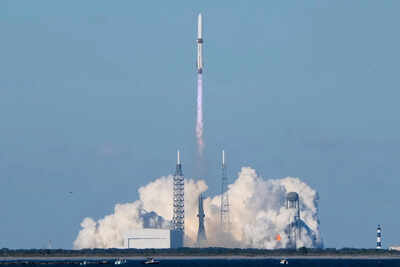
Representative Image AP/PTI(AP11_14_2025_000005B)
Just days ago, Elon Musk's Starlink rival Amazon Leo sent a letter to the Federal Communications Commission (FCC) to reject Spacex’s 1 million-satellite proposal for orbiting data centers.
Amazon's letter claimed that Starlink's project would take "centuries" to deploy. The 17-page filing to FCC from Amazon asks for complete dismissal of the Starlink proposal.
The letter says that Starlink's application promises no less than a “first step towards becoming a Kardashev II-level civilization” -- in other words, a society capable of harnessing the full power of the Sun -- while “ensuring humanity’s multiplanetary future among the stars.”
Now Amazon founder Jeff Bezos’ space company Blue Origin has applied to launch up to 51,600 datacenter satellites. A filing argues that the FCC should approve Blue Origin’s plans because “insatiable demand for AI workloads” means orbiting servers represent “a complement to terrestrial infrastructure by introducing a new compute tier that operates independently of Earth-based constraints.” The filing says that the explosive growth in artificial intelligence (“AI”) workloads, machine learning, and cloud computing is driving unprecedented demand for data center capacity that is already encountering severe roadblocks to scale through terrestrial infrastructure alone.
Blue Origin wants to build orbiting datacenters anyway and says its planned “Project Sunrise” will see it launch “up to 51,600 satellites operating in sun-synchronous orbits from 500–1,800 km, with inclinations between 97 degrees and 104 degrees, with each orbital plane containing approximately 300–1,000 satellites. "Project Sunrise will consist of up to 51,600 satellites operating in sun-synchronous orbits from 500–1,800 km, with inclinations between 97 degrees and 104 degrees, with each orbital plane containing approximately 300–1,000 satellites.
For data, Project Sunrise will rely on optical links to support its communications by routing traffic through its TeraWave system and other mesh backhaul networks to transmit to the ground," says the filing. Blue Origin's filing shares three ways how the grant of its application will serve public interest
* Space-based Data Centers Address a Critical Infrastructure Gap and Expand Sustainable Capacity
The insatiable demand for AI workloads has led to the rapid buildout of terrestrial data centers globally. Space-based data centers will be a complement to terrestrial infrastructure by introducing a new compute tier that operates independently of Earth-based constraints.
Satellites operating in sun-synchronous orbits have access to near-constant solar power, enabling continuous baseload compute without additional draw from terrestrial electrical grids or water supplies.
By adding compute capacity to orbit, the constellation will expand total industry capacity and introduce new sources of clean power for compute workloads while preserving terrestrial infrastructure for uses that cannot be replicated in space.The demand for space-based compute power is growing. Competition among these systems will drive innovation and enhance service quality. Encouraging diverse participation in the space-based data center market will catalyze advancements in technology and resource efficiency, ultimately leading to more robust and sustainable solutions. Blue Origin contends that this application will foster a competitive environment that will benefit consumers and industry alike.
Therefore, expeditious grant of this authorization is in the public interest.
* Orbital Data Centers Will Make AI Compute More Accessible
The transformative potential of AI extends well beyond the technology sector. AI-driven applications are already improving patient outcomes through earlier disease detection and more accessible diagnostics in healthcare, increasing agricultural productivity through precision monitoring of weather and soil, expanding educational access through personalized instruction and intelligent tutoring, and advancing climate science through higher-resolution modeling andpredictive analytics. Yet the societal benefits of AI are fundamentally constrained by the availability and affordability of the computing infrastructure that powers it. Space-based data centers can help break this bottleneck. The built-in efficiencies of solar-powered satellites, always-on solar energy, lack of land or displacement costs, and nonexistent grid infrastructure disparities, fundamentally lower the marginal cost of compute capacity compared to terrestrial alternatives. Empowered by the revolutionary capability of New Glenn’s launch capacity, the economics of space-based compute will enable access at price points that were previously unattainable.
Blue Origin’s Project Sunrise will serve the broad AI data center market and enable U.S. companies developing and using AI to flourish, accelerating breakthroughs in machine learning, autonomous systems, and predictive analytics in support of broad societal benefit.
* Constellation Will Use Spectrum Efficiently and Operate on a Non-interfearance Basis
Project Sunrise will primarily rely upon optical inter-satellite links as a means of communication, with no planned use of radio frequency transmissions under nominal operating conditions.
To enhance system reliability, particularly during early-mission, post-mission, and emergency phases, satellites will be capable of conducting TT&C operations in the Ka-band on a non-interference, unprotected basis.
The constellation will use the 18.8–19.3 GHz (space-to-Earth) and 28.6–29.1 GHz (Earth-to-space) bands, which the Commission allocates for NGSO fixed-satellite service (“FSS”) operations on a primary basis.Safety is core to the Blue Origin mission, and this extends to operation of our satellites. Use of this spectrum is in the public interest, as the Commission has repeatedly found, to ensure the reliability of the satellites during early-mission, post-mission, and emergency operations. Blue Origin seeks to operate on a non-interference basis in bands that are already allocated for NGSO FSS operations, further ensuring compatibility with current and future users.









 English (US) ·