

 4 days ago
23
4 days ago
23
ARTICLE AD BOX
An in-depth study conducted by experts from Dr Y S Parmar University of Horticulture and Forestry, Nauni, has concluded that forest ecosystems across Sirmaur, Shimla, and Solan districts of Himachal Pradesh are in a state of critical ecological decline, primarily due to the long-term impact of repeated forest fires, compounded by insect infestation, fungal infections, and increasing anthropogenic pressures.
The study, commissioned by the state government, examined forest divisions in Bogdhar in Sirmaur, Banuti in Shimla, and Piplughat, Shalaghat and Darlaghat in Solan. It found that despite variations in vegetation—from century-old Ban Oak (Quercus leucotrichophora) forests in Sirmaur to Pine-dominated stands in Shimla and Solan—the underlying cause of widespread tree mortality across all three regions was historical and recurring forest fires that have severely weakened the forests’ natural resilience.
The study was ordered by Chief Minister Sukhvinder Singh Sukhu in December last year following reports of rapid drying and death of pine and oak trees in these districts. A team of expert entomologists and plant pathologists, comprising Dr Manika Tomar, Dr Ajay Sharma and Dr Sumit, undertook field research on December 27, and the detailed report was submitted to the state government earlier this week.
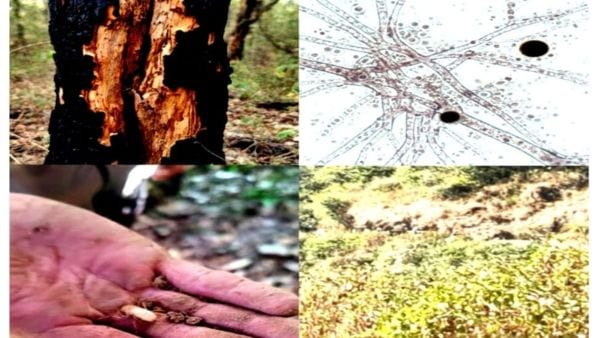 Forest fires, drought, fungal and insect infestation and weed presence in ban oak forest in Bogdhar, district of Sirmour, HP.
What the study found
According to the study, historical fire incidents—some dating back 35 to 40 years—played a decisive role in triggering long-term ecological damage, particularly in the Bogdhar forest area of Sirmaur district. “Though villagers had managed to extinguish surface fires within two to three days at the time, the fires continued to “simmer” beneath thick layers of fallen leaf litter, especially in Ban Oak forests,” the study notes.
This prolonged sub-surface heat caused irreversible damage to root systems and scorched the crowns of mature oak trees. “The soil was effectively baked, leaving surviving trees in a chronically weakened state and highly vulnerable to secondary biological attacks,” the study noted.
The Bogdhar Ban Oak forest, a century-old community-managed ecosystem critical for soil conservation and hydrological regulation, has also suffered from growing anthropogenic pressure. The construction of cemented paths and the expansion of orchards within forest areas have fragmented natural habitats, disrupted moisture-retention systems, and further reduced the forests’ ability to recover naturally.
Following fire damage, weakened trees across all sites became susceptible to severe entomological and pathological attacks. The study documented widespread infestation by termites, stem borers and bark-feeding insects, which exploited charred heartwood, damaged bark and compromised root systems. These insect galleries, in turn, facilitated the entry of virulent fungal pathogens such as Rosellinia necatrix (white root rot), Fusarium spp. and Rhizoctonia, accelerating tree decay and mortality.
Story continues below this ad
In pine forests across Banuti in Shimla district and Piplughat, Shalaghat, and Darlaghat in Solan district, similar patterns were observed. Inspections in the Tutikandi–Taradevi forest range and Kalzoon forest beat in Shimla revealed that at least 150 pine trees showed severe needle blight caused by combined stress from fire and drought. Fire damage to stems was widespread, although limited new sprouting indicated a fragile attempt at recovery.
Laboratory analysis confirmed the presence of soil-borne fungal pathogens in fire-injured pine trees, while evidence of bark-feeding insects, borer exit holes, and termite infestation was particularly pronounced in burnt and weakened trees.
The study also highlighted the role of invasive weeds, particularly Eupatorium, whose aggressive spread has choked the forest floor, arrested natural regeneration, and increased fire fuel loads. Orchard encroachment and other human interventions have further compounded ecological stress in these fragile forest systems.
Reviving the forests
Dr Devina Vaidya, Director of Research at Dr Y.S. Parmar University, said the findings clearly indicate that these forests can no longer recover through natural succession alone. “Restoration now requires a dual approach—immediate weed eradication to reduce fire fuel and competition, followed by phased, scientific plantation efforts to rebuild these vital ecological shields,” she said.
Story continues below this ad
She added that the study recommends specific restoration techniques, including cow-dung seed curing for oak regeneration and soil aeration for pine plantations. “Furthermore, the introduction of native, fire-resilient grasses such as Heteropogon contortus and Chrysopogon fulvus is essential to stabilise soil, suppress invasive weeds, and restore nutrient cycling on the forest floor,” the report stated.
For pine-dominated divisions, the study has recommended the removal of heavily infested and fire-killed trees to prevent the spread of insects and fungal spores, intensive eradication of Eupatorium, and patch-wise plantation to fill canopy gaps created by fire-induced mortality.
The findings underline the urgent need for scientifically guided restoration and sustained management intervention if the forest ecosystems of these three districts are to be protected from further irreversible decline.









 English (US) ·