

 1 hour ago
6
1 hour ago
6
ARTICLE AD BOX
Before the 1984 European Championship, the French manager Michel Hidalgo had a problem. He had four virtuosic playmakers, but not a centre forward. An idea was born, he made a midfield square with his gifted playmakers, helmed by the impeccable Michel Platini. It came to be known as magic square, or the Le Carre Magique, and they inspired their maiden championship triumph of note.
Decades later, Hidalgo’s distant successor Didier Deschamps – whose France beat Norway 4-1 to top World Cup Group I – had a problem, too. He had a superfluity of riches that he couldn’t configure the perfect deception code. Both, Kylian Mbappe and Ousmane Dembele, were wingmen repositioned to the centre by their clubs with staggering success. But he could slot only one. He could drop Mbappe or shunt him to the left for Dembele; he could not bench Dembele, the reigning footballer of the year, either.
ALSO READ | The Ousmane Dembele show: The art of minimalism and scoring goals
The confusion did not end there. He had two exceptionally versatile playmakers, Michael Olise and Desire Doue. Both could play behind the centre forward as well as on the wings. He had difficult choices to make, the pieces of the puzzles muddying his mind. He could drop none—for the clubs, Mbappé, Dembélé, Michael Olise and Désiré Doué scored 97 goals between them last season and, including assists, were involved in 157 goals—yet couldn’t fit in all in their preferred spots.
A pragmatic manager, he chose the well-worn structure of his. A centre forward (Mbappe), two men on the flanks (Olise and Dembele), and one playmaker just behind them (Doue in the Antoine Griezmann role). The first half was a miasma of broken notes. Echoes of their horrid opening game in the 2002 edition against the same opposition whirled. France had too much talent for their own liking, and they crashed out in the first round without scoring a single goal.
During the break, though, Deschamps found his magic square. He shifted Olise to the centre, in the No 10 role, so that he could keep the inert Mbappe busy. He had thrived in the role in Bayern Munich, even though at Crystal Palace he was a winger. Doue was the auxiliary playmaker, thus a playmaking double pivot. Consequently, Dembele was thus furnished the liberty and space to drive through the inside right channel, rather than being stretched to the right side, so that he wouldn’t trespass Mbappe’s space.
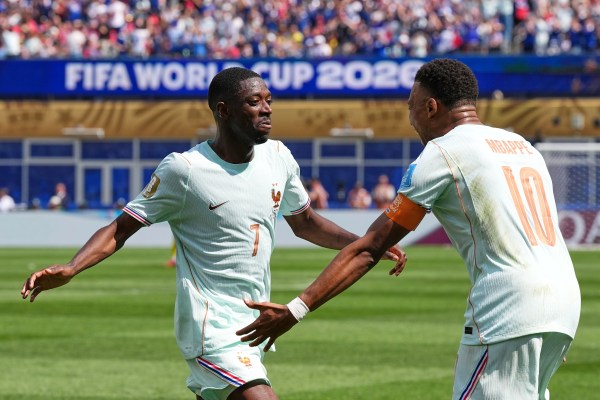 France’s Ousmane Dembele celebrates with Kylian Mbappe, right, after scoring his side’s third goal against Norway. (AP Photo/Martin Meissner)
The result proved devastating for their opponents. Every one could perform what everyone loves to. Mbappe could drift a fraction to his left and find vast expanses of space; Dembele could cut inside and wreak havoc. Both were repurposed centre forwards, and the instincts are quite not those of a classical centre forward relishing the centrality of the role. Both love a bit of width on their side, yet not too much width like conventional wingers. The result: Mbappe 5 goals; Dembele: 4 including a brace. France: 10 goals in three games; 23 shots on target. Deschamps’ biggest headache was solved—to harness the best of his two monumental forwards. It was the chief debating point in France before the tournament. Former legends had criticised Deschamps’ handling of Dembele, who before the tournament had only eight goals and six assists in 61 games from his national side. “There should be a campaign to save Dembele, the way they have handled him is lamentable,” Bixete Lizarazu wrote in his column in L’Equippe.
Story continues below this ad
Inadvertently, hello unleashed the most attacking iteration in 14-year-tenure. It’s his last World Cup, and perhaps it’s how he wants the world to judge him—as the ringmaster of the most destructive French side of this century.
The jigsaw solved, everything fell into place. Olise pulls the strings with magnificent maturity. His assist for Mbappe, a splendidly disguised diagonal pass, for the opening goal against Senegal was designed in footballing heaven. Endowed with dexterous feet and wits sharpened by playing chess in spare time, he has a preternatural spatial awareness. He can be an agent of chaos as well exude control. “He is a dream come true. He doesn’t play the game, he thinks the game,” Thierry Henry, his former U-21 coach, gushed on Fox Sports. He is only 24, yet he is the beating heart of this wondrous French quartet.
ALSO READ | FIFA refused France’s request to wear black armband for Didier Deschamps’ mom
Doue, only 21, has a vast repertoire of jaw-dropping skills. But he restrains himself from the flourishes. When Olise is around, he is more like the studious apprentice, taking cues from the master. He left Deschamps impressed after the very first sighting. “He has the ability to beat people. to cover a lot of ground, which isn’t always the case (for players with his profile). So he is able to play in the attack and midfield,” he once said.
Story continues below this ad
All four bring different traits to the table to form a comprehensive whole, Mbappe has pace, precision and presence; Dembele is all slick, incisive movements; Olise has intuition, a through-the-roof genius in team play; Doue is a blithe spirit, unpredictable and wild, someone who could find a solution from nothing. The communication is telepathic now—there is not a need to gesture or howl. When Olise has the ball, Mbappe knows where exactly he needs to move, just as Olise knows where precisely Mbappe is heading to. When Mbappe has the ball on his feet, Dembele’s mind charts out the potential paths. Mbappe assisted Dembele’s first two goals. All four could assist and score goals, all perform their defensive duties tidily. They could hound individually as well as collectively.
The destination of the World Cup would depend on who could dismantle Deschamps’ magic square.


 English (US) ·