

 54 minutes ago
7
54 minutes ago
7
ARTICLE AD BOX
A Mumbai woman's unborn baby received an anti-cancer drug to shrink heart tumours (AI-generated image used for representational purposes)
For 38-year-old Jogeshwari resident Sevanti (name changed), reaching the 24th week of pregnancy after three early miscarriages felt like a victory.Then came devastating news: her unborn baby had five growing tumours in the heart and nodules in the brain, leaving doctors uncertain if the foetus would survive.Determined to have the baby, she refused an amniocentesis test that would confirm the underlying genetic disorder and instead urged doctors at Wadia Hospital in Parel to focus on saving her child.Doctors put Sevanti on an oral anti-cancer drug called Everolimus for four weeks to “shrink” the tumours in the foetus.On June 18, Sevanti gave birth to a 2.5-kg boy who has already undergone two heart scans. “The tumours shrank before his birth itself and don’t seem to be growing after his birth,” said foetal cardiologist Dr Shreepal Jain.
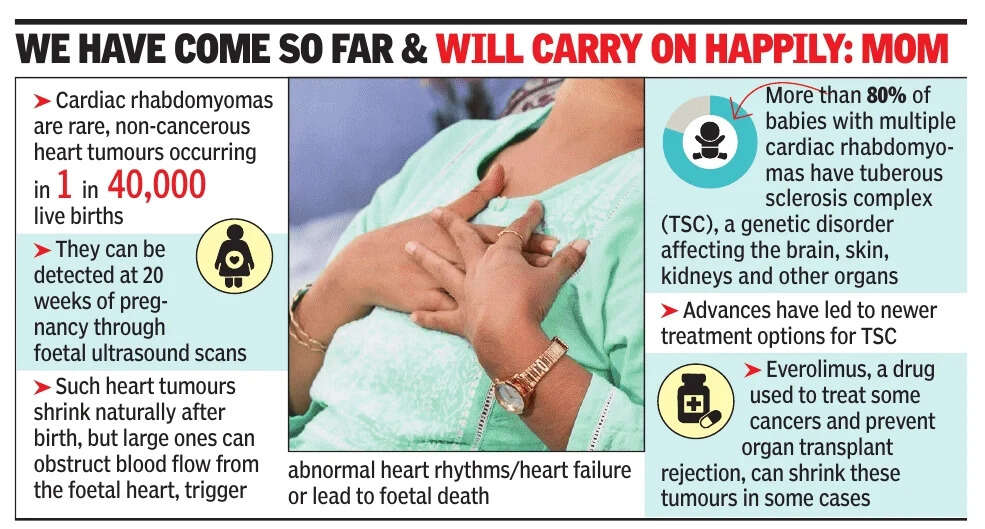
We have come so far and will carry in happily: Mom
Docs: We expect boy’s tumours to continue regressing and disappear as he grows older
When Jogeshwari’s Sevanti (name changed) found out her unborn baby had five tumours in the heart and nodules in the brain, she said she told the doctors, “Knowing the cause wouldn’t have changed my mind about having the baby, so why waste time?”The hospital’s newly formed foetal medicine team suspected the foetus had tuberous sclerosis, a genetic disorder often associated with multiple rhabdomyomas (heart tumours) and brain nodules.
The oral anti-cancer drug Everolimus given to her for four weeks to “shrink” the tumours worked, “and we prolonged her pregnancy till the 36th week before delivering the baby,” said obstetrician Dr Pooja Bandekar and foetal medicine specialist Dr Vandana Bansal, who were treating her since the 20th week of pregnancy.On June 18, Sevanti gave birth to a 2.5 kg boy. “The tumours shrank before his birth itself and don’t seem to be growing after his birth.
We expect them to disappear as he grows older,” said foetal cardiologist Dr Shreepal Jain.Dr Jain said one of the tumours grew large enough to obstruct blood flow from the foetal heart. The team reviewed published reports on the use of Everolimus during pregnancy before deciding to administer it to the mother so it could cross the placenta and reach the foetus. (Everolimus is also given to neonates in whom the cardiac rhabdomyomas are detected after birth. )The treatment required close monitoring because Everolimus can significantly raise cholesterol levels.
Sevanti underwent regular blood tests to monitor drug levels and cholesterol while weekly scans tracked the baby’s condition.Two post-birth echocardiograms showed the tumours shrank before delivery and have not grown since. “The tumours shrank before his birth and don’t seem to be growing after birth. We expect them to continue regressing as he grows older,” said Dr Jain.Wadia Hospital CEO Dr Minnie Bodhanwala said this is possibly Mumbai’s first reported case in which maternal treatment with Everolimus was successfully used to shrink foetal cardiac rhabdomyomas.
“A similar case was previously reported from Hyderabad,” she said.Dr Bansal said multiple cardiac rhabdomyomas are strongly associated with tuberous sclerosis complex, a genetic disorder affecting the brain, skin, kidneys and other organs. Because the baby also has brain nodules, he could develop seizures later in life, but these can usually be managed with medication, said Dr Bandekar.Independent foetal medicine specialist Dr Chander Lulla, who was not involved in the treatment, said cardiac rhabdomyomas are rare and Everolimus has emerged as an effective option in selected cases.Sevanti is optimistic. “We have come so far and will carry on happily,” she said.








 English (US) ·