

 6 hours ago
6
6 hours ago
6
ARTICLE AD BOX
A captured Iranian drone design has been reverse-engineered by the United States and redeployed on the battlefield, according to a senior US military commander, highlighting how rival powers are increasingly copying each other’s unmanned weapons.Speaking at a press conference on Thursday, US central command (CENTCOM) commander Admiral Brad Cooper said American forces are now using a drone derived from an Iranian design that had been captured and studied.“LUCAS... indispensable. This was an original Iranian drone design. We captured it, pulled the guts out, sent it back to America, put a little ‘Made in America’ on it, brought it back here, and we’re shooting it at the Iranians,” Cooper said, as quoted by ET.The remarks came as the US and Israel continue their military campaign against Iran.
LUCAS drone and Iranian Shahed design
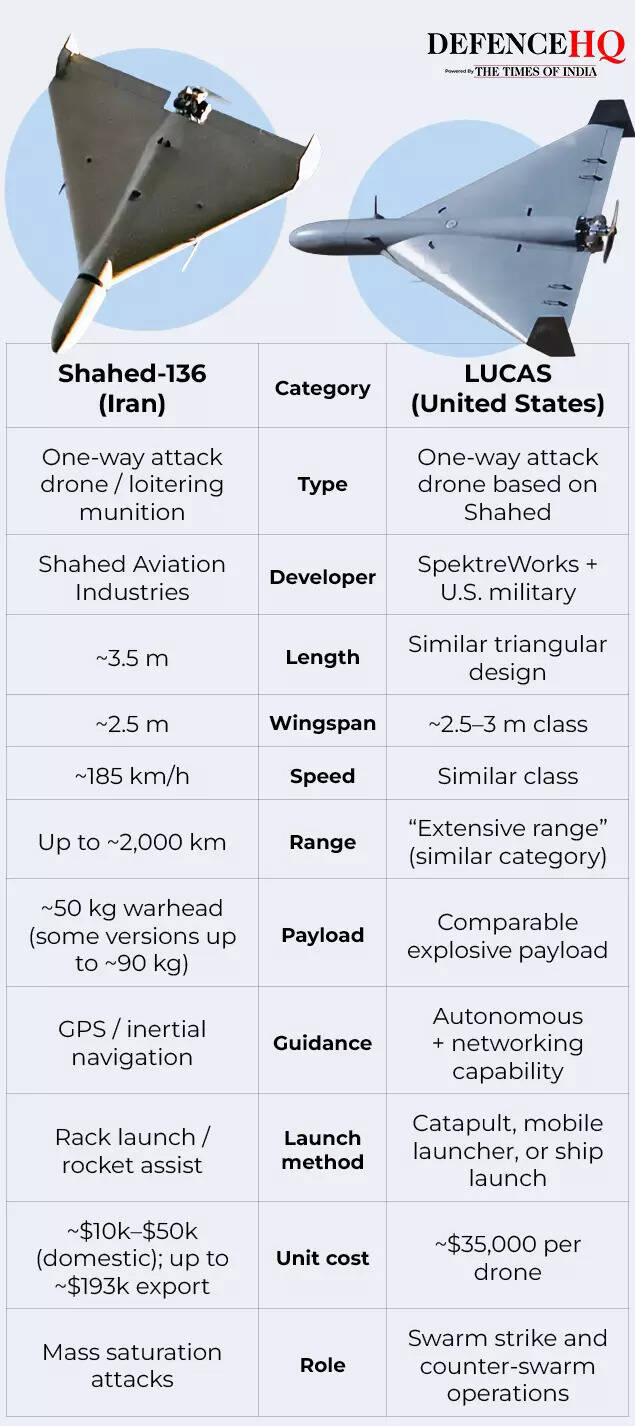
At the centre of the development is the LUCAS (Low-cost Uncrewed Combat Attack System), an American kamikaze drone that closely resembles Iran’s Shahed-136 loitering munition.
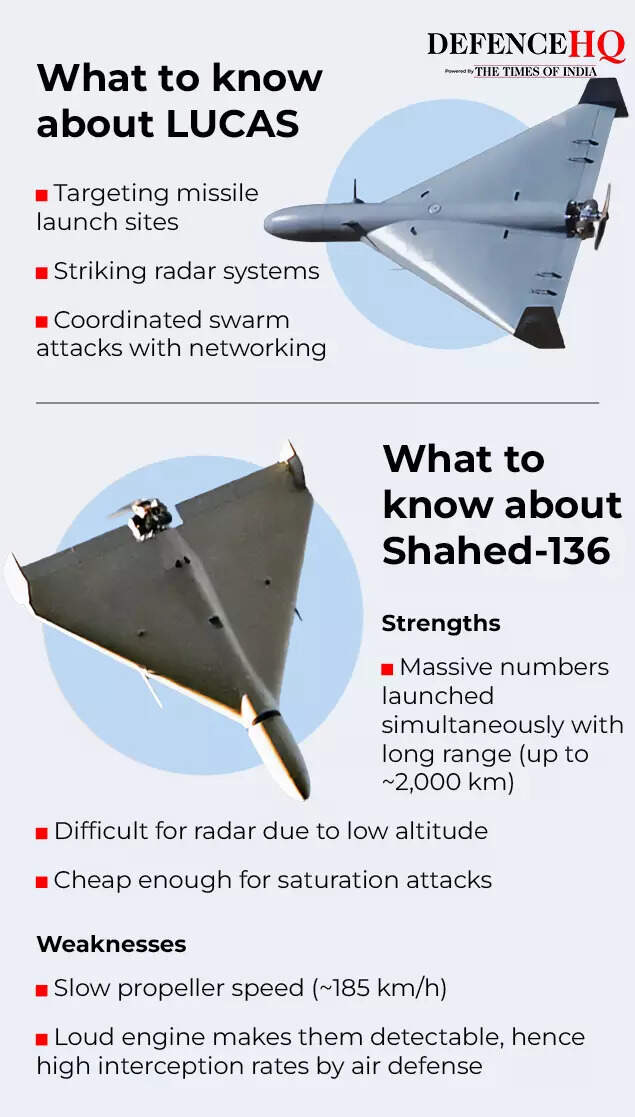
The Shahed-136, unveiled by Iran in 2021, became widely known after Russia used it extensively in the war in Ukraine. The relatively inexpensive one-way attack drone is designed to loiter over a target area before striking.
According to Cooper, US forces captured an Iranian drone and transported it to the United States for analysis and redesign. The resulting system, LUCAS, has reportedly been deployed in combat during Operation Epic Fury.The drone was formally showcased in July 2025. During the event, US defence secretary Pete Hegseth displayed equipment from multiple companies competing for defence contracts in the Pentagon courtyard.
Among them was Arizona-based SpektreWorks, the company behind the LUCAS system.Drone specialists told Reuters that the aircraft shows clear similarities to the Shahed series, including its triangular flying-wing layout, rear pusher propeller and relatively simple structure.Analysts told the news agency the US design reflects lessons from recent conflicts, particularly the Ukraine war, where inexpensive drones were used to overwhelm air defence systems at far lower cost than cruise missiles.
Iran’s own history of reverse engineering
Military analysts note that Iran’s Shahed programme itself drew inspiration from earlier unmanned systems.According to analysts cited by Reuters, the Shahed-136 shares design concepts with Israel’s Harpy loitering munition, an anti-radar drone developed in the 1990s. Similar loitering munition designs have since been adopted by several countries including China and Taiwan.Iran has also previously claimed to replicate American drone technology after capturing US aircraft.In December 2011, Tehran announced it had captured a Lockheed Martin RQ-170 Sentinel, a stealth reconnaissance drone operated by the CIA from Afghanistan. Iranian officials later said they reverse-engineered the aircraft to produce drones such as the Shahed-171 Simorgh and Saegheh.According to AP, Iran’s semi-official Tasnim news agency reported in 2016 that the Saegheh drone developed by the Islamic Revolutionary Guard Corps was modelled on the captured American aircraft.Iran has also said it recovered other US drones, including a ScanEagle surveillance drone manufactured by Boeing, which it claimed had entered Iranian airspace over the Persian Gulf.
Cheap drones reshape modern warfare
The emergence of systems such as LUCAS illustrates how drone technology is spreading through capture, analysis and adaptation.
Instead of relying only on expensive precision missiles or fighter aircraft, militaries are increasingly deploying large numbers of low-cost unmanned systems capable of striking targets while saturating air defences.The Shahed-136 became a symbol of this shift when Russia used it in large numbers against Ukrainian infrastructure.According to Reuters, the Pentagon has been actively seeking similar low-cost unmanned systems from private manufacturers to expand weapons that can be mass-produced quickly and deployed in large numbers during high-intensity conflicts.(With agency inputs)





 English (US) ·