

 1 hour ago
5
1 hour ago
5
ARTICLE AD BOX
A ground visit to Jhabua found women trekking to dry riverbeds, dry taps and an almost empty overhead tank despite Jal Jeevan Mission work being marked complete. Read our detailed ground report.
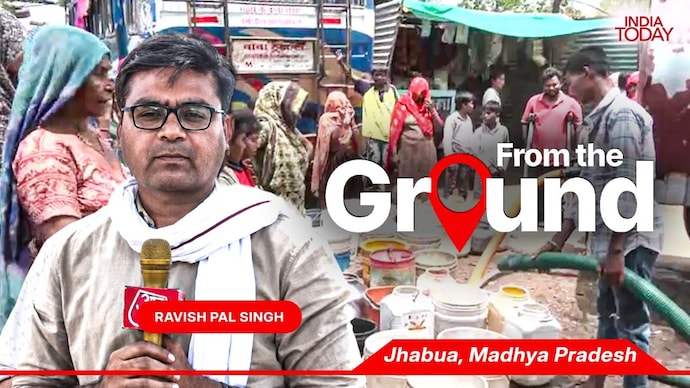
Locals said the water tank initially supplied water for a few days after construction, but then stopped functioning.
"Water is life" is a line often repeated in India's development narrative. But in Jhabua district of Madhya Pradesh, a two-day ground visit shows a very different reality: where life exists, but water remains distant.
A India Today team visited Jhabua to assess the on-ground status of the multi-crore Jal Jeevan Mission. Official records claim over Rs 430 crore has already been spent in the district. Hundreds of villages have been covered, schemes completed, and handed over to panchayats. On paper, the system appears functional. On the ground, it tells another story entirely.
WOMEN WALKING TO DRY RIVERBED FOR WATER
The first stop was Kheda village in Jhabua. Early that day, around 10-12 women were seen walking in a queue, balancing pots on their heads, heading toward a distant mound behind the village. They were not going to a handpump or tap. They were heading nearly one kilometre away to a dried riverbed, where water is collected from pits dug into the sand.
The conditions were harsh. Temperatures hovered around 42 degrees Celsius. The terrain was uneven -- rocks, slopes, and rough pathways making the journey difficult. Some women carried one pot, while others balanced two earthen pitchers.
The routine, villagers said, is daily. The round trip takes two to three hours. In case of weddings or when guests arrive, the trip doubles. An elderly woman said she has been walking this route for years and her legs have started giving way.
When asked about the Jal Jeevan Mission, villagers pointed to a pipeline laid in 2022. Four years later, there are still no functional taps and no water supply to homes.
TAPS INSTALLED, BUT NO WATER
The second location was Bakhtapura ward under Para panchayat. Here, the infrastructure looks complete. Pipes have been laid. Taps are installed outside homes. Officially, the work has been marked complete and handed over to the panchayat.
But the ground reality is starkly different.
Residents depend on water tankers. Several families spend money every month to buy water. Large drums are placed outside homes to store tanker-supplied water.
When the taps were tested, none of them worked. Not a single drop came out.
In a striking visual, villagers said some of these unused taps are now being used to tie goats.
Locals said multiple complaints were made to officials. "I have written seven letters to different authorities regarding the water crisis, but nothing has changed. Even as water remains absent, the panchayat continues to demand water tax payments from residents, a young resident named Satish said.
50,000-LITRE TANK THAT BARELY HOLDS WATER
The third stop was Dhandhalpura village. At the centre stands a large overhead water tank, painted with a declared capacity of 50,000 litres.
Locals said the tank initially supplied water for a few days after construction, but then stopped functioning.
Inside the tank, the reality was even more striking. Instead of being full, it contained only a shallow layer of water -- barely above ankle level.
Nearby stands a water disinfection unit meant to purify the supply. It has remained unused. Dust covers the machine, wires hang loose. Residents say it was never connected to electricity, and therefore never operational.
RS 430 CRORE SPENT, BUT VILLAGE STILL THIRSTY
Across Jhabua, out of 713 villages, 519 have been marked as completed under the Jal Jeevan Mission and handed over to local panchayats.
The district has reportedly spent around Rs 430 crore so far. Individual allocations include nearly Rs 75 lakh in Kheda village, about Rs 50 lakh in Para panchayat, and over Rs 1 crore in Dhandhalpura for pipelines and tank infrastructure.
Yet the question repeated in every village remains the same: if the scheme is complete, where is the water?
OFFICIAL RESPONSE & ACCOUNTABILITY GAP
When contacted, Public Health Engineering (PHE) Executive Engineer Jitendra Mavi said the department completes the scheme and hands it over to panchayats, after which operation and maintenance becomes a local responsibility.
PHE Minister Sampatiya Uike said some regions face difficulties due to summer conditions and falling groundwater levels, and efforts are underway under the Chief Minister's directions to address them.
But the contrast on the ground remains hard to ignore -- women walking to dry river pits under a 42 degrees Celsius sun, families relying on tankers, empty overhead tanks, and unused taps turned into tethering posts for goats.
In Jhabua, the promise of the Jal Jeevan Mission appears complete in records. In villages, there is still a promise waiting for water.
- Ends
Published By:
Sahil Sinha
Published On:
Jun 5, 2026 10:38 IST






 English (US) ·