

 10 hours ago
4
10 hours ago
4
ARTICLE AD BOX
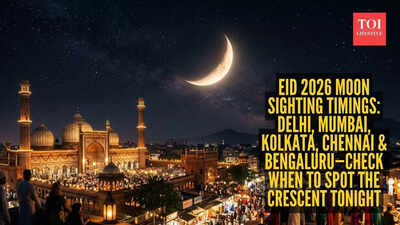
India awaits the Chand Raat moon sighting tonight, March 19, 2026, to determine Eid al-Fitr. While Saudi Arabia celebrates on March 20, India's decision hinges on local sightings. The crucial viewing window is brief, post-sunset, with specific times varying by city. A sighting means Eid on March 20; no sighting pushes it to March 21.
If you’ve been glancing at the sky every few minutes or compulsively refreshing your social media feed, you’re definitely not alone. There is a very specific kind of magic in the air across India right now as we enter the high-stakes window of Chand Raat 2026.We already have some clarity from across the map. Saudi Arabia and several neighboring countries have made their official call: the moon wasn't spotted on Wednesday evening. This means they are completing a full 30 days of fasting and will be celebrating Eid al-Fitr on Friday, March 20, 2026.However, in India, the story is still very much unfolding. Because the country relies on its own local moon-sighting committees and the actual physical sighting of the crescent on our own shores, everything hinges on what happens in the sky over the next hour.
The Golden Window: When to Look Up
For most of us in India, if the crescent moon is going to show up, it’s going to be a "blink and you’ll miss it" moment. Typically, it appears in a very narrow window—about 15 to 25 minutes right after the sun goes down.Your practical viewing window: Roughly 6:20 PM to 6:50 PM IST, though this shifts slightly depending on which city you’re calling home.
City-by-City: Your Local Moon-Sighting Guide
Since India is geographically vast, the sun says goodbye at different times. Here is a quick cheat sheet for the best viewing times in your neck of the woods:Kolkata: Sunset is early at ~5:50 PM → Best viewing: 5:50–6:10 PMChennai: Sunset ~6:15 PM → Best viewing: 6:15–6:35 PMBengaluru: Sunset ~6:25 PM → Best viewing: 6:25–6:45 PMDelhi / New Delhi: Sunset ~6:30 PM → Best viewing: 6:30–6:50 PMChandigarh: Sunset ~6:28 PM → Best viewing: 6:30–6:50 PMHyderabad: Sunset ~6:28 PM → Best viewing: 6:30–6:50 PMMumbai: Sunset is later at ~6:45 PM → Best viewing: 6:45–7:05 PMQuick Reality Check: Remember, these are astronomical estimates.
Whether you actually see that silver sliver depends entirely on the weather, city haze, and how clear your horizon is.
So, What Happens Next?
It’s a simple "either/or" situation that changes the plans for millions:✅ If the moon is sighted tonight (March 19): Eid will be celebrated tomorrow, Friday, March 20.❌ If it’s not sighted: Ramadan completes its 30-day cycle, and Eid will fall on Saturday, March 21.
Pro Tips for Your Chand Raat Search
If you're heading to the terrace or a nearby open ground, keep these tips in mind to boost your chances:Find the Horizon: Choose a spot with a totally clear view of the western sky—tall buildings are your enemy here.Escape the Glow: Try to get away from heavy streetlights and pollution-heavy areas if you can.Be Quick: Start looking immediately after the Maghrib prayer.Use Tools, but Trust Your Eyes: Binoculars are great for locating the moon, but official religious confirmation usually requires a naked-eye sighting.
The Bigger Picture
India isn’t the only nation holding its breath tonight. From Pakistan and Bangladesh to Indonesia, Malaysia, Oman, and Morocco, millions of people are scanning the skies at this very moment. It’s a fascinating blend of ancient tradition and modern life; despite all our advanced astronomical tech, the final word still rests with the traditional moon-sighting committees.Because at the end of the day, Chand Raat isn’t just about a date on a calendar. It’s about that shared pause, that collective gaze toward the heavens, and that quiet, universal hope for a fresh start.







 English (US) ·