

 1 hour ago
4
1 hour ago
4
ARTICLE AD BOX
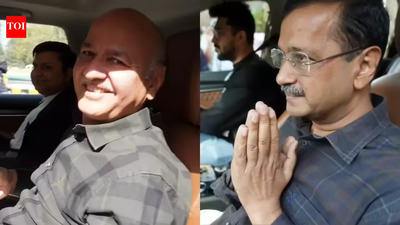
NEW DELHI: A Delhi court discharged on Friday AAP supremo and former Delhi CM Arvind Kejriwal, former deputy CM Manish Sisodia, former BRS MLC K Kavitha and 20 others in a corruption case related to the alleged excise policy scam, criticising the manner in which the probe was conducted by CBI and bringing the case to a halt at its very first stage of framing charges. In its 598-page order, special judge Jitendra Singh of Rouse Avenue courts came down heavily on the prosecution, observing that the "voluminous chargesheet" of thousands of pages contained several lacunae without support from witness statements or admissible evidence.
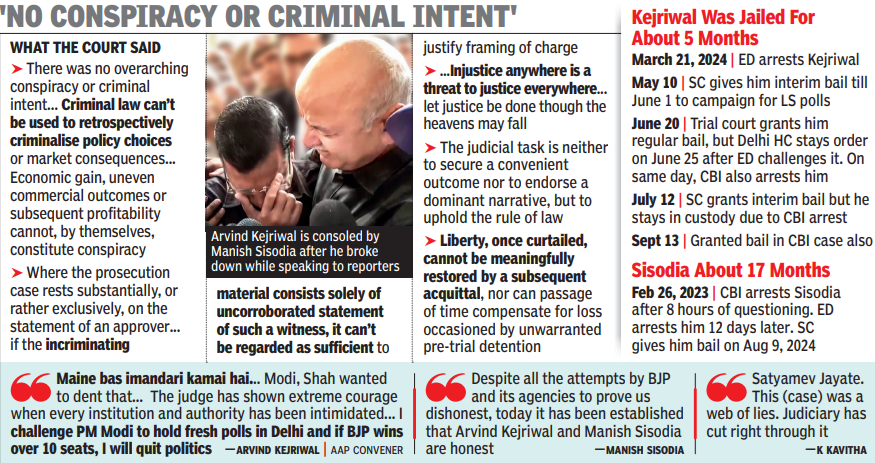
"To compel the accused to face the rigours of a full-fledged criminal trial in the stark absence of any legally admissible material connecting them to the alleged offences would not serve the ends of justice; it would instead constitute a manifest miscarriage of justice and an abuse of the criminal process, offending the most basic tenets of fairness and the rule of law," the court noted.
It pointed to "misleading averments" and internal contradictions that struck "at the very root of the alleged conspiracy theory".
It held that the prosecution's case did not disclose "even the threshold of a prima facie suspicion", as projected by CBI, thus making the claims "wholly unable to survive judicial scrutiny and discredited in entirety". The matter arose from allegations that the 2021-22 policy, which sought to privatise liquor trade, granted undue advantage to private entities at the cost of the public exchequer and "smacked of corruption", as alleged by CBI and ED.
The policy was later withdrawn. The prosecution projected Kejriwal as occupying the apex position and exercising overarching control over the alleged conspiracy in the policy's formulation and implementation, while Sisodia, as excise and finance minister, was said to be instrumental in shaping it. Durgesh Pathak and Vijay Nair were alleged to have worked in proximity to further the conspiracy, with Arjun Pandey described as closely associated with Nair.
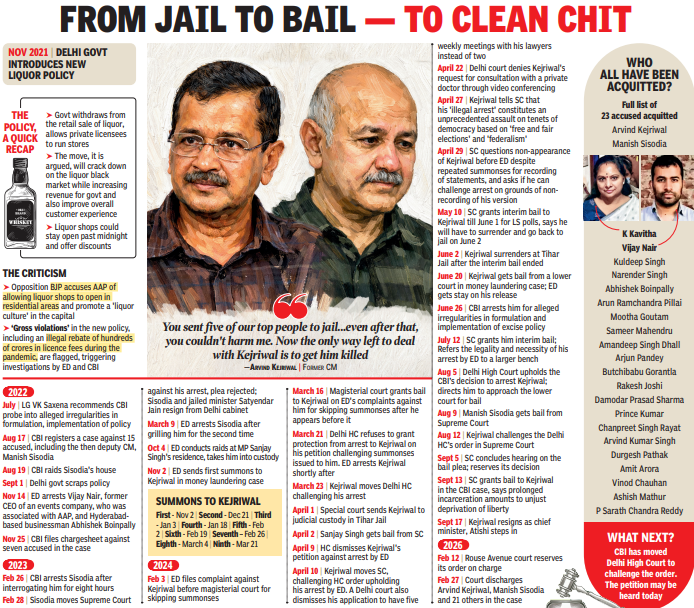
Rejecting the allegations against Kejriwal outright, Judge Singh noted that his role featured only in the fourth supplementary chargesheet filed in July 2024 and that the principal material relied upon to implicate him was the statement of approver Magunta Sreenivasulu Reddy. Dismissing the claim that Kejriwal played a central conspiratorial role, the court stated, "Serious allegations must be supported by admissible material.
In the absence of foundational material connecting Kejriwal with any criminal design, and in the absence of independent corroboration of the statements... the attribution of a central conspiratorial role cannot be sustained."Even on Sisodia, the court found that the prosecution failed to establish even a prima facie case against him. He was arrested by CBI in Feb 2023 and later by ED in March, was accused of "recommending" and "taking decisions" regarding the policy "without the approval of any competent authority".
"The attempt to connect Sisodia to the alleged money movement through another accused was based on inference rather than admissible proof," Judge Singh noted.The judge further upheld "procedural integrity of the policy-making process", observing that the excise policy was formulated through consultations involving LG and the council of ministers, following constitutional procedures. The court held there was no admissible material demonstrating that Sisodia or Kejriwal exercised official authority with the intent to confer undue benefits or participate in a criminal conspiracy.
"In the absence of a tainted policy or unlawful implementation, the prosecution theory is reduced to conjecture," it added, noting that private persons deriving commercial advantage from a policy validly framed and lawfully implemented, without any established violation of conditions or statutory prohibitions, could not be compelled to face criminal prosecution.The court also scrutinised prosecution's overreliance on Magunta's statement, noting that the certain cases against the accused were built almost entirely on such statements without "any independent corroboration".
Discharging primary accused Kuldeep Singh, an excise department official, the court rapped the investigating officer, saying, "there is no material at all. I am repeating, there is no material at all, and you have framed him as accused number 1.
"Examining the broader conspiracy theory, the court said: "The alleged conspiracy, from its very inception, has progressively unravelled and, on close scrutiny, is revealed to be nothing more than a speculative construct resting on conjecture and surmise, devoid of any admissible evidence."
The investigation failed to properly appreciate the evidence, rendering the prosecution case "legally infirm, unsustainable, and unfit to proceed any further in law".
Judge Singh also pulled up CBI for apparent "dilution" of the Indian Evidence Act, observing that "however elaborate the investigative exercise may be", the discipline of evidence can't be compromised. When tested on admissibility, relevance and probative value, the alleged conspiracy collapsed into a case based on inadmissible material and post-facto reconstruction. He further pointed to an "attempt to stitch together disparate fragments so as to create an impression of a vast and complex conspiracy", noting that the probe appeared to have followed a "premediated" trajectory to lend "an illusion of depth and credibility to an otherwise fragile narrative".





 English (US) ·