

 1 hour ago
4
1 hour ago
4
ARTICLE AD BOX
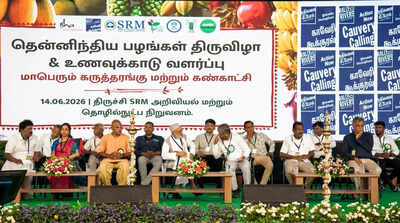
South Indian Fruits Festival and Food Forest Cultivation Conference in Trichy
Trichy: Sadhguru’s Save Soil–Cauvery Calling movement organised the ‘Food Forest Cultivation and South Indian Fruits Festival’ on SRM University campus in Trichy on Sunday. Scientists and farmers at the conference emphasised that food forest cultivation and tree-based agriculture are highly effective solutions for enhancing farmer incomes and public health.Around 6,000 people, mostly farmers, participated in the event. Tamilmaran, coordinator of Cauvery Calling, said awareness about tree-based agriculture has grown through the movement, resulting in a rise in demand for saplings from their nurseries. “This model improves soil fertility, water retention, river health, and farmer incomes,” he said.R Selvarajan, director of the National Research Centre for Banana, highlighted that excessive use of chemical fertilizer has degraded soil health and reduced productivity, making tree-based agriculture essential.
He encouraged farmers to boost incomes through banana value-added products.T N Balamohan, former dean of Horticultural College and Research Institute, Periyakulam, spoke on food forests within coconut plantations, stating that they provide farmers with additional and reliable income.Scientists from four agricultural research institutions, including the ICAR–National Institute of Horticultural Research, offered technical guidance on cultivation, market opportunities, and management of mango, jackfruit, and avocado.
Experts from NIFTEM, Thanjavur, shared technologies for value addition and marketing of fruit products.Padma Shri awardee Kaleem Ullah Khan, known as India’s ‘Mango Man’ for growing 300 mango varieties on a single tree, presented his success strategies.The exhibition displayed more than 60 banana varieties and more than 100 varieties each of mango and jackfruit. Saplings of mango, jackfruit, avocado, apple, and other fruit trees were made available at subsidised prices.








 English (US) ·