

 2 hours ago
6
2 hours ago
6
ARTICLE AD BOX
As West Bengal voted, Narendra Modi's football outing in Sikkim and the Ganga Expressway launch in Uttar Pradesh drew national attention. During election campaigns, Modi often does something distinctive. Here's a look at his appearances through the polls, that carry political and cultural signalling.
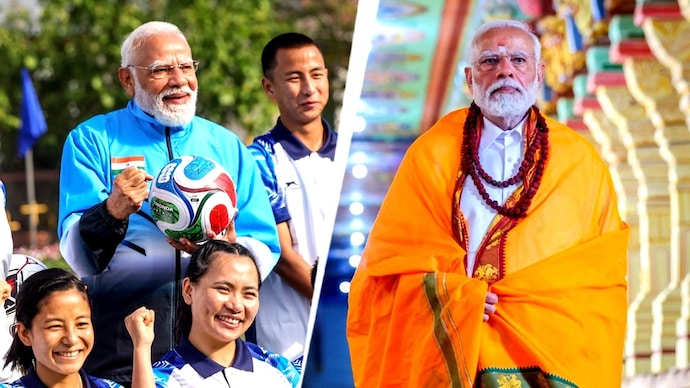
For Prime Minister Narendra Modi, silence during poll campaigns is deliberate, calculated and clearly visible to his target audience. (Image: PTI)
New Delhi,UPDATED: Apr 29, 2026 19:57 IST
He played football in Sikkim on Tuesday, the eve of voting in West Bengal, and inaugurated the Ganga Expressway on Wednesday, even as the state voted. No one has mined the 48-hour period of silence before voting like Prime Minister Narendra Modi has. Election after election he has made the period of silence scream his messaging.
After his rallies in West Bengal, Modi reached Sikkim and played football with children in the golden light of the morning on a lush green field. He high-fived and scored a goal on the field. With the happy moments captured and disseminated, Modi might have scored a bigger goal off the field in West Bengal – a football-crazy state.
On Wednesday, Modi inaugurated the Ganga Expressway in Hardoi, Uttar Pradesh. Mind the name. Ganga. People in Howrah, 1,110 km away, must have noticed what was happening in Hardoi. Ganga is a name that resonates with the Bengalis. The Hooghly, a major distributary of the Ganga, is Bengal's agricultural and cultural backbone. It is a state that religiously celebrates the Gangasagar Mela.
Contrast this with Rahul Gandhi, the Congress's de facto leader and the party's face. Rahul Gandhi was in the Great Nicobar Island, criticising an infrastructure project of strategic significance as "one of the biggest scams". Great Nicobar doesn't fit into the great mindscape of the Bhadralok voters.
There is a pattern in Modi's election-day events. This keeps repeating even as the 48-hour mandatory period of silence, an archaic concept in the age of social media, kicks in before an election.
Let's go back to the last Assembly election in West Bengal in 2021. On the first day of polling on March 27, Modi was in Bangladesh's Orakandi, the birthplace of Harichand Thakur, the spiritual figurehead of the Matua community. The Matua voters hold considerable electoral significance in West Bengal.
On February 5 last year, as Delhiites queued up to vote, Modi, in a red jacket and strings of rudraksh beads around his neck and wrists, took a dip at the Sangam during the Mahakumbh. Opposition parties accused him of trying to use religion to sway voters in Delhi, where the Aam Aadmi Party was already resorting to soft-Hindutva.
A year before that, on November 20, 2024, as voters were casting votes in the second phase of the Jharkhand Assembly election, Modi was in Guyana. Why Guyana?
Thousands of people from Bhojpuri-speaking regions of Jharkhand and Bihar were taken by the British to Guyana as indentured labourers to work on sugar plantations. About 40% of Guyana's population is of Indian origin, and big chunk of it has roots to undivided Bihar from which Jharkhand was carved out.
In the first phase of voting on November 13, Modi was in Bihar inaugurating AIIMS.
Then on February 28, 2022, on the day of the Assembly election in Manipur, Modi addressed a post-Budget conference in Guwahati through videoconferencing. He mentioned the Centre's development vision for the northeast.
How can one discuss Modi's eloquence in silence and miss his 45-hour retreat for meditation at the Vivekananda Rock Memorial in Kanyakumari, Tamil Nadu, in 2024?
He was in on May 30 to June 1, and the results of the general election was declared on June 4. Images of Modi meditating after a high-octane election campaign flooded media.
This was the place where Narendra had meditated exactly 131 years ago and emerged as Swami Vivekananda with vision of modern India. For Modi, after his no-holds-barred strikes at the opposition, it was the time to project the image of a leader who has the vision for a modern India and would work for its development.
Panchatantra has the tale of the geese and the turtle. Silence is golden is the moral of that story. In Modi's case, the silence is a glittering golden that is obvious to his target audience.
- Ends
Published By:
Anand Singh
Published On:
Apr 29, 2026 19:57 IST
Tune In




 English (US) ·