

 1 day ago
6
1 day ago
6
ARTICLE AD BOX

PhD in artificial intelligence is no longer just an academic pursuit – it can unlock some of the highest salaries in tech today. Globally, top AI PhD graduates are commanding compensation packages running into hundreds of thousands of dollars, even touching the million-dollar mark in some cases.
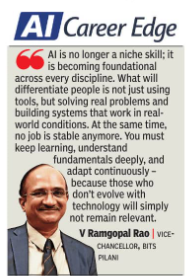
For students weighing their options, that signals a clear shift: deep specialisation is becoming incredibly valuable in the AI era.That is precisely why V Ramgopal Rao, vice-chancellor of BITS Pilani, believes more Indian students should consider going beyond a basic engineering degree. “There is often this misconception that doing a PhD is only to become a professor. That is far from the truth,” he said, adding that advanced expertise is critical for building foundational technologies, not just business models.But Rao’s larger message goes beyond degrees. AI, he argues, is no longer a niche skill – it is becoming as fundamental as mathematics. “Irrespective of whether you are a civil engineer or a mechanical engineer, you need to start using AI in your own area,” he said. The real differentiator, however, is not simply using tools. “Everybody is using AI tools… but system-level thinking – solving a real problem using AI and making it work reliably – that is what will differentiate people.
”
-
For students, that means shifting focus from passive usage to active building. Writing code or generating assignments with AI is no longer impressive. “These are skills that everybody will have,” Rao noted. What matters instead is whether you can create something meaningful – a full system, a working product, or even an AI agent that solves a real-world problem.Domain Knowledge is crucialThis is where domain knowledge plays a crucial role. Rao does not believe AI will replace core disciplines.
Instead, it will amplify them. “If you are designing a building and you are not using AI, you would take much longer,” he explained. The combination of domain expertise and AI capability can dramatically improve productivity, but only if students understand both.At the same time, blindly relying on AI tools can be risky. Rao warned against treating them as “black boxes”. Students must understand how these systems work, their limitations, and when not to trust them.
This is why institutions are now introducing AI education early, even in the first year, to build foundational understanding rather than superficial familiarity.Equally important is exposure to the real world. Academic exer cises, Rao pointed out, are often based on clean datasets and welldefined problems. Industry is very different. “There are no clean datasets, the goals are am biguous and deadlines are tight,” he said.
This gap is why longterm internships and industry immersion are becoming criti cal. Students need to experience messy data, unclear objectives, and real constraints to truly be come job-ready.Why soft skills is keySoft skills, often overlooked by engineering students in pursuit of grades, are also rising in importance. “Communication is becoming more important than ever,” Rao said. With AI tools improving written output for everyone, the ability to clearly explain ideas – especially to non-experts – has become a key differentiator.
Teamwork and interdisciplinary collaboration are equally vital, as AI projects increasingly involve people from diverse fields such as healthcare, climate science and agriculture.Underlying all of this is a deeper shift in how careers themselves are evolving. Rao emphasised that the idea of a “safe” job is quickly becoming outdated. Roles across industries are being reshaped by AI, and the expectation now is not stability, but adaptability.
“No job is stable anymore,” he said, stressing that even traditionally secure professions are being redefined by automation and intelligent systems.This has direct implications for students. It is no longer enough to qualify for a role and rely on that knowledge for years. Rao pointed out that technologies are changing so fast that what you learn in your first or second year of college may already be outdated by the time you graduate. So, continuous learning becomes the only real job security.







 English (US) ·