

 1 week ago
6
1 week ago
6
ARTICLE AD BOX

India may not have an OpenAI of its own, but global giants are building the AI products of tomorrow from hereFor months, the conversation around India’s place in the AI race has been dominated by what the country lacks. It has no OpenAI, no DeepMind and no home-grown frontier model capable of matching the world’s most powerful AI systems.
Critics argue that India risks becoming a consumer of AI rather than a creator of it.But that view overlooks where much of AI innovation is actually taking place. Across healthcare, smartphones, automotive engineering and industrial systems, global companies are choosing India not merely to deploy AI, but to invent it. Indian engineers are building AI that cuts MRI scan times in half, developing language models that run directly on smartphones used by millions worldwide, shrinking vehicle development cycles, and designing autonomous driving systems for some of the world’s toughest roads.
Far from sitting on the sidelines of the AI revolution, India is now one of the world’s most important centres for applied AI research and engineering.
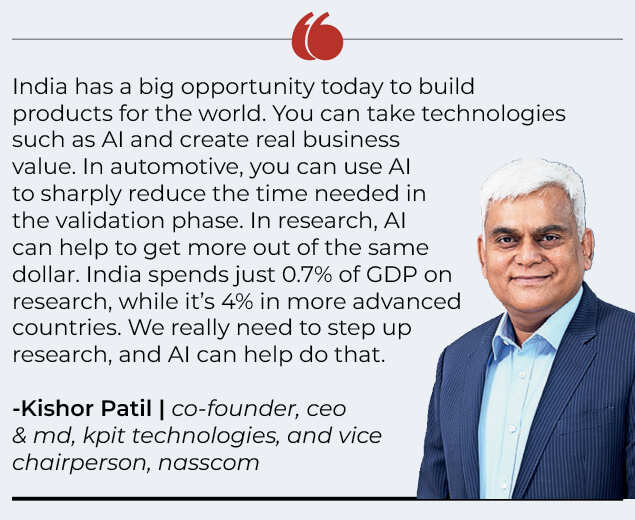
“People originally came to India for cost and scale,” Kishor Patil, co-founder & CEO of KPIT Technologies, and vice chairperson of Nasscom, noted during a webinar we held recently in association with Nasscom. “Today, the most important factors are speed, reliability and innovation.
India means innovation.”That shift is being driven by a combination of deep engineering talent, decades of software expertise, experience in building products for global markets and access to one of the world’s richest and most diverse pools of real-world data. Those strengths are persuading MNCs to move increasingly sophisticated AI R&D work to India.Patil, who is also vice chairperson of Nasscom, believes the timing could not be better.
Technologies like AI are making it possible to create real business value “Most MNCs are expanding here and Indian enterprises themselves have started adopting technology much faster,” he said.Making AI fit in your pocketYou can see that at Samsung’s R&D centre in Bengaluru, one of the company’s largest research hubs outside South Korea. It is one of Samsung’s key R&D centres contributing to the development of Galaxy AI technologies and experiences, working closely with the company’s worldwide research network.
Many of these innovations are now available on Samsung smartphones used by millions of people around the world.
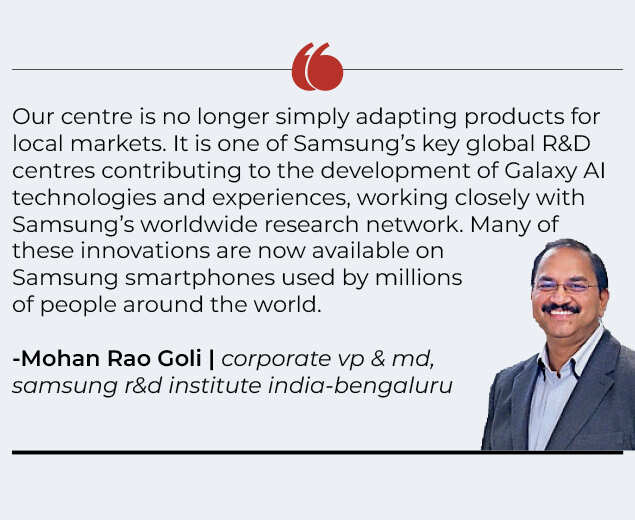
One of the most recognisable features is Live Translate, which allows two people speaking different languages to hold conversations in real time.“You can speak in your native language and the other person hears it in theirs,” said Mohan Rao Goli, corporate VP and MD of Samsung R&D Institute IndiaBengaluru.
“Our teams in Bengaluru contribute to the development and optimisation of language AI technologies.”The India team also contributes AI-powered features such as Photo Assist and computer vision capabilities that allow smartphones to better understand images and generate content. It’s a hard engineering challenge. Unlike cloud-based AI systems that rely on powerful data centres, these models have to run directly on smartphones.
“You have constraints like battery life, thermal limits, memory footprint and limited computing power,” Goli noted.
That means sophisticated AI models have to be redesigned to deliver fast responses while preserving battery life, protecting user privacy and functioning even without an internet connection.Indian engineers, Goli said, are moving from technology implementation to product innovation, platform engineering and product technology leadership within global R&D organisations.Transforming MRIsAt Philips Innovation Campus in Bengaluru, Indian engineers are building AI technologies that are already transforming healthcare across the world. Rather than simply helping doctors detect diseases, AI is being woven into the entire clinical workflow to reduce the time in diagnosing and treating, which allows doctors to spend more time with patients and treat more people.
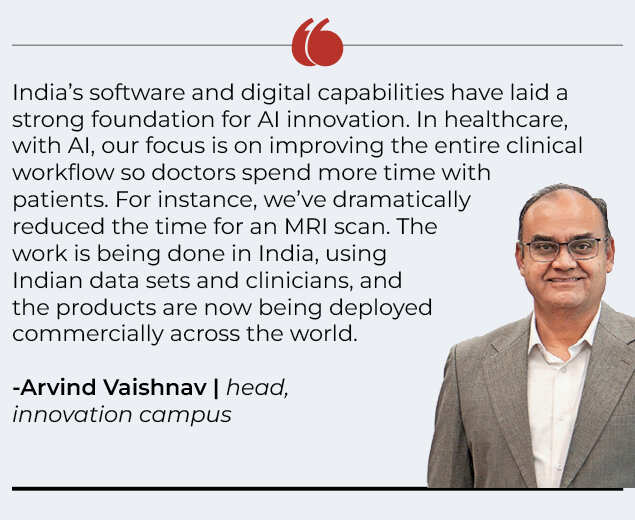
“A typical MRI scan can take around an hour,” said Arvind Vaishnav, head of Philips Innovation Campus.
“We developed an AI platform that can reduce that scan time to around 30 minutes, and in some applications even below 15 minutes.”So, patients spend less time inside the MRI scanner, clinicians examine more people every day, and hospitals make better use of expensive equipment.AI is also dramatically reducing the time required to prepare scans. “Planning a cardiac MRI used to take 14 or 15 minutes,” Vaishnav said.
“Today AI reduces cardiac scan planning to less than a minute.”The technology, he said, was conceived and built in India, using Indian data sets and working closely with clinicians here. The products are now being sold commercially across the world.”Rise of software-defined machinesAutomotive engineering is undergoing an equally dramatic transformation. Vehicles are becoming software-defined machines where AI is increasingly involved in design, testing and eventually driving itself.
But according to Sai Prasad, CTO for IoT and digital engineering at TCS, success depends less on using AI everywhere than on knowing where it genuinely adds value.
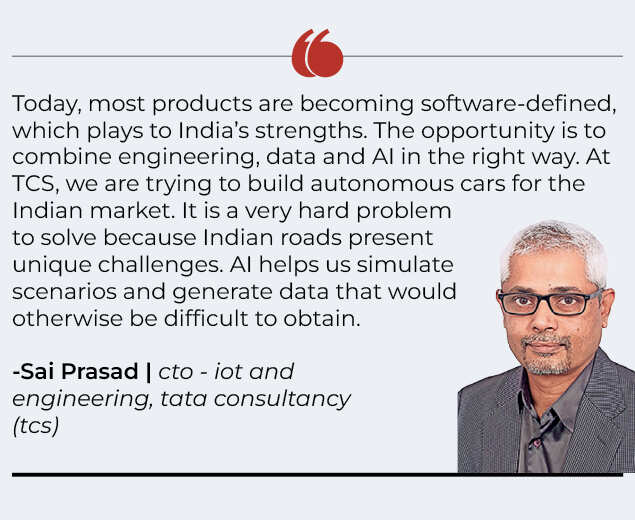
“Everybody wants to use generative AI, but that is only one part of AI,” he said. “If you are making engineering decisions that affect passenger safety or medical devices, you need a combination of engineering knowledge, physics and AI. Identifying the right use cases is extremely important.”TCS is using AI to build digital factory operating systems that allow manufacturers to deploy AI applications at scale. The company is also working on autonomous driving technologies specifically designed for Indian roads. “It is a very hard problem to solve because Indian roads present unique challenges. AI helps us simulate scenarios and generate data that would otherwise be difficult to obtain.”KPIT is applying AI to one of the biggest bottlenecks in automotive development: validation – the painstaking process of testing whether every system in a vehicle functions safely before it reaches customers. “If you can reduce validation by nine to twelve months, it changes everything,” Patil said. “It allows manufacturers to launch products much faster.” He believes this capability could help India emerge as a major global automotive technology player.Prasad noted that the fuel for innovation is data, and India generates incredibly diverse data. That, he said, gives us a big advantage if we use it responsibly.








 English (US) ·