

 1 week ago
4
1 week ago
4
ARTICLE AD BOX
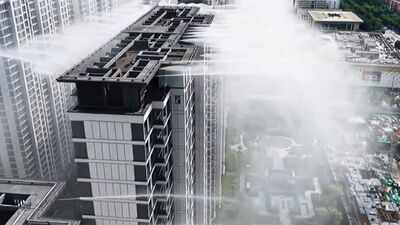
Heatwaves have become an increasingly familiar part of summer across many parts of Asia, with densely built cities often feeling much hotter than the surrounding countryside. Glass towers, concrete surfaces and packed neighbourhoods continue to store heat long after the sun has gone down, leaving many outdoor spaces uncomfortable for much of the day.
Against that backdrop, videos from China have been attracting attention online after showing what many social media users have labelled an "outdoor air conditioner". The clips appear to show rooftops and open terraces filled with a fine cooling mist, prompting widespread curiosity about whether the technology can genuinely reduce temperatures. While the nickname is catchy, the systems being shown are not outdoor air conditioners in the traditional sense.
They rely on a different method that has existed for years but is receiving renewed interest as hotter summers become more common.
The science behind China's viral outdoor cooling system
The equipment featured in the widely shared videos is an outdoor mist cooling system rather than a conventional air conditioning unit. Instead of chilling air through refrigerants and compressors, the system releases an extremely fine spray of water through specially designed nozzles positioned around outdoor areas.
The droplets are so small that they evaporate rapidly after entering the air. As the water changes from liquid to vapour, it absorbs heat from the surrounding atmosphere. This natural process, known as evaporative cooling, lowers the temperature in the immediate area without flooding the ground or leaving people noticeably wet when the system is properly adjusted.The effect is local rather than widespread. It creates a cooler zone around seating areas, walkways or terraces instead of attempting to cool an entire neighbourhood.
How China's outdoor mist cooling system lowers temperatures
The principle behind these systems is straightforward. Water requires energy to evaporate, and that energy comes from the heat already present in the surrounding air. As millions of microscopic droplets disappear into the atmosphere, they remove part of that heat, making the nearby environment feel cooler.Under suitable weather conditions, temperatures around the misted area may fall by several degrees. The exact reduction depends on factors such as humidity, wind speed and air temperature.
In drier conditions the cooling effect is generally stronger because evaporation happens more quickly, while very humid weather limits how much additional moisture the air can absorb.For that reason, the systems perform differently from place to place and from one day to another.
Why they are appearing in more public spaces
Outdoor mist cooling systems have been used commercially for many years, particularly in places where people gather outside during warm weather.
Restaurants, cafés, hotel terraces, gardens, amusement parks, warehouse entrances and event venues often install them to improve comfort without enclosing the space.Because they cool only selected areas, they usually consume far less electricity than trying to air-condition an open environment. Water use is also carefully controlled through high-pressure pumps that produce an ultra-fine mist rather than large droplets.Businesses often choose these installations because they can be integrated into pergolas, umbrellas, roof edges or support structures without requiring major building alterations.
Why cities feel hotter than nearby rural areas
The growing attention around mist cooling reflects a wider problem affecting urban centres around the world. Buildings, roads and pavements absorb large amounts of solar energy during the day before gradually releasing it after sunset.
Limited vegetation and heavy traffic add further heat, while tall buildings can restrict natural airflow.This combination creates what is commonly known as the urban heat island effect. As a result, city temperatures often remain several degrees higher than those recorded in nearby rural locations, particularly during prolonged hot spells.Residents frequently experience uncomfortable evenings because surfaces continue radiating stored heat even after direct sunlight has disappeared.
Can mist systems help during extreme heat
Mist cooling cannot solve the wider challenge of rising urban temperatures, but it can make certain outdoor spaces more usable during periods of intense heat. Public squares, transport waiting areas, outdoor markets and restaurant seating can become noticeably more comfortable when local temperatures are reduced.The technology is especially useful where traditional air conditioning is impractical. Open-air environments cannot easily retain cooled air, making standard cooling systems inefficient and expensive.
Evaporative mist systems avoid that problem by cooling people within a limited area instead of trying to chill the entire atmosphere around them.Even so, they are not equally effective everywhere. High humidity reduces evaporation, meaning the cooling effect becomes less pronounced in damp conditions than in dry climates.
Heatwaves continue to challenge cities
Interest in outdoor cooling technologies has grown alongside increasingly frequent periods of extreme heat.
Large cities across Asia have experienced prolonged hot weather in recent summers, with densely populated urban districts often recording particularly uncomfortable conditions because of retained heat and limited natural cooling.In India, severe heatwaves have repeatedly pushed temperatures to dangerous levels in recent years. High daytime readings are increasingly accompanied by unusually warm nights, giving residents little opportunity to recover after sunset.
Weather agencies have also warned that climate change is increasing both the frequency and intensity of extreme heat events.As cities look for practical ways to improve outdoor comfort, mist cooling systems are attracting fresh attention. They are not a replacement for conventional air conditioning, nor do they address the underlying causes of rising temperatures, but they offer one relatively simple way to reduce heat in busy public spaces where traditional cooling methods are difficult to use.









 English (US) ·