

 1 hour ago
6
1 hour ago
6
ARTICLE AD BOX

FPI buying of government securities up amid push for forex
MUMBAI: Foreign funds have been pouring money into sovereign bonds after govt and RBI, earlier this month, eased rules for these investors to invest in govt securities (G-Secs), aimed mainly at supporting the rupee.
Between June 5, the day the rules were changed and now, FPIs have net bought G-Secs worth about $2 billion, official data showed.
Some estimates, however, said the total is nearing the $3 billion mark.Among the rules that were changed was removal of withholding tax for foreign portfolio investors (FPIs) investing in G-Secs and increase in some of the investment limits in these bonds. Govt's decision to ease investment rules for NRIs to invest in India have also been aiding this FPI surge in govt bonds, market players said.
.
According to Sandeep Bagla, CEO, TRUST Mutual Fund, the decision to remove withholding tax on interest on G-Secs has attracted FPI flows from a variety of players - real money investors with a longer term horizon, multi asset funds who have shifted to G-Secs for margin to exchanges to support derivative positions and bond traders. "Funds have invested across the yield curve from 5-year to over 30-year G-Secs as outlook on rupee is positive now," Bagla said.
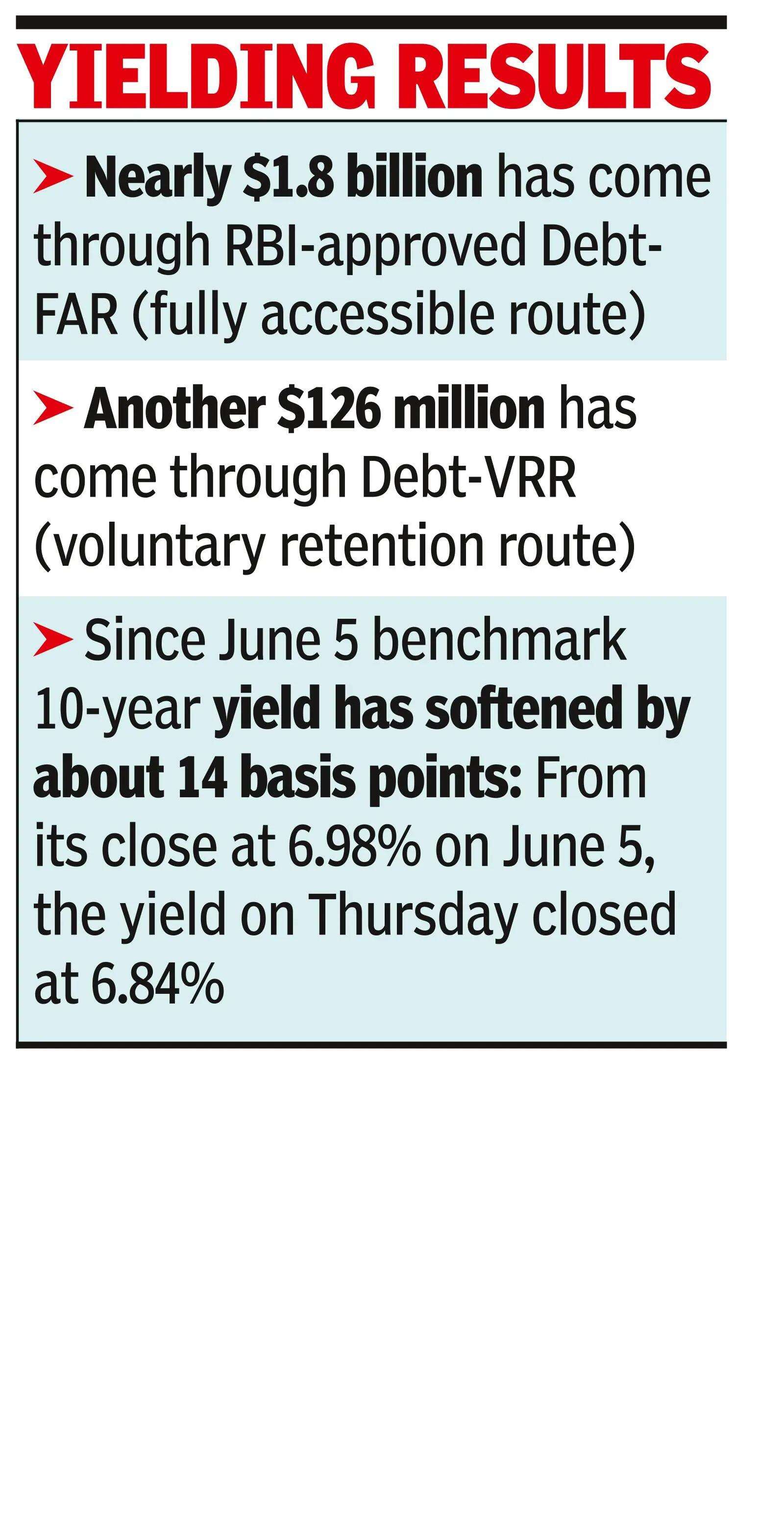
Data from NSDL showed that while nearly $1.8 billion came through the RBI-approved Debt-FAR (fully accessible route), another $126 million came through the Debt-VRR (voluntary retention route).Debt market players said that govt's and RBI's decision on G-Secs could now also allow some Indian sovereign bonds to be included in global bond indices, resulting into more FPI buying interest in these papers.As the result of the foreign fund flows into G-Secs, since June 5 the benchmark 10-year yield has softened by about 14 basis points: From its close at 6.98% on June 5, the 10-year bond yield on Thursday closed at 6.84%.









 English (US) ·