

 1 hour ago
7
1 hour ago
7
ARTICLE AD BOX
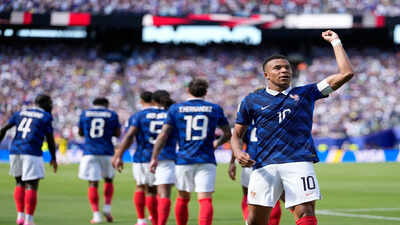
France's Kylian Mbappe celebrates after scoring the opening goal of his team during the World Cup Group I soccer match between France and Senegal in East Rutherford, N.J., near New York, Tuesday, June 16, 2026. (AP Photo/Frank Franklin II)
Twenty-four years after Senegal produced one of the most famous upsets in FIFA World Cup history by defeating defending champions France in Seoul, the two nations met again on football's biggest stage with a very different storyline unfolding at MetLife Stadium.
France began their 2026 FIFA World Cup campaign with a 3-1 victory in Group I, but the scoreline only tells part of a contest that remained finely balanced deep into the second half before Kylian Mbappé took control of the occasion. The France captain scored twice, broke Olivier Giroud's long-standing national scoring record, moved beyond Just Fontaine as his country's leading World Cup goalscorer and ensured Didier Deschamps' side opened the tournament with maximum points against one of Africa's strongest teams.
Mbappé turns a tense contest in France's favour
France arrived in New Jersey among the favourites to lift the trophy, carrying an attacking group packed with elite talent and the experience of reaching the last two World Cup finals. Senegal, meanwhile, entered the tournament as unbeaten qualifiers and Africa's reigning standard-bearers, determined to remind the world of the fearless football that stunned France in 2002. The opening hour reflected that balance. France controlled possession with 54 per cent of the ball and circulated play confidently, yet Senegal's compact defensive structure prevented clear openings for long periods.
Nicolas Jackson provided a constant outlet on the break and came closest to breaking the deadlock during the first half when an effort struck the post, briefly silencing the large French contingent inside the stadium. Despite finishing with 11 shots to Senegal's six and generating an expected-goals figure of 1.89 compared to Senegal's 0.50, France found opportunities difficult to create against a disciplined opponent that matched them physically and tactically.
Both teams finished with identical passing accuracy of 87 per cent, illustrating how competitive much of the contest remained. The breakthrough finally arrived in the 66th minute through two of France's most influential players. Michael Olise, who consistently found pockets of space between Senegal's defensive lines, delivered a perfectly weighted pass into the penalty area. Mbappé timed his movement expertly and guided a composed finish beyond Édouard Mendy to give France the lead.
Senegal respond but France's quality proves decisive
The opening goal altered the rhythm of the match. Senegal could no longer remain compact and patient, forcing them to commit more players forward in search of an equaliser. That change created spaces France had struggled to find earlier in the evening. Adrien Rabiot exploited one of those openings in the 82nd minute with a clever forward pass that released Bradley Barcola. The substitute showed impressive composure, delicately lifting the ball over the advancing Mendy to double France's advantage and seemingly place the result beyond doubt. Senegal, however, refused to allow the evening to end quietly. Their persistence was rewarded in stoppage time when 18-year-old Ibrahim Mbaye announced himself on the World Cup stage. Introduced from the bench, the teenager struck with his first and only shot of the match to reduce the deficit to 2-1 and briefly revive hopes of a dramatic comeback. Those hopes lasted barely a minute. From almost immediately after the restart, Mbappé produced the defining moment of the contest.
Collecting possession in space, he drove forward before unleashing a stunning long-range effort from approximately 35 yards that flew beyond Mendy and into the net. The strike sealed a 3-1 victory and ensured the match would be remembered primarily as another landmark evening in Mbappé's extraordinary international career.
A record-breaking night for France's captain
The result carried significance beyond France's position in Group I because Mbappé left the field having rewritten several chapters of French football history. His brace moved him from 56 international goals to 58, taking him beyond Olivier Giroud's previous national record of 57 and making him the outright leading goalscorer in the history of the French men's national team. The achievement arrived on his 99th international appearance, leaving him one cap away from reaching a century for Les Bleus. The goals also elevated his World Cup tally from 12 to 14. That total moved him past Just Fontaine's long-standing French World Cup mark and strengthened his pursuit of the global record held by Germany legend Miroslav Klose, who finished his career with 16 World Cup goals. Fontaine still retains one remarkable distinction. His 13 goals at the 1958 World Cup remain the highest number scored by any player in a single tournament. Mbappé, however, now stands alone as France's leading World Cup goalscorer and continues to climb the all-time international rankings at an age when many forwards are only entering their prime years. France leave their opening match sitting atop Group I with three points, three goals and renewed momentum. Senegal depart without a result, but with enough evidence from long stretches of the contest to suggest they remain capable of challenging for a place in the knockout rounds. On a night shaped by memories of 2002, it was ultimately Mbappé who ensured the latest chapter belonged firmly to France.





 English (US) ·