

 1 hour ago
4
1 hour ago
4
ARTICLE AD BOX
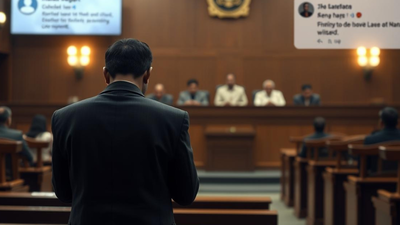
The Allahabad High Court discharged an advocate from criminal contempt after accepting his unconditional apology for remarks made in court (AI image)
In a significant ruling delivered on February 24, a division bench of Justices JJ Munir and Pramod Kumar Srivastava of the high court of Judicature at Allahabad disposed of a criminal contempt proceeding against an advocate, while issuing a broader caution about rising instances of contemptuous remarks against courts on social media.The Bench accepted the unconditional apology tendered by Advocate Hari Narayan Pandey and discharged the notice issued against him. At the same time, the court recorded strong observations on the growing trend of “virtual abuses” directed at courts under the guise of free expression, warning that such conduct may invite strict legal consequences if taken cognizance of in contempt jurisdiction.The judgment balances individual contrition with institutional concern, reiterating the limits of permissible criticism of the judiciary and reaffirming the scope of criminal contempt under the Contempt of Courts Act, 1971.
Background of the case
The proceedings arose from a reference dated January 29, 2025, made under Section 15 of the Contempt of Courts Act, 1971 by Mr Amit Mishra, then Civil Judge (Senior Division), Basti.The reference alleged that on January 22, 2025, while appearing in O.S. No. 679 of 2024 during arguments on a temporary injunction application, Advocate Hari Narayan Pandey used words in open court that amounted to criminal contempt. The high court noted that the words spoken “scandalize and lower the authority of the Court” within the meaning of Section 2(c)(i), and interfered with the due course of judicial proceedings under Section 2(c)(ii).
The matter was processed administratively, placed before the Chief Justice and the Administrative Judge, and ultimately registered as a criminal contempt case. On April 23, 2025, the Division Bench issued notice to the contemnor after finding a prima facie case.The court consciously chose not to reproduce the exact words used, stating that repeating them would amount to echoing disrespect shown to the judiciary.
Appellant's arguments
Though technically a reference proceeding rather than a conventional appeal, the contemnor’s defence was placed through affidavits and submissions.Advocate Pandey filed an affidavit dated July 8, 2025 tendering an “unconditional, sincere and heartfelt apology.” He stated:The incident was “unfortunate” and involved “some unwilling disrespect.”
- He had no intention to dishonour the court.
- His conduct was neither deliberate nor intended to show disrespect.
- He deeply regretted the incident and undertook not to repeat such conduct.
- He held the judiciary “in the highest esteem.”
When appearing in person before the Bench, he did not justify his conduct.
The court recorded that he stated he was “utterly distressed” on the day of the incident for personal reasons. The Bench also noted that he was a well-groomed member of the Bar with long years of practice and no prior record of contumacious conduct.In compliance with court directions, he appeared before the concerned judicial officer—by then posted at Raebareli—and tendered an unconditional apology there as well.
Response of respondents
The high court was represented by Special Counsel Mr. Sudhir Mehrotra. During the proceedings, he cautioned the Bench that the commission of criminal contempt “has become the order of the day.”The court recorded that this caution was “certainly not misplaced and had lots of wisdom to them.” While the Bench clarified that it was not taking judicial notice of social media trends, it said it was paying “judicial attention” to the growing instances of contemptuous expressions online.The concerned Civil Judge accepted the apology insofar as remarks made against him personally were concerned. However, he noted that disparaging words had also been spoken against the District Judge and the high court, and left it to the high court’s wisdom to decide whether the apology in that regard deserved acceptance.
High court's analysis
The Bench unequivocally held that the words spoken in court amounted to criminal contempt within the meaning of Section 2(c) of the 1971 Act. It found that the remarks:
- Scandalized and lowered the authority of the court.
- Were unrelated to the proceedings.
- Were a calculated attempt to browbeat the court into passing an order not dictated by judicial conscience.
- Interfered with the due course of judicial proceedings.
The court explained why it declined to reproduce the offending words: doing so would amplify disrespect and feed a public tendency to accept baseless insinuations against the judiciary.The Bench also made broader observations on contemporary public behaviour. It remarked that outlandish expressions against courts have become a “favourite pastime” and warned that such behaviour may usher in a lawless society if unchecked.However, after assessing the contemnor’s demeanour, early apology, lack of prior misconduct, and the Civil Judge’s acceptance of remorse, the court concluded that the apology was genuine and not merely a contrivance to escape consequences.
Legal significance
The judgment clarifies several aspects of criminal contempt jurisprudence:Words spoken in open court that attempt to browbeat a judge can constitute both scandalizing the court and interference with judicial proceedings.Courts may refrain from reproducing contemptuous remarks in their orders to avoid amplifying disrespect.An early, unconditional, and bona fide apology can weigh significantly in deciding whether to punish for contempt.The court distinguished between taking judicial notice and paying judicial attention to broader societal trends, signalling caution without formally expanding the scope of proceedings.The Bench also underscored the boundary between fair criticism and contempt, stating that “virtual abuses” on social media that go beyond fair comment or informed criticism may attract penalties if taken cognizance of.
The final order
After considering all materials, the Bench held: “So far as the present contempt matter is concerned, we accept the contemnor's apology and discharge the notice issued to him.”The matter was consigned to record.Thus, while the court found that criminal contempt had been committed, it refrained from imposing punishment in view of the unconditional apology and demonstrated remorse.
Key takeaways from the judgment
- Criminal contempt includes attempts to scandalize the court or interfere with judicial proceedings.
- Courts retain discretion to accept a genuine and unconditional apology.
- Institutional dignity remains central to contempt jurisdiction.
- Free speech does not extend to abusive or contumacious attacks on the judiciary.
- Social media conduct may fall within contempt jurisdiction if it crosses established limits.
Why this matters
The ruling is significant beyond the individual case. While showing judicial magnanimity toward a remorseful advocate, the court used the occasion to send a wider message about responsible speech concerning the judiciary.By warning that “words that are most unambiguously contumacious” circulating on social media may attract strict legal consequences if taken cognizance of, the Bench reaffirmed that contempt jurisdiction remains a live and potent tool to safeguard the administration of justice.At a time when digital platforms amplify commentary on court decisions, the judgment draws a clear line: informed criticism is permissible, but abuse and attempts to undermine judicial authority are not.Read full order here:








 English (US) ·