

 1 hour ago
8
1 hour ago
8
ARTICLE AD BOX
Long before public libraries became familiar fixtures in towns and cities, access to books was often limited by money, geography or social standing. For many people, reading remained a privilege rather than an everyday opportunity.
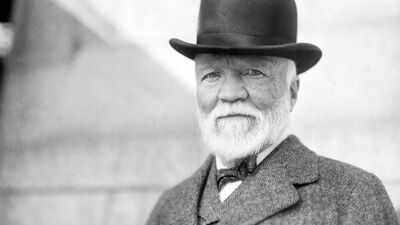
The growth of free libraries in the late nineteenth and early twentieth centuries changed that landscape, and few individuals had a greater influence on that transformation than Andrew Carnegie. The Scottish-born industrialist, who arrived in the United States as a child immigrant, devoted a large share of his fortune to expanding public access to knowledge.This began as a personal belief shaped by his own experiences and eventually developed into one of the largest philanthropic library programmes in history.
How Andrew Carnegie's library legacy started with access to books
The official Andrew Carnegie Foundation reveals that his formal education ended when he was 12 years old. In 1848, he and his family left Scotland and settled in Allegheny, Pennsylvania, now part of Pittsburgh. Like many immigrant families of the period, they arrived with limited resources and faced the realities of working-class life.During those early years, Carnegie gained access to a private collection of books owned by Colonel James Anderson, a retired businessman who allowed local workers to borrow reading material every Saturday.
Anderson's library contained around 400 volumes.“He only had about 400 volumes in his library, but they were valuable books, and I shall never forget the enjoyment and the instruction I gained from them when I was too poor to buy books myself,” Carnegie told the New York Times in 1899.Years later, Carnegie recalled deciding that if he ever possessed significant wealth, he would use part of it to help others gain access to books in the same way.
How Andrew Carnegie built thousands of libraries around the world
The first major step came in 1881 when Carnegie funded a library in Dunfermline, the Scottish town where he had been born. That gift marked the start of a programme that would eventually span several continents.Over time, Carnegie and later Carnegie Corporation of New York provided roughly $56 million for the construction of 2,509 public libraries worldwide. The scale of the undertaking was unprecedented. Of those buildings, 1,681 were established in the United States, as revealed by the Andrew Carnegie Foundation.The connection to Dunfermline carried personal significance. After supporting the town's library, Carnegie learned that his father had been one of three local weavers who had contributed books to Dunfermline's first free public library in 1808. He viewed this family connection with particular pride, describing it as a legacy he would not exchange for any other.
Andrew Carnegie's philosophy behind public library funding
Carnegie did not simply provide money and walk away. Communities seeking support had to agree to maintain and operate the libraries after construction was complete.This requirement reflected his broader philosophy of philanthropy. In his book The Gospel of Wealth, Carnegie argued that a free public library represented one of the most valuable gifts a community could receive, provided local authorities accepted responsibility for its long-term upkeep.The arrangement ensured that buildings would not become neglected monuments. Instead, they would function as lasting public institutions supported by the people they served.
The first American Carnegie libraries
Reportedly, in 1886, Carnegie offered Allegheny a gift of $250,000 to establish a free public library. City officials initially hesitated but eventually accepted the proposal. The library opened in 1890 and attracted national attention, including participation from President Benjamin Harrison during its dedication.Although Allegheny was the first community to receive a Carnegie library grant, the first Carnegie-funded library to open its doors was located in Braddock, Pennsylvania.
Situated near Carnegie's steel operations, the Braddock Carnegie Library welcomed visitors in 1889.As the programme expanded, more than $40 million was directed towards constructing library buildings in 1,412 American communities.Carnegie reveals, “The taste for reading is one of the most precious possessions of life”.
The $5.2 million gift that reshaped New York's libraries
At the beginning of the twentieth century, Carnegie made what was then one of the largest library donations in American history.
The official foundation reports, in 1901 he committed $5.2 million to the New York Public Library system, funding the construction of 65 branch libraries.The gift helped create the largest free public library network in the United States. Its impact extended beyond the buildings themselves. By spreading branches throughout neighbourhoods, the project brought books and educational resources closer to residents, including many newly arrived immigrants.Carnegie had argued for this approach years earlier. In 1895, while plans were being developed for a major central library in Manhattan, he publicly expressed concern that a grand building alone would not adequately serve the public. He believed branch libraries were essential if access was to reach ordinary people rather than a limited group of scholars and researchers.
Carnegie's evolving vision for public libraries
By 1917, Carnegie Corporation of New York had awarded its final grants for new library buildings.
The First World War created shortages of both materials and labour, making large construction projects increasingly difficult.The foundation's attention gradually shifted towards the quality of library services rather than the number of new structures being built.A survey commissioned in 1915 raised concerns that many Carnegie libraries were underperforming because they lacked professionally trained staff.
Alvin S. Johnson, the economist who prepared the study, argued that future investment should focus on librarian education and shared professional services such as cataloguing and book selection.That recommendation influenced the next phase of Carnegie's library legacy.
Carnegie helped build the future of the library profession
In 1926 Carnegie Corporation provided $2 million to endow the American Library Association. The grant formed part of a broader ten-year initiative worth $5 million that aimed to strengthen library services through professional development and education.The programme drew heavily from recommendations made in Charles C. Williamson's influential study Training for Library Service, published in 1923.Funding supported existing library schools and helped establish the University of Chicago Graduate Library School. Launched in 1926 with Carnegie grants totalling $1.385 million, the institution offered the first doctoral programme in library science in the United States.Universities and colleges also received support for expanding their collections, enabling them to acquire books and strengthen research resources.
Supporting Black history and cultural preservation
Another significant initiative emerged in 1926 when Carnegie Corporation funded the New York Public Library's acquisition of an extensive collection documenting Black life, history and culture.The archive had been assembled by Arturo Alfonso Schomburg, a bibliophile and collector who spent decades gathering rare manuscripts and books by Black authors.
The collection contained more than 10,000 items and became the foundation of what is now the Schomburg Center for Research in Black Culture.The institution has since expanded to more than 11 million items and serves as a major centre for research into the experiences and contributions of people of African descent. Among its holdings are the papers of James Baldwin and the long-lost chapter of The Autobiography of Malcolm X.
How Carnegie's library legacy continued into the modern era
Nearly a century after Carnegie's earliest library gifts, the foundation continued investing in the institutions that had grown from them.In 1999, marking one hundred years since Carnegie's major public library initiatives in the United States, Carnegie Corporation distributed $15 million in commemorative grants to 25 libraries. Awards ranged from $500,000 to $1 million and were used to improve collections and modernise services.Libraries in cities including Atlanta, Chicago, Detroit, Philadelphia, Kansas City and Los Angeles benefited from the programme, alongside several major library systems in New York.
Expanding support beyond North America
Carnegie's library influence also reached Africa. Beginning in 2004, Carnegie Corporation invested more than $10 million to strengthen public libraries in South Africa and improve university libraries in Uganda, Tanzania, Ghana and Nigeria.The funding contributed to the creation of model public libraries in Cape Town, Johannesburg, Pietermaritzburg and Pretoria. Government investment increased alongside the philanthropic support, while universities used the resources to modernise technology and improve access to information.These efforts continued a relationship that stretched back to 1911, when Carnegie first funded library construction projects in South Africa.
Recognising librarians and preserving global collections
The foundation's later work expanded into new areas. Reportedly, a grant of $489,000 in 2008 established the American Library Association's I Love My Librarian Award. Each year, ten librarians are recognised after being nominated by members of the public for their contributions to local communities.The following year, Carnegie Corporation provided $2 million to the Library of Congress to help create the World Digital Library.
Another $2 million followed three years later. The initiative brought together more than 160 libraries from 75 countries, making cultural and historical materials available online to audiences around the world.The project built upon decades of Carnegie support for the Library of Congress, including earlier funding that helped establish its fine arts chair and Africana unit.
Libraries in the digital age
In 2011, Carnegie Corporation awarded $5 million to New York City's three public library systems: the New York Public Library, Brooklyn Public Library and Queens Public Library.The funding supported literacy programmes, preservation efforts and children's library services. It also assisted the digitisation of more than 200,000 rare audio and visual items, ensuring that fragile historical materials could remain accessible for future generations.By this point, the foundation's role had evolved far beyond constructing buildings. The focus increasingly centred on access, technology and the preservation of knowledge in digital formats.
How Carnegie's commitment to libraries endures today
Carnegie Corporation reaffirmed its support for libraries in 2024. Under the leadership of Dame Louise Richardson, the foundation announced a $4 million grant for New York City's library systems to expand adult language learning, workforce development programmes, civic engagement initiatives and college-access services.Another $500,000 was directed to the Library of Congress to explore new ways of connecting the public with historical materials.
At the same time, a separate $5 million initiative was launched to help libraries serving under-resourced communities across the United States.The following year, nearly 1,350 Carnegie Libraries received gifts of $10,000 each as part of the Carnegie Libraries 250 initiative. The programme, valued at $20 million, was created to support civic institutions and commemorate the 250th anniversary of the Declaration of Independence.









 English (US) ·