

 1 hour ago
8
1 hour ago
8
ARTICLE AD BOX
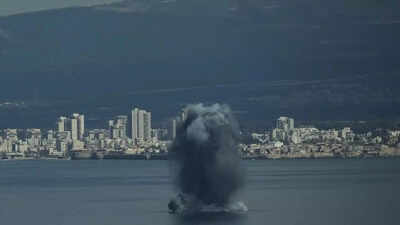
An explosion over Haifa Bay, northern Israel (AP photo)
Israel and the United States launched a joint preemptive military operation against Iran, deploying advanced air, naval and missile systems in strikes that triggered sweeping Iranian retaliation across the region.Israel’s Operation Roaring Lion and the US-led Operation Epic Fury targeted Iranian military and nuclear-linked sites in Tehran, Isfahan and Shiraz. US and Israeli forces used long-range cruise missiles, stealth aircraft, precision-guided munitions and armed drones in what marks a major escalation in US military involvement amid tensions over Tehran’s nuclear programme and internal unrest.Iran responded with missile and drone barrages toward Israel, followed by strikes on US military facilities in Bahrain, Kuwait and Qatar, signalling that the conflict has widened beyond the two principal adversaries.
Weapons used by Israel and the United StatesAmong the key systems deployed were Tomahawk cruise missiles, long-range, all-weather, subsonic weapons primarily used by the US Navy. Launched from warships and submarines, Tomahawks fly at extremely low altitudes of around 30 to 50 metres to evade radar and air defences. Measuring roughly 5.6 metres in length and weighing up to 1,600 kg, they cruise at about 880 kmph and can strike targets more than 1,600 km away depending on the variant.
Israel also fielded its F-35I “Adir” stealth fighters, a customised version of the F-35A Lightning II that is uniquely permitted to integrate indigenous software and hardware. The aircraft’s stealth design, sensor fusion and electronic warfare capabilities allow it to penetrate heavily defended airspace and conduct precision strikes.Supporting the operation were F-15I Ra’am strike fighters, developed to provide Israel with deep-strike capability after Iraqi Scud missile attacks during the 1991 Gulf War.
Introduced in 1998, the aircraft can carry heavy payloads of bombs and missiles over long distances.Israel also employed stand-off cruise missiles such as Delilah and Rampage, designed to strike targets from outside enemy air defence range. Delilah can loiter over a target area to confirm objectives before impact, while Rampage is optimised for hardened and time-sensitive targets.Precision-guided munitions featured prominently, including SPICE kits developed by Rafael Advanced Defence Systems.
These convert unguided bombs into autonomous weapons capable of operating in GPS-denied or jammed environments using electro-optical guidance and stored imagery. Joint Direct Attack Munition kits were also used to transform conventional bombs into all-weather smart munitions guided by GPS and inertial navigation systems.To target fortified sites, US and Israeli forces deployed GBU-28 bunker-buster bombs, 5,000-pound laser-guided penetrator weapons designed to destroy deeply buried command centres and hardened nuclear facilities.Long-endurance unmanned systems such as the Heron and Eitan drones were also utilised for surveillance, intelligence gathering and precision strike missions.Weapons fired by IranIran’s retaliation included the use of Shahab-3 medium-range ballistic missiles, liquid-fuelled, road-mobile systems derived from North Korea’s Nodong-1. The Shahab-3 was Iran’s first missile capable of striking all of Israel and remains central to its long-range deterrent.Tehran also fielded the Emad precision-guided ballistic missile, unveiled in 2015 and equipped with terminal guidance for improved accuracy over earlier variants.The Ghadr medium-range missile, an upgraded version of the Shahab-3, offers extended range, enhanced mobility and improved precision, enabling Iran to target much of the Middle East while complicating interception efforts.The attack had been widely anticipated after US President Donald Trump ordered the largest American military deployment to the Middle East in years. However, lawmakers have for days questioned why Trump has not addressed the US public or Congress to explain the need for war.







 English (US) ·