

 1 hour ago
6
1 hour ago
6
ARTICLE AD BOX
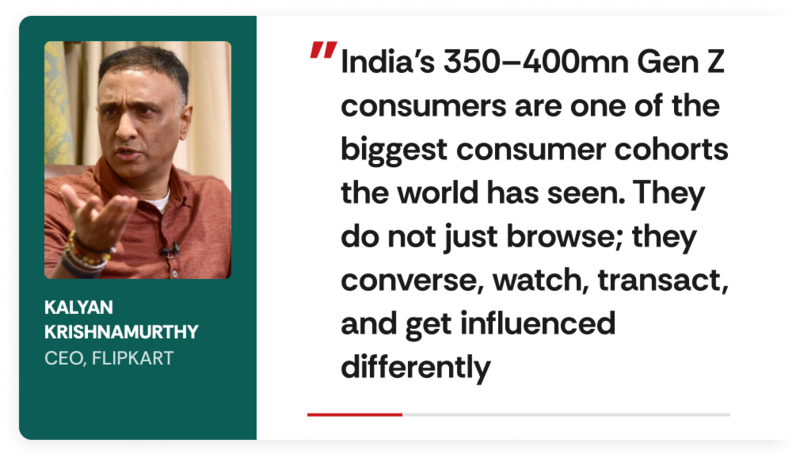
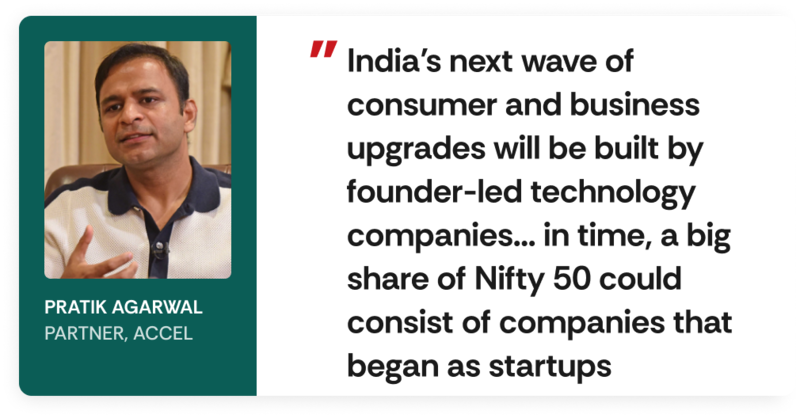
At a TOI roundtable in Bengaluru last week, CEO, founder and investors from Flipkart, Groww, Acko, Snabbit and Accel decoded what their platforms see first: trust shifting to apps, aspiration becoming affordable, and technology discovering markets hiding in plain sight. Edited excerpts from a two-hour, idea-packed discussion:The question at the heart of the discussion was simple: what does Indian demand look like when seen through the platforms millions now use every day? The answers went beyond shopping — to how Indians invest, insure, save, outsource work, build trust, take risks and adopt new habits.For Pratik Agarwal of Accel, the larger shift is that Indian consumer technology is no longer a collection of isolated founder success stories.Looking back, he said, Flipkart’s founding appeared like a singular moment: a company started by a handful of founders who willed a new market into existence. With the benefit of nearly two decades, however, that early activity now appears to be part of a larger secular transformation.India, he said, remains one of the world’s fastest-growing consumer economies, but also one of its most informal. Earlier generations saw lifestyle upgrades come either from large industrial groups or ingenious local entrepreneurs. That has changed. “What creates customer adoption now has a big element of digital experience in it,” he said. As AI becomes more capable, the ability of software to reshape industries will become even more expansive.His central thesis is sweeping: “Every marginal upgrade in customer lifestyle across different customer segments, and every incremental improvement in business productivity, will largely be driven by founder-driven tech companies.” The reason, he argued, is that technology evolves too quickly for incumbents to take advantage. They did not grow up with these technologies in the same way that startups have. As technology becomes a larger part of how products and services are delivered, founder-led companies gain a stronger right to win.He believes this shift will reshape India’s corporate landscape over the coming decades. In time, he said, a significant share of India’s Nifty 50 could consist of companies that began as startups.Kalyan Krishnamurthy of Flipkart broadly agreed. In many large global markets, he pointed out, a significant share of the top listed companies are tech or consumer-tech companies. India does not yet have that representation, but he sees it as a matter of time. More importantly, he said, the Indian consumer has changed in a way that is not always captured by headline economic data.In the last seven or eight years, he said, India has seen the rise of consumerism in the truest sense: the consumer becoming influential, almost to the point of dictating choices. Consumers are demanding a certain kind of selection, seeking more value, and refusing to pay for products that are overspecced or irrelevant to them. This shift did not happen on one particular day; it has been gradual, and it has been helped by the removal of information barriers.One force behind this is India’s Gen Z economy, which Kalyan described as a cohort of 350 million to 400 million people — among the largest consumer cohorts the world has seen. This generation, he said, consumes differently from the previous one. It does not interact with apps only through search and browsing. It watches. It converses. It is influenced differently. The way these hundreds of millions of consumers consume content, conduct transactions and form preferences is “completely different” from the previous 10 or 15 years.For Flipkart, that has meant constantly changing how the platform serves different categories and customer segments. Kalyan said he does not think of quick commerce as a separate category in the way the market often does. For him, commerce is a matrix of customer segments, geographies, income levels, and categories. A customer in a smaller city buying unbranded fashion may want selection and price. A customer buying consumables may want speed. A customer buying a television in a non-metro may need affordability and exchange.He gave the example of kurtis. The customer wants the assurance that the platform has an enormous selection — perhaps five lakh kurtis — but then wants to be shown the few hundred that are relevant to her. In appliances, the need is different. The Indian consumer is aspirational. “If they can immediately afford X, they want to aim for X-plus,” he said. That requires affordability constructs: the ability to pay 10%, 20%, or 30% upfront and finance the rest. The second value proposition is exchange. If a household buys a new television or refrigerator, it wants someone to pick up the old one and ideally give value for it. That, he said, is how that category sells.
Quick commerce, in his view, is just one such value proposition. Instant delivery will raise the country’s general expectation of speed. A shipment from Surat to Guwahati that once took three-and-a-half days may now be expected in two-and-a-half. But not every category can or should be forced into the quick-commerce model. Supply chains matter. A dark store in a prime urban location cannot carry hundreds of televisions. The next winners in consumer internet, he said, will be those with flexible supply chains, flexible tech stacks, and commercial teams that can move quickly. AI, he argued, may be most useful not merely in conversation or customer support, but in giving companies agility and speed to market.If Flipkart showed how ecommerce became mainstream, Groww’s story showed how investing moved beyond old assumptions about income, taxation and geography. Ishan Bansal said Groww exists because Indian investing was deeply underpenetrated. When Groww started, the active NSE investor base was around 50 lakh. Today, he said, it is roughly 5 crore. Groww did not merely take share from incumbents; it helped grow the market. He estimated that 1.3 crore investors came through Groww.A key reason was the phone. “If you have to cater to India as a whole, you should not build for desktop at all,” he said. In his telling, 95% of India does not have a desktop, but 80% has a phone. Desktop-led investing is effectively metro-led investing, or at best, white-collar-led investing. The phone opened up the market.Groww also learnt that tax filing and investing were not as linked as many assumed. A common argument in the early days was that India had only a few crore taxpayers, so the investment market must be small. But many Groww users have lower incomes and may not file or pay tax. That did not mean they could not invest. They might invest Rs 5,000 a month over years and build savings that give them financial confidence.The biggest surprise was geography. Ishan said more than 49% of Groww’s customers are beyond the top 100 cities. These users are not just making quick-commerce purchases or impulse buys; they are investing. In smaller towns, he said, users may actually have more time to learn through YouTube and other content than someone in Bengaluru commuting to office and back. Nor do they need to be in formal jobs. A kirana owner or a person sitting at a small shop counter can learn, download Groww, and begin investing.
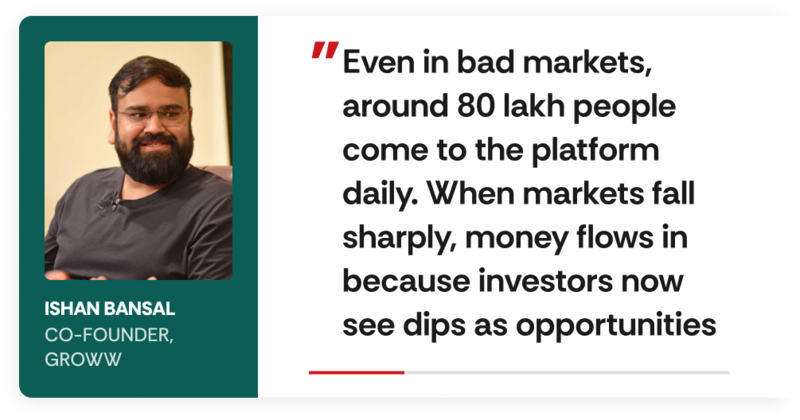
Risk appetite has also changed. Younger consumers, he said, have not seen the same hard times their parents did. That has made them more willing to take risk. Groww sees customers move across products. It began with mutual funds; stocks came later. Today, he said, more than 70–80% of customers do both. In a good market, stocks look attractive. In a bad market, mutual funds, bonds, gold, silver ETFs may draw attention. A portfolio, he said, is often not built by design from day one. It is the output of several decisions made at different points in time. If the customer keeps at it, that portfolio can create wealth over the long run.There are gender shifts too. Groww’s customer base, he said, was earlier roughly 90:10 male-female. It is now closer to 80:20. Women investors, he said, tend to take less risk, which can mean better retention. Apps also create privacy. The older habit of women saving money separately from the household can now happen on a platform instead of in cash. SIPs are another striking change. Groww has more than one crore active mutual fund customers, he said, and 60–70% are SIP investors.Market volatility has not necessarily scared this new investor away. In bad markets, he said, around 80 lakh people may still come to the platform daily, not dramatically lower than in good markets. When the market falls sharply, money flows in. ‘Buy the dip’ has worked for many investors over the past several years, building a belief, especially post-pandemic, that dips are opportunities. His sharper distinction was this: ordinary losses do not destroy trust in the market; scams do. In genuine market cycles, people may lose or gain money, but if they believe the system is transparent and their money is safe, trust compounds.
For Varun Dua of Acko, the new consumer is shaped by two deeper changes: exposure and conditioning. Earlier, exposure to the world was limited. Today, someone in a small village may be watching the same global content as someone in a metro. “Exposure arbitrage has completely collapsed,” he said. A generation that grew up after liberalisation also has different conditioning. It did not grow up queuing for milk or fearing scarcity in the same way. “Their conditioning is not to save. Their conditioning is to spend,” he said.This matters for every category, including insurance. Varun argued that once you bet on the internet, exposure and habit change, even complicated categories can move online. People now buy furniture, real estate, and insurance online. They may not trust a platform instantly, but they trust their own research. Barriers to information access have collapsed. A consumer can learn how to buy health insurance from YouTube, he said, sometimes better than from an agent.Acko began with motor insurance because it was mandatory, simple to understand, and had a lower cost of trial. Insurance is a trust category: the customer must believe the insurer will pay when something goes wrong. Competing with established names was not easy. But trust built over time as customers saw claims settled, neighbours getting paid, and processes moving faster. That trust then allowed Acko to move from car insurance into health, life, and other products.Acko looks at the household rather than the individual as its unit. The “belly” of the Indian market, Varun said, is one car in a household. Assets are household assets. Health insurance is a family decision. Life insurance is about family liability. The platform also sees life moments: a family grows, buys assets, has children, or sees a parent fall ill and realises it needs protection.One of Acko’s more surprising adjacencies is cars. Since it owns the car insurance relationship over several years, it can often infer when a customer is likely to upgrade. Lower-value insurance purchases, usage patterns, and vehicle age can signal that moment. That led to AckoDrive, where customers can buy cars online. Varun said Acko now sells roughly 1,000 cars online a month, with customers paying booking amounts as high as Rs 50,000 and, in some cases, buying without a test drive. The customer has often already done the research on YouTube, driven a friend’s car, compared features, and made up his mind about what he wants.
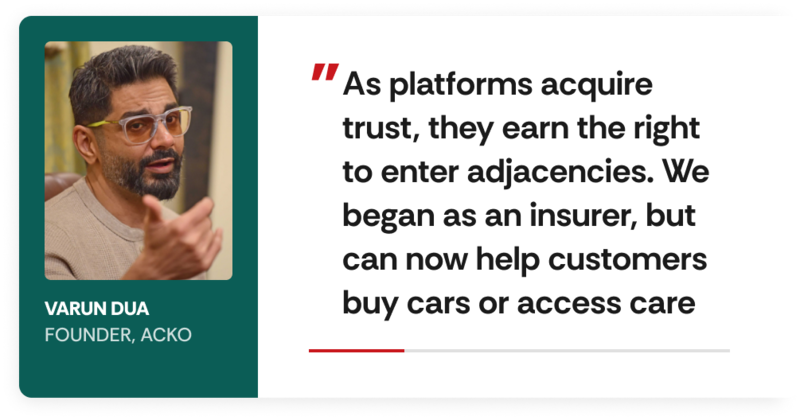
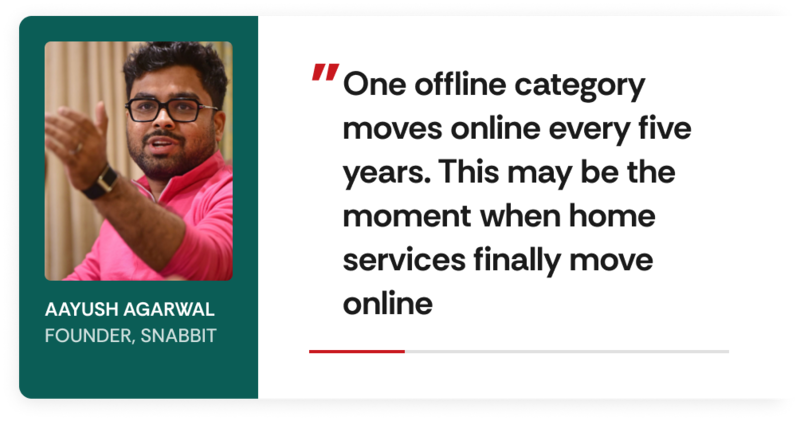
For Varun, this proves a larger point: as platforms acquire trust, they earn the right to enter adjacencies. Their identity is not locked into the category they started with. Acko may have begun as an insurer, but if the customer trusts the platform, it can help with car purchases or primary care. India, however, cannot be treated as one market. “India is twenty countries, twenty income cohorts,” he said. Some consumers do not want to be called; others see a call as a sign that the company values them. A blanket rule fails.He was especially blunt on life insurance. Traditional savings-linked life insurance products, he argued, have often been poor for consumers. Pure life insurance, in his view, should mean one thing: if you die, your family gets money. Term insurance is the right product for that need, but physical distributors have little incentive to sell low-commission products. That is why, he said, around 40% of term life insurance in India is sold online. Similarly, after the insurance sold at the time of purchase, much of bike insurance renewal is digital because the ticket size is too small for a traditional agent. Right financial products, he argued, will penetrate through consumer internet platforms because no other channel can manage the cost.Aayush Agarwal of Snabbit brought the newest category to the table: household help on demand. He called it “India’s last large offline habit to go online.” His argument was that Indians spend discretionary income across six large categories, and five have been digitised over the past 25 years: travel and entertainment, commerce, mobility, food delivery and grocery. These categories now have significant digital penetration among the top consuming Indians. Services, however, remain barely digitised.This is striking because India spends heavily on services. “We seek help in everything,” he said. Yet only 2–3% of this market is digitised. His thesis is that one offline category moves online roughly every five years, and household services may now be at that point.Indian consumption, he said, is very different from the West. The West stocks up. India prefers high frequency and low average order value. Grocery was once a kirana habit and is now also a quick-commerce habit. Mobility works because it is frequent and low-ticket. Household services, in his view, have similar traits.The trust shift is equally important. Earlier, household help was passed down through generations and embedded in relationships. Today, many consumers are moving toward convenience and on-demand choices. A question Aayush often gets is: how are customers okay with the same person not turning up every time? His answer: they would rather control their time. They do not want to hire, supervise, and manage end-to-end. They are willing to make bite-sized purchases whenever they need them and trust a platform to deliver.Snabbit’s data showed something more surprising: the reason many households had daily help was not because they needed daily help, but because that was the only available model. Some households were happy to get cleaning once or twice a week, but no such solution existed. Snabbit thought it was 50% more expensive than offline help because it charged, say, Rs 150 an hour against Rs 100 offline. But consumers saw the math differently. Instead of paying Rs 100 a day, or Rs 3,000 a month, they might pay Rs 150 twice a week — around Rs 1,200 a month. For them, it was cheaper.
There are two types of users. A primary consumer defaults to the app for everyday needs. A secondary consumer uses it as a reliable backup when the existing system fails. Families without children are more likely to become primary users because they prefer flexibility. Families with children often need predictability and use the platform when their regular help is absent.The anecdotes reveal how elastic the category is. In posh societies, Aayush said, sometimes it is not the household but the existing help who books Snabbit to supplement her day’s work — “the help needs help.” In low-income settlements, a family that never had paid help may use Snabbit once or twice a month when the woman of the house is unwell. Digitising supply, therefore, expands both ends of the market.The supply side may be even more important. Snabbit has 25,000 experts, he said, half of whom received a formal income for the first time through the platform. Many have linked Aadhaar and PAN, opened bank accounts, taken insurance for their families, and asked for savings products. They are not only service providers; they are also consumers of the same digital economy — shopping on ecommerce platforms, taking rides, buying insurance and wanting to save for children’s education.Aayush argued that this model also addresses women’s work in a way conventional employment often cannot. In many households, the secondary breadwinner, usually the woman, must manage domestic contingencies. If a child is unwell, in-laws visit, or water comes at a fixed hour, she stays back. A rigid five- or six-day job does not work. What she needs is flexibility in hours, days, and work pattern. A mother can send her child to school, work four hours, return before the child comes back, work around 20 days a month, and earn Rs 8,000–9,000. Depending on the household, this can augment family income by 30–100%.He pushed back against the idea that this is a supply-constrained business. The supply exists, he said, but it is invisible from middle-class homes. “Go and stand where they live and hold a placard; 20 people will run to you and ask for a job.” The challenge is access, training, mobility, and trust. Snabbit’s average expert works 21 days, not 26 or 27, and earns 1.5–2 times what she would have earned for the same number of hours if she wasn’t on the platform. The platform is also building “Snabbit Seva” spots by tying up with neighbourhood establishments — PGs, shops, restaurants — where experts can use washrooms and rest. It already has 500 such spots and aims to reach 1,000 shortly. In dense markets, an expert may travel only around 250 metres between jobs.So, the new consumer is...The conversation, taken together, suggested that consumer internet is no longer just a distribution story. It is a discovery engine. It discovers investors beyond the top 100 cities, households that do not want daily help, women who want flexible paid work, car owners about to upgrade, and customers who want selection without being overwhelmed by it. It also aggregates scattered demand and scattered supply into usable markets.The deeper message was that India’s consumer is becoming more informed, more impatient, more experimental and more demanding. But this is not simply a story of affluence. It is also a story of value, trust, flexibility, and relevance. The new Indian consumer wants more choice, but only the right choice. More speed, but only where speed matters. More aspiration, but within a budget. More control, but without the burden of managing everything alone.







 English (US) ·