

 1 hour ago
6
1 hour ago
6
ARTICLE AD BOX
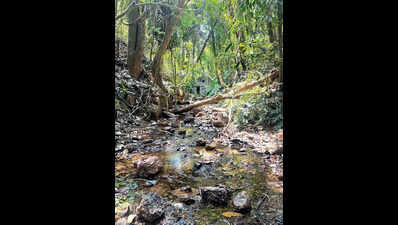
Panaji: An unauthorised hill-cutting in a deep valley on Old Goa-Bainguinim border has drawn attention to the vulnerable status of a historic spring eulogised by foreign travellers in the 17th century.
Development nearby poses threats to the once-popular fount and local ecology.The built heritage of Old Goa, as a former capital city, has been already impounded by unregulated growth. In its outlying green buffer zones, sites with old ruins and hydrological heritage spots like Bainguinim are also in danger.The spring, Fonte de Santo Antoino, praised by French traveller, François Pyrard de Laval as “a great fountain of pure and limpid water called Banguenim” once supplied water to Old Goa city.
Slaves carrying the water in pots sold it in the city, less than 1-km away. A pot sold at five bazarucos - the currency of the time.Nestling in a north-south valley, up the slope from the Old Goa-Ribandar road towards Kadamba plateau, the fount now lies in a state of degradation.Old Goa residents once walked along the shady promenade on the valley’s western side to the spring or enjoyed bathing in its cool waters.Earlier, people even visited it at night “armed with weapons, and dressed only in their shirts and pantaloons”, as Pyrard wrote.
Heritage lovers and others are worried over existential threats to the spring due to development in its catchment areas.In this recent case, the Old Goa panchayat found after an inspection that a project promoter had illegally built a 105-m retaining wall below an excavated north-eastern slope of the spring.“This project is proposed lower down on an already built-up slope. There is a possibility of landslides in the catchment area of the spring and its valley,” Glean Cabral, a local activist and the complainant said.A visit to the spring along the old promenade from Ribandar road showed that the path has been blocked by a stone wall about 100m short of the fountain. Thick overgrowth also hampers access to the spring and visitors reach it from the southern side — the Kadamba plateau.A mid-stretch of the stream from the spring that flows to Mandovi, barely one km away, was also found to be choked by huge quantities of mud. The same project promoter had pushed the mud into the stream after levelling the eastern slope, sources said.Not far away, a western slope near the spring identified as a private forest has also been dug up.“During very heavy rains a few years ago, flood water from the stream had entered residential areas near the road,” a villager said. Run offs from slopes during monsoon are likely to carry sediment to the already silted river.Multi-dwelling units on slopes are a serious pollution threat under the present sewage system, comprising septic tanks, which is adequate only for single-dwelling units.“Overflow of sewage from such septic tanks can spill and seep into the lateritic strata leading eventually into groundwater feeding the spring,” Hector Fernandes, a geologist said.Heritage lovers said the spring as a historic site and a hydrological heritage asset can add to Old Goa’s tourism profile. “It is a quiet place with lots of birds that can be developed with minimal investment for locals and tourists,” Abhinav Apte, a waste management expert said.The spring pours like a waterfall during monsoon and has clean water till October, Apte who organized a clean-up drive at the spring through community efforts in Oct 2021 stated.Watershed areas of springs like Bainguinim need urgent ground truthing and mapping at a higher resolution. The maps should then be reflected in statutory planning maps to protect slopes, architect Fernando Velho, professor at CEPT University said.“People have taken ownership of the wetlands as could be seen recently in Chimbel. But springs are far more fragile than lakes and wetlands,” Velho stated.Velho with architects Oriana Fernandez, Aisha Kalangutkar, Visvesh Kandolkar and others had studied the Old Goa scenario a few years ago.“The large movement of earth for mega infrastructure development and housing has changed Old Goa’s watershed and hydrology and led to a larger volume of water flowing down into the core area,” their report stated.Water resources department had initiated some area-specific remedial measures but the larger threat remains, sources said.









 English (US) ·