

 1 week ago
10
1 week ago
10
ARTICLE AD BOX
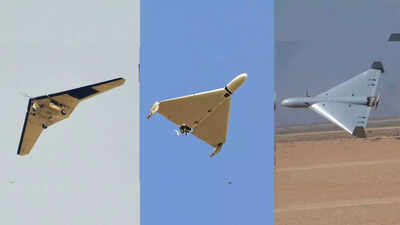
On a quiet December day in 2011, a secret American surveillance mission ended in a way few in Washington expected. Instead of returning to its base in Afghanistan, a highly classified drone landed deep inside Iranian territory.The aircraft was widely believed to be the RQ-170 Sentinel, one of the United States’ most advanced stealth surveillance drones. Known informally within military circles as the “Beast of Kandahar,” the aircraft had been used in some of the most sensitive intelligence operations of the post-9/11 era.Its unexpected capture by Iran triggered one of the most unusual technological feedback loops in modern military history.
Iran claimed to have reverse-engineered the drone and built its own versions. Over the following decade, those Iranian designs evolved into widely deployed systems. Eventually, the United States itself began adopting similar low-cost drone concepts.What began as the loss of a single aircraft became a turning point in the global evolution of drone warfare.
The stealth drone behind America’s secret missions
The RQ-170 Sentinel was developed by Lockheed Martin’s Skunk Works, the same division responsible for the U-2 spy plane and the F-117 stealth fighter.
Introduced around 2007, the aircraft was designed primarily for stealth reconnaissance missions in heavily defended airspace.Unlike traditional drones with fuselages and tail structures, the Sentinel used a flying-wing design similar to the B-2 stealth bomber. This configuration reduced radar reflections and allowed the aircraft to operate over hostile territory with a lower chance of detection.Key capabilities believed to be part of the RQ-170 included:
- High-resolution optical and infrared surveillance sensors
- Signals intelligence equipment capable of intercepting communications
- Satellite-based command and control links
- Radar-evading coatings and stealth shaping
The drone was operated by the US Air Force for the CIA, and most of its missions were classified.One of its most notable roles was reportedly in the intelligence operation that led to the 2011 raid on Osama bin Laden in Abbottabad, Pakistan. RQ-170 drones conducted surveillance flights over the compound in the months before the operation, gathering imagery used by American planners.Because of these missions, the aircraft represented one of the most sensitive surveillance platforms in the US arsenal.
The 2011 incident: A stealth drone lands in Iran
On December 4, 2011, Iran announced that its armed forces had captured an American stealth drone inside its territory.
According to Iranian officials, the aircraft had entered Iranian airspace before being intercepted near Kashmar, roughly 225 kilometres from the Afghan border.Iranian media soon released photographs showing a relatively intact flying-wing drone displayed in a hangar.Tehran claimed its electronic warfare units had taken control of the drone’s navigation systems, forcing it to land safely. Iranian officials said they had manipulated the aircraft’s GPS signals and guided it to the ground.The United States confirmed that it had lost an unmanned aircraft near the Iranian border, but disputed Iran’s explanation. American officials suggested the drone likely suffered a technical malfunction, possibly losing communication with its operators.Pentagon officials said there was no evidence of hostile fire, and suggested that equipment failure could have caused the drone to drift off course.Regardless of the cause, the result was extraordinary. One of America’s most advanced stealth drones had fallen largely intact into the hands of a geopolitical rival.
Why the captured drone mattered
The potential intelligence value of the captured aircraft was enormous.If Iranian engineers were able to analyse the drone’s structure and electronics, they could gain insights into several key technologies:
- Stealth design principles
- Radar-absorbing materials
- Surveillance sensor systems
- Satellite communication architecture
- Flight control software
Such information could help adversaries learn how to detect or counter stealth aircraft, including not only drones but also advanced fighters like the F-35.Washington was concerned enough that then-US President Barack Obama publicly asked Iran to return the aircraft.
Tehran refused.Iran instead displayed the drone on state television and said it would study the technology and reproduce its design domestically.
Iran’s reverse-engineering effort
In the years following the incident, Iran announced the development of several drones that closely resembled the RQ-170.Among them were:Shahed-171 SimorghA large flying-wing drone designed for reconnaissance and potentially strike missions. The aircraft’s shape and configuration strongly resemble the Sentinel.Saegheh UAVA smaller flying-wing drone believed to be derived from the same reverse-engineering effort. Iranian officials claim it can carry four precision-guided bombs.Iran’s Revolutionary Guards said their engineers had extracted significant technical information from the captured drone.While outside analysts debate how much of the Sentinel’s technology Iran successfully replicated, there is little doubt that the incident accelerated Tehran’s drone programme.Iran had already been developing unmanned systems since the Iran-Iraq War of the 1980s, but the captured Sentinel provided valuable insights into modern stealth drone design.
The expansion of Iran’s drone arsenal
By the 2010s, Iran had developed one of the most diverse drone fleets in the Middle East.Key systems include:Shahed-129A medium-altitude long-endurance drone comparable to the American MQ-1 Predator. It can carry guided munitions and conduct long-range surveillance missions.Mohajer series dronesUsed for reconnaissance and tactical strike roles.Shahed-136 loitering munitionA triangular drone designed to crash into targets carrying an explosive warhead.The Shahed-136 in particular became widely known after being used in conflicts across the Middle East and later in the Russia-Ukraine war.Unlike large surveillance drones, the Shahed-136 is cheap, simple and mass-produced.
Estimates suggest each unit may cost tens of thousands of dollars, far less than advanced American drones.This shift toward low-cost expendable drones has reshaped modern warfare.Instead of relying only on expensive aircraft, militaries increasingly deploy swarms of cheap unmanned systems capable of overwhelming air defences.
The unexpected twist: The US copies the concept
In a striking twist, the technological imitation eventually moved in the opposite direction.The United States began developing low-cost loitering attack drones inspired by systems like the Shahed-136.One example is the Low-cost Uncrewed Combat Attack System (LUCAS) developed by the American company SpektreWorks.The drone shares several features with Iranian loitering munitions:
- Triangular flying-wing design
- Small size and low radar signature
- Catapult or rocket-assisted launch
- One-way attack capability
Unlike expensive surveillance drones, LUCAS is designed to be cheap and expendable, with an estimated cost of around $35,000 per unit.US Central Command officials have described such systems as “indispensable” in modern conflict environments where low-cost drones are increasingly dominant.The irony is striking. A technological cycle that began with a lost American stealth drone has now resulted in the United States adopting concepts similar to those developed by Iran.
How one drone reshaped the drone arms race
The 2011 RQ-170 incident triggered a chain reaction that continues to influence military technology today.
- The United States developed advanced stealth drones for high-risk surveillance missions.
- Iran captured one of these drones, gaining access to valuable technology.
- Iran reverse-engineered aspects of the design, strengthening its domestic drone programme.
- Iran developed low-cost drones that spread across regional conflicts.
- The United States began adopting similar low-cost drone concepts for modern warfare.
The episode illustrates how military innovation rarely moves in a straight line. Technology spreads, evolves and often returns in unexpected forms.Today, drones have become one of the defining weapons of modern conflict, used not only by major powers but also by smaller states and non-state groups.And in many ways, that transformation can be traced back to a single stealth aircraft that never made it home from a mission over Afghanistan.









 English (US) ·