

 5 days ago
7
5 days ago
7
ARTICLE AD BOX
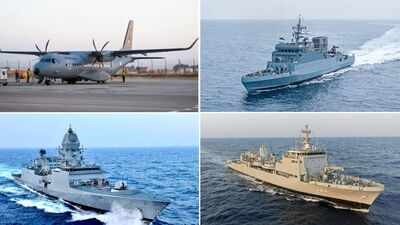
File photo: India's first made-in-India C-295 military transport aircraft and the indigenous naval platforms INS Dunagiri, INS Sanshodhak and INS Agray. The platforms reflect India's expanding defence manufacturing capabilities under the Atmanirbhar Bharat initiative
NEW DELHI: Prime Minister Narendra Modi on Sunday used his Mann Ki Baat address to highlight a series of indigenous defence milestones, saying India's achievements in June reflected the country's growing security capabilities and its march towards self-reliance.From the maiden flight of the first India-made C-295 military transport aircraft to the induction of three indigenously built naval platforms and the successful test of a new long-range cruise missile, the Prime Minister said the developments showcased the growing strength of India's defence manufacturing ecosystem under the Atmanirbhar Bharat initiative."Half of the year 2026 is drawing to a close. Over these six months, we have discussed numerous achievements of our countrymen in Mann Ki Baat.
In June as well, the nation has attained certain achievements that fill every citizen with pride. These successes are linked to the country's security and self-reliance," Modi said.
C-295 becomes a milestone for Indian aerospace
Among the achievements highlighted by the Prime Minister was the maiden flight of the first C-295 military transport aircraft assembled in India by Tata Advanced Systems in partnership with Airbus."The C-295 aircraft is 'Made in India'; C-295 aircraft has completed its maiden flight and 40 such aircrafts are being manufactured right here in India.
This is providing new momentum to the MSME and aerospace sectors, raising employment opportunities, and strengthening the resolve for an Atmanirbhar Bharat," Modi said.The C-295 programme represents one of India's biggest aerospace manufacturing projects. Under the Rs 21,935 crore agreement signed with Airbus in 2021, 16 aircraft are being delivered from Spain in fly-away condition, while the remaining 40 will be assembled at the Vadodara facility inaugurated by Modi and Spanish Prime Minister Pedro Sánchez in October 2024.Beyond replacing the Indian Air Force's ageing Avro-748 fleet, the programme has created an extensive domestic industrial ecosystem. Around 13,400 parts and 4,600 sub-assemblies are now being sourced from Indian suppliers, while more than 96% of the work previously undertaken in Spain is gradually shifting to India.The aircraft is designed for troop transport, logistics missions, medical evacuation and special operations.
It can carry up to 70 soldiers, 48 paratroopers or 24 stretchers and operate from short and semi-prepared airstrips, making it particularly suitable for India's mountainous and remote regions.The programme has already expanded beyond the original order. The government has approved the procurement of an additional 15 C-295 aircraft, including nine for the Indian Navy under the Medium-Range Maritime Reconnaissance Aircraft programme and six for the Indian Coast Guard under the Multi-Mission Maritime Aircraft programme.
Three indigenous naval platforms strengthen maritime capability
PM Modi also referred to the induction of INS Dunagiri, INS Sanshodhak and INS Agray into the Indian Navy earlier this month."Recently, I had the opportunity to attend a Navy-related event in Kolkata. There, INS Dunagiri, INS Sanshodhak, & INS Agray were inducted into the Indian Navy's fleet. Everything from the design to the manufacturing of these ships is indigenous," he said.Although commissioned together, the three vessels perform different but complementary missions.INS Sanshodhak, a Survey Vessel (Large), maps the seabed and collects hydrographic data that supports submarine operations, navigation and maritime domain awareness.INS Agray, an Anti-Submarine Warfare Shallow Water Craft, has been designed to detect, track and neutralise hostile submarines operating close to India's coastline and strategic sea lanes using advanced sonar systems and underwater sensors.INS Dunagiri, a Project 17A stealth guided missile frigate, forms the combat layer of the network. Equipped with advanced sensors, air defence systems, anti-ship missiles, torpedoes and helicopter facilities, it is capable of engaging threats across the surface, underwater and aerial domains.Together, the three platforms represent the Navy's shift towards integrated, network-centric maritime operations where surveillance, underwater awareness and combat capability work as a single system rather than as isolated platforms.
Indigenous missile adds another layer
The Prime Minister also highlighted the successful test of the Long Range Land Attack Cruise Missile (LRLACM), developed jointly by DRDO laboratories and Indian industry."This month, the DRDO also successfully tested an indigenous 'Long-Range Land-Attack Cruise Missile'. It was developed jointly by DRDO laboratories and Indian industry partners; in other words, from the seas to the skies, our India is becoming increasingly secure and self-reliant," Modi said.The missile was successfully flight-tested from Dr APJ Abdul Kalam Island off the Odisha coast on June 15. According to DRDO, all mission objectives were achieved during the trial.
A broader Atmanirbhar push
Taken together, the C-295 programme, the induction of the three naval platforms and the successful cruise missile test underline India's broader effort to build indigenous defence capability across air, land and maritime domains.While the C-295 is helping create India's first private-sector military aircraft manufacturing ecosystem, the three Navy platforms demonstrate the country's growing ability to design and build specialised warships domestically. Combined with indigenous missile development, the projects reflect New Delhi's long-term objective of reducing dependence on foreign suppliers while expanding India's defence industrial base under the Atmanirbhar Bharat vision.









 English (US) ·