

 1 day ago
5
1 day ago
5
ARTICLE AD BOX
Why the most extreme routine on Earth is quietly becoming a lifestyle trend
The internet loves extremes that feel credible. Astronauts aren’t influencers though, they are proof. Proof of human beings being capable of pushing their mind and body to such extremes that they would literally defy gravity.
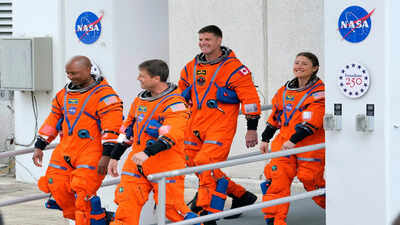
It’s their job. And it’s a very hard job to do. So for the past year, when we heard—Reid Wiseman, 50, Victor Glover 49, Christina Hammock Koch, 47 and Jeremy Hansen, 50—the four astronauts talking about their routine training that would take them to the far side of the Moon, it was mostly awe and wonder. It was around this time that influencers around the world started breaking down “NASA morning routines”, fitness creators began copying astronaut-style strength and discipline systems for their clientele, and wellness experts talked about framing astronauts as the ultimate optimisers of time, sleep, and focus. Their routines got positioned as the gold standard that you should try, even if in a diluted, lifestyle-friendly way. There’s a new kind of morning routine doing the rounds online these days. It doesn’t involve lemon water, journaling, or a 10-step skincare ritual. It starts with waking up at the exact same time every day without a snooze button. No smartphones allowed. Within minutes, your body is moving—mobility drills, strength work… something deliberate, something hard.
Something to aspire for. Meals are planned, not improvised. Screens are limited. Sleep is non-negotiable. If this sounds less like wellness and more like mission control, well, that’s the point.
Can you take the astronaut routine challenge?
It does not involve the glamour of space travel, but has the discipline that makes it possible. In a culture saturated with soft self-care, anxiety-ridden bodies and minds, and constant distractions, “the astronaut routine” is becoming a huge hit among people because the training is rigorously structured and almost clinical.
Something that we sorely lack in our lives. It is catching on because our bodies, at this moment in time, are not attuned to nature, neither gets the minimum care, as we move from crisis to crisis in our daily lives looking to find some strength at the end of an unending long tunnel.
It’s as if after the pandemic, we have been moving and doing things and getting along with life, but the sense of a particular direction, a worthy purpose are all gone now.
The ultimate biohack isn’t actually a hack
Astronauts train for years before they ever leave Earth. There is no “listening to your body” in space. There is only preparation. Their routines are engineered to within an inch of precision: sleep cycles calibrated, nutrition measured, workouts designed to counteract the effects of microgravity. Every habit serves a purpose. That’s the attraction for people. For years, the wellness industry has sold us optimisation in digestible pieces—better sleep, cleaner eating, mindful mornings.
Astronaut life takes all of that and removes the choice. It’s the opposite of the modern wellness paradox—endless options, minimal consistency. Which is perhaps why it feels so appealing. In a world where routines are aspirational but rarely sustained, the astronaut lifestyle offers something radical: discipline without negotiation.

Astronauts spend hours every day exercising, not to feel good but for preservation, for survival under extreme conditions in space. Strength, here, is not a goal. It’s a necessity.
Sleep is not self-care. It’s survival.
If there is one pillar of astronaut training that translates most directly to everyday life, it’s sleep.
Astronauts don’t treat sleep as a reward for a productive day. It’s a prerequisite. Their schedules are built around it, not squeezed in after everything else. Light exposure, screen time, even emotional stress are managed to protect it. On Earth, we’ve done the opposite. We treat sleep as flexible—something to cut back on when work piles up, or social life demands it.
The result is a population that is permanently tired, overstimulated, and under-recovered.
The astronaut model flips that hierarchy.
Training for a body that doesn’t give up
Perhaps, this is the most important appeal in our times. It’s tiring, how hard life has become. At home, at work, even on vacations and casual gatherings, there’s this lingering feeling that all is not okay. That a little nudge from someone and either we will burst out in tears or lash out in anger. None of us seem to understand how to fix this feeling. Well, astronauts have no choice.
In space, the human body begins to deteriorate almost immediately. Muscle mass drops. Bone density decreases. Strength fades. The only solution is relentless training.
They spend hours every day exercising, not to feel good but for preservation, for survival under extreme conditions in space. Strength, here, is not a goal. It’s a necessity.Back on Earth, we’re only just catching up to this idea. The shift from cardio-heavy, weight-loss-focused routines to strength and functional training mirrors, in a diluted way, what astronauts have always known: a strong body is a resilient one.
You don’t need to simulate zero gravity to adopt that mindset. It shows up in small ways, like prioritising strength over calorie burn, training for endurance, not exhaustion and seeing fitness as maintenance, not punishment.
.
Isolation training in the Age of Burnout
Perhaps the most unexpected overlap between astronaut training and modern life lies in something less visible: psychological endurance. Oh, boys and girls, don’t we all need buckets and buckets of it if we could drink Psychological endurance from a bottle? Astronauts are trained to handle isolation.
A long mission means confined spaces, limited human interaction, and seeing the same faces, day after day. There is no escape, no quick change of scenery, no stepping out for a break.
To prepare for this, astronauts undergo simulations: controlled environments where they learn to manage stress, monotony, and interpersonal friction. It sounds extreme. Until you consider urban life. All of us are experiencing a diluted version of the same thing. Long work hours, digital fatigue, shrinking social bandwidth. Constant connectivity paired with emotional isolation. We are always “on,” yet often alone. The difference is, astronauts train for it. They build mental routines. They practise emotional regulation. They develop coping mechanisms for boredom and stress. There’s a lesson there. What if we treated mental resilience as something to train, not something to fix?

All of us are experiencing a diluted version of the same thing. Long work hours, digital fatigue, shrinking social bandwidth. Constant connectivity paired with emotional isolation. We are always “on,” yet often alone. The difference is, astronauts train for it. They build mental routines. They practise emotional regulation. They develop coping mechanisms for boredom and stress.
The Rise of the “Astronaut Routine” Online
It was perhaps inevitable that social media would get involved. Search for “astronaut routine” or “NASA morning habits,” and you’ll find a growing ecosystem of content—YouTubers attempting astronaut-style days, productivity influencers borrowing elements of their schedules, fitness creators breaking down their workouts. The appeal is obvious. Unlike the endless churn of wellness trends, this feels grounded in something real.
These routines aren’t designed to sell products. They exist because they have to.But as with all internet trends, there’s a risk of oversimplification. Astronaut life is not aesthetic. It’s not designed to be copied wholesale. It’s extreme by necessity, not by choice. The danger lies in turning it into yet another checklist without understanding the underlying principle: consistency over intensity.As NASA prepares to send humans around the Moon again with Artemis II, the fascination with astronaut life will only grow.
There will be more content, more breakdowns, more attempts to translate space habits into Earth routines. Some of it will be gimmicky. Some of it will be useful. But beneath the trend is a more enduring idea. Astronauts don’t rely on motivation. They rely on systems. And in a world where motivation is fleeting, that might be the most valuable lesson of all.
Astronaut Glover, from Artemis II, put it best when he said in a NASA interview: “Pushing ourselves to explore is core to who we are. It is part of being human.” Perhaps, the astronaut-level fitness and wellness regimen is just about that. To re-learn how to be human.








 English (US) ·