

 1 hour ago
7
1 hour ago
7
ARTICLE AD BOX
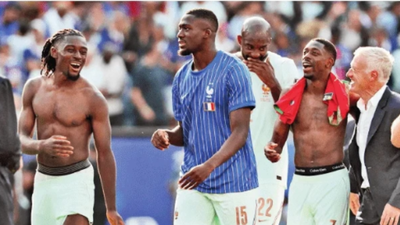
Didier Deschamps' France Story (Image: AFP)
Les champions du monde des matchs amicaux .” The world champions of friendlies.Not long ago, France were often looked down upon with such playful and backhanded insults. Curiously invigorating and iridescent in style but their football never looked fully in command of their gifts.Le Carre Magique, the ‘Magic Square’ of Luis Fernandez, Jean Tigana, Alain Giresse and Michel Platini had waltzed into our consciousness like a theatre in midfield creativity in the 1980s. Yet, despite reaching the World Cup semifinals in 1982 and 1986 in between winning Euro 1984, its abundantly fertile and powerfully ingenious sensation was felt so briefly that it didn’t seem pulsating enough on the game’s biggest stage.As the 1990s ushered us into the unprecedentedly evolving political and social times with the collapse of the Soviet Union, German reunification and the end of Apartheid, French football oddly became trapped in stagnation, fading from the limelight after failing to qualify for the 1990 and 1994 World Cups.The prelude to Didier Deschamps’s arrival on Les Bleus stage ahead of the 1998 World Cup couldn’t have become more dramatic with all its contradictions, from a haunting past hanging overhead to guiding an engine of change coinciding with the emerging dot-com boom.
When Aime Jacquet gave the then Juventus defender the captain’s armband following suspension of its original holder Nicolas Anelka ahead of the Euro 1996, the French manager affectionately called his new on-field lieutenant ‘ trois pommes ’ or ‘three apples’ given the player’s short stature.A disgruntled Anelka on his return to the team described the new captain ‘ le porteur d’eau ’ — a water carrier, alluding that his role was limited to winning the ball and passing it to more creative players.
Far beyond the spectrum of flop sweat and false bravado, the seed of a promise which the JacquesDeschamps partnership had sowed before going down to England via sudden death in Euro 1996 bloomed with a moving tale of redemption as well as a significant leap into France’s evolving landscape in what is now commonly called as the ‘Zidane effect.
’ Before the opening match, Jacques took Deschamps and his players to the training centre and told his captain to play as a united force.
That victory with a team of players of mixed racial background thus gave birth to a New France. Zidane, who has Algerian parents, was the main architect, scoring a brace in the final against Brazil. Semifinal hero Lillian Thuram’s family was from Guadeloupe while Christian Karembeu, another star, was born in New Caledonia.As Deschamps prepares his team to face Spain in the World Cup semifinal at the Dallas Stadium, eight years after becoming the third player to lift the trophy as a captain and coach, he has possibly found in Kylian Mbappe an alter ego, together charting a brand new path in World Cup history.
And at the core of this irresistible and revelatory bond between the coach and his captain lies the symbol of France’s multicultural unity under the term ‘Black, Blanc, Beur’ — something Deschamps had learnt from his mentor Jacques. It’s the kind of a bond deserving of enormous canvases and Deschamps has let us in with his own ‘Magic Square’ of Kylian Mbappe, Ousmane Dembele, Michael Olise and Desire Doue.What makes the bond between a manager and his captain tick in a World Cup? A captain is often viewed as an extension of his coach, although it also has its counter-narratives.
The ill-famous “bus of shame” incident in Knysna during the 2010 World Cup — when Anelka verbally abused coach Raymond Domenech and captain Patrice Evra led a player mutiny — remains a stain on Les Bleus.Just like his emergence as France captain before the 1998 World Cup, Deschamps’s ascension to the team’s dugout as manager also came against a turbulent setting following that bust-up in Knysna. But unlike Jacques, who stepped down immediately after the 1998 World Cup, Deschamps has gone onto forming his own legacy despite laying his hands on the coveted trophy again in 2018.France’s rise under Deschamps, with Mbappe as the driving force of the engine, is a rich portrait of a multi-nuanced France’s convictions and conscience, building a delightfully defining case for challenging some iconic blasts from the past. And there’s a growing perception that Les Bleus under Deschamps and Mbappe could now be considered as good as Pele’s threetitle winning Brazil or Ronaldo’s Selecao from 1994 to 2002.



 English (US) ·