

 1 hour ago
5
1 hour ago
5
ARTICLE AD BOX
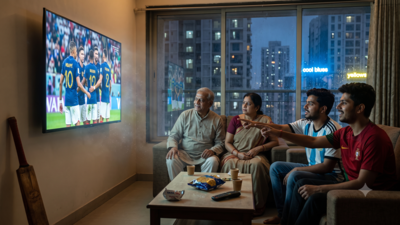
AI generated image for representation
For many Indian households, the FIFA World Cup has become more than just a late-night sporting event. It is increasingly influencing how people watch sports at home. Even in a country where cricket continues to dominate the sporting landscape, football has steadily built a sizeable audience, and that growing interest is now being reflected in TV buying patterns.It’s not all that surprising that football is popular in India. Research released by Nielsen in May shows that football has become the second most popular sport among adults in India after cricket. That expanding fan base seems to be translating into demand for a better home viewing experience during the World Cup.TV industry executives say the FIFA World Cup is also prompting more consumers to upgrade to bigger TVs, with 55-inch and larger screens increasingly the choice of many buyers.
The trend comes at a time when India's overall smart TV market has slowed, suggesting that consumers are increasingly looking beyond entry-level models in favour of larger displays and newer display technologies.Counterpoint Research estimates that shipments of India’s Smart TVs fell by 3% year-on-year in Q1 2026. This dip is blamed on inflation and other internal factors affecting Indians' spending. The lower-segment TVs saw low demand, as most households decided to delay buying larger appliances.
Yet the premium segment continued to move in the opposite direction.Counterpoint said TVs measuring 55 inches and above accounted for nearly one-third of all smart TV shipments during the quarter, making them the fastest-growing screen-size category. The report also noted that QLED televisions expanded their market share to 30%, while MiniLED shipments increased more than 13-fold compared with a year earlier, although from a relatively small base.
TV makers say the World Cup has reinforced this ongoing shift.
TV brands on how larger screens are gaining traction during FIFA World Cup 2026
Abhiral Bhansali, Business Head – Home Entertainment, LG Electronics India Limited, also pointed to increased demand for larger televisions during the tournament."We have launched 'Bring Home The Stadium' marketing campaign, which has resonated strongly with consumers and reinforced our commitment to delivering the best big-screen viewing experience this season. Markets like West Bengal and Kerala have been particularly strong, reflecting the deep-rooted passion for the sport in these regions.We are witnessing 2X growth in large screen TVs during sporting events, as consumers increasingly seek a stadium-like viewing experience at home. Features such as Dolby Vision and Dolby Atmos are emerging as key enablers, where consumers expect superior picture quality and powerful sound for a truly immersive experience.”Vasudeva G, Director at Acerpure India, said the company has also seen stronger demand for larger televisions during the tournament.“At Acerpure, we have observed an increase in TV sales during the FIFA World Cup season, particularly for larger screen sizes. Sporting events of this scale often inspire consumers to upgrade their home entertainment experience, and we are seeing growing interest in larger-screen TVs as viewers look to enjoy every moment of the action with immersive visuals and sound.As a new-age consumer technology brand, Acerpure focuses on large-screen TVs, including 75-inch, 85-inch, and 100-inch models, designed to deliver a more lifelike and immersive viewing experience. The excitement around the tournament has certainly contributed to stronger demand, with consumers prioritising bigger displays and premium home entertainment experiences for watching matches with family and friends.”
Global market also sees World Cup impact
The World Cup has also influenced television shipments in international markets.
According to Counterpoint Research's Global Monthly TV Tracker, global TV shipments increased 8% year-on-year in April 2026 as brands and retailers built inventory ahead of the FIFA World Cup, which is being held from June 11 to July 19 across the United States, Canada and Mexico. The research firm said the increase was largely driven by channel inventory rather than immediate consumer demand.Western Europe recorded the highest regional growth, with shipments rising 48% year-on-year during April.
Counterpoint attributed this increase to new product launches, a relatively low base in the previous year and stronger channel stocking ahead of the tournament.North America, one of the World Cup host regions, recorded 10% year-on-year shipment growth during April. The research firm noted that brands steadily built inventory between January and April, with MiniLED televisions emerging as a key area of competition.However, China remained under pressure, with TV shipments declining 15% year-on-year. Counterpoint said reduced funding for trade-in subsidies and demand pulled forward during the earlier subsidy cycle continued to affect domestic consumption.Changes were also evident in the competitive scenario. Samsung is still the market leader in Western Europe, with a market share of 27%, while Xiaomi's shipments in the region increased by almost 12x from last year after it introduced its 2026 S Mini LED TV line.
Yet, according to Counterpoint, Xiaomi TV shipments declined 17% globally from January to April 2026.Bob O'Brien, Research Director at Counterpoint Research, said several Chinese television brands are increasingly focusing on overseas markets as domestic demand remains weak. According to the research firm, Western Europe has become a key region for expansion ahead of the FIFA World Cup, with manufacturers introducing new MiniLED models and strengthening retail channels.In terms of market trends, while the overall television demand continues to be influenced by economic factors, consumers upgrading their TVs are still opting for larger displays and advanced display technologies. Global sporting events are providing another reason for purchase decisions in both India and a few international markets.








 English (US) ·