

 1 day ago
5
1 day ago
5
ARTICLE AD BOX
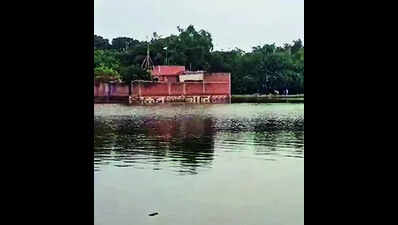
Bihar's flood-prone regions now have a new GeoAI framework to assess school vulnerability. Developed by CUSB and Arizona State University, it maps flood-depth scenarios, identifying over 40 schools in high-risk zones in Darbhanga alone. This innovation aids disaster-resilient educational planning, prioritizing safer school construction and preparedness for millions.
Patna: Even as 73% of Bihar’s land area is prone to floods, with 76% population of its northern part living under the threat of annual inundation, the researchers from geography department of Central University of South Bihar (CUSB), in collaboration with Arizona State University, USA, have developed an innovative GeoAI-based framework to assess school exposure to varying flood-depth scenarios in flood-prone regions of Bihar.
The research has been published in the latest edition of an internationally reputed journal of natural hazards, Springer Nature.The paper, titled “Developing a framework for assessment of the school’s exposure to flood-depth scenarios: a case study of Darbhanga, Bihar, India,” has been authored by Chandrakanta Bishui, Somnath Bera, Shivam Priyadarshi, Pritha Ghosh, and Kshitij Dahal. According to team leader Bera, “The proposed framework offers a scientific basis for disaster-resilient educational infrastructure planning.
It can assist policymakers in prioritising flood-resilient school construction, retrofitting, and emergency preparedness.
The framework is scalable and can be applied to other flood-prone regions across the country”.The study points out that north Bihar has a long history of devastating floods, including major events in 1973, 1978, 1988, 2007, 2014, 2016, 2019, and 2020. During the 2007 floods, nearly 1,960 schools in Bihar suffered extensive damage, while 159 schools were destroyed in 2008.
These recurring events underline the vulnerability of educational infrastructure across the region.According to the study, floods frequently disrupt educational infrastructure in Bihar, affecting student safety, attendance, and learning continuity. Schools often function as emergency shelters during disasters, making it crucial to assess their vulnerability under different flood conditions. Using Google Earth Engine (GEE) and a machine learning model, the research team generated flood depth susceptibility maps for three depth categories: below 1.5 metres, 1.5-3 metres, and above 3 metres.
A spatial analysis of 2,010 schools in Darbhanga district was conducted.The findings reveal that nearly 20% of the district has a high probability of experiencing floods exceeding 3 metres in depth. Under extreme flood scenarios, 43 schools were identified within high-susceptibility zones. The study also highlights that rural schools are comparatively more vulnerable than urban schools.With Darbhanga’s literacy rate at 56.56%, repeated flood disruptions further strain education. The study recommends elevating school buildings, retrofitting high-risk schools, improving drainage, and integrating flood exposure maps into district planning. The GeoAI-based framework can be scaled across North Bihar districts such as Madhubani, Sitamarhi, Saharsa, and Muzaffarpur to strengthen disaster-resilient education systems, Bera added.









 English (US) ·