

 1 hour ago
6
1 hour ago
6
ARTICLE AD BOX
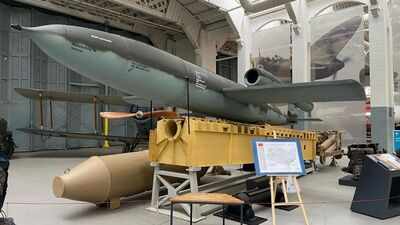
Photo credit: Imperial war museum duxford
Germany's decision to acquire US-made Tomahawk cruise missiles has revived one of military history's greatest ironies. More than 80 years ago, Germany became the first country to develop and operationally deploy a cruise missile, the V-1 Flying Bomb.
Today, it is turning to the United States to acquire one of the world's most advanced long-range cruise missiles.V-1: The flying bombGermany became the first country in the world to build a cruise missile during the second world war. In 1944, Nazi Germany introduced the V-1 flying bomb (Fi 103), a revolutionary weapon that fundamentally changed the future of missile warfare.Powered by a pulsejet engine, the V-1 was an unmanned, pilotless weapon capable of flying autonomously to a pre-programmed target before delivering an explosive warhead.
Unlike conventional bombs dropped by aircraft, it could travel hundreds of kilometres under its own power, making it the world's first operational cruise missile.
Nicknamed the "Buzz Bomb", the V-1 could reach speeds of about 600 km/h and strike targets up to roughly 250 kilometres away. It carried an 850-kilogram high-explosive warhead, making it capable of causing extensive destruction against urban and strategic targets.
First launched against London in June 1944, the V-1 was later used extensively against cities in Britain and Belgium. Although relatively inaccurate by modern standards, it demonstrated a completely new way of conducting long-range precision attacks.The weapon laid the foundation for the evolution of modern cruise missiles, influencing designs that eventually led to systems such as the US Tomahawk, Russia's Kalibr, and India's BrahMos.After the warGermany's defeat in the second world war marked the end of its pursuit of offensive missile programmes. Following the collapse of Nazi Germany in 1945, the country was demilitarised under Allied occupation, while much of its military infrastructure and weapons research was either dismantled, restricted or brought under Allied control.When West Germany established the Bundeswehr (Germany armed forces) in 1955 and joined NATO the same year, its defence doctrine was fundamentally different from that of wartime Germany.
Rather than developing independent long-range strike weapons, the country embraced Nato's principle of collective defence.Under this arrangement, Germany relied on the alliance partners particularly the United States for strategic deterrence and deep-strike capabilities, while concentrating on strengthening conventional forces for the defence of Europe. The Bundeswehr's constitutional mission was therefore centred on defending Germany and its allies rather than projecting military power independently.Successive governments therefore prioritised capabilities such as fighter aircraft, air defence systems, armoured vehicles, submarines and multinational defence projects over indigenous land-attack cruise missiles.Capability never lostGermany's decision to acquire the Tomahawk is not a reflection of technological weakness. Despite abandoning indigenous long-range land-attack cruise missile programmes after the second world war, the country retained one of Europe's most advanced missile industries and continued to develop sophisticated guided weapons.A prime example is the Taurus Kepd 350, a long-range, air-launched cruise missile jointly developed by MBDA Deutschland and Sweden's Saab. Germany has also developed the IRIS-T family of missiles through Diehl Defence, including the combat-proven IRIS-T SLM air-defence system, while contributing to multinational programmes such as the Meteor beyond-visual-range air-to-air missile.For decades, Germany relied on Nato's collective deterrence to provide long-range strike capabilities, allowing it to focus its defence investments on other priorities.
That strategic approach, however, is now being fundamentally reassessed.A rapidly deteriorating security environment in Europe, driven primarily by Russia's full-scale invasion of Ukraine has exposed critical capability gaps and prompted Berlin to rethink its long-held defence assumptions. The war in Ukraine demonstrated the decisive role of long-range precision strikes in modern warfare, from targeting command centres and logistics hubs to disrupting military infrastructure deep behind enemy lines.Recognising the need to strengthen its own deterrence, Chancellor Friedrich Merz's government had accelerated the modernisation of the Bundeswehr. The acquisition of the Tomahawk is intended to close what Merz described as a "critical strategic gap" in Germany's defence, while Berlin simultaneously works with its European partners to develop indigenous long-range strike systems.Today, as Europe's security environment undergoes its most profound transformation since the Cold War, Berlin has concluded that a long-range conventional strike capability is once again indispensable.Germany possesses the technological expertise and industrial base to develop such a missile on its own, but doing so would require years of research, testing and integration time that policymakers believe they no longer have amid a rapidly evolving security landscape.








 English (US) ·