

 3 days ago
6
3 days ago
6
ARTICLE AD BOX
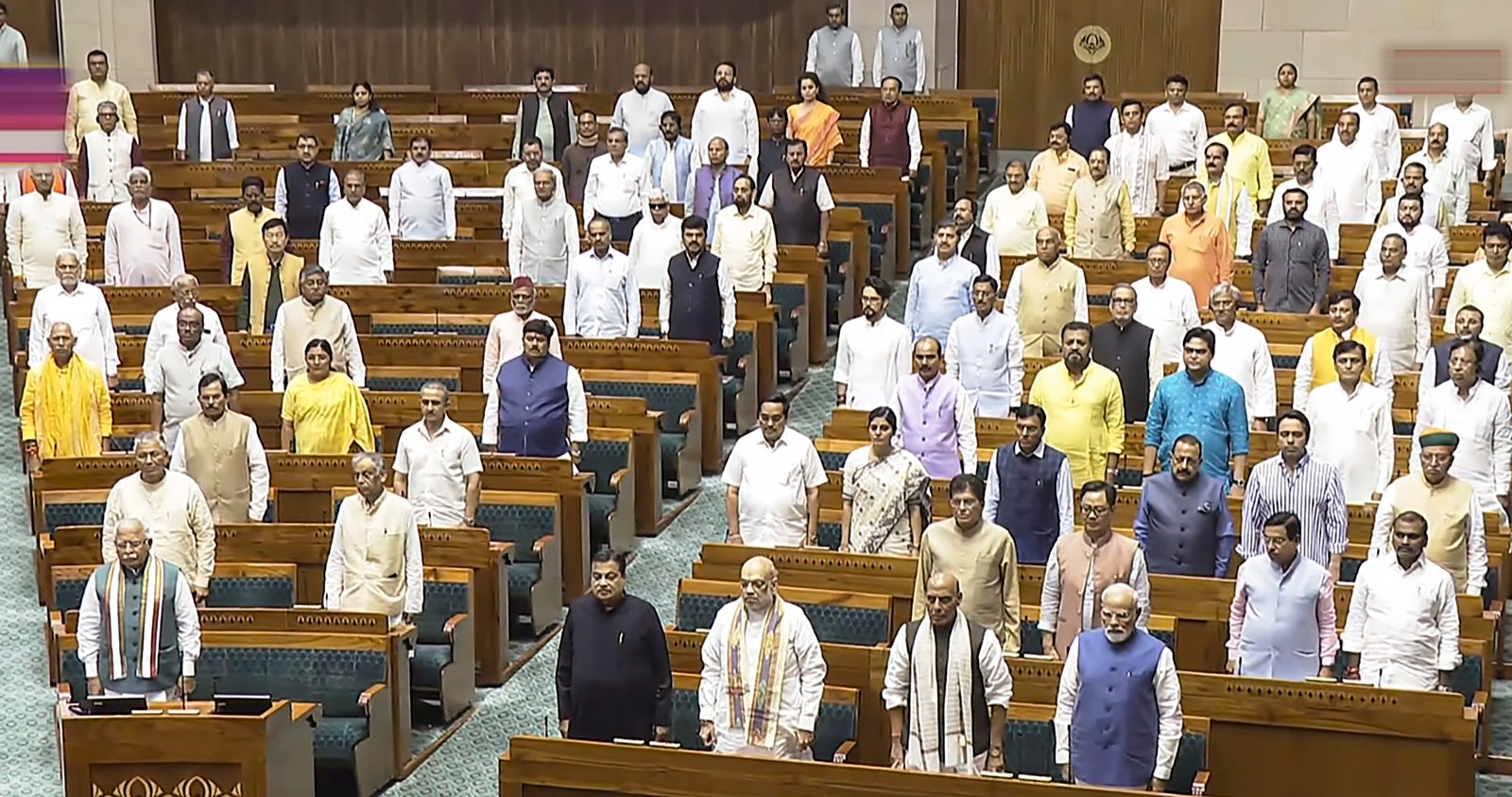 Members of the Lok Sabha stand for the national anthem during the Monsoon session of Parliament on Thursday. (Photo: PTI)
A HIGH-level government meeting was held earlier this month to examine and debate possible protocols for the recitation of the national song Vande Mataram, similar to those in place for the national anthem Jana Gana Mana, The Indian Express has learned.
Written by Bankim Chandra Chattopadhyay, Vande Mataram emerged as a rallying cry during the Swadeshi movement (1905–08), becoming closely associated with the freedom struggle. While the Constituent Assembly accorded the song equal honour and respect alongside the national anthem, there is currently no compulsory etiquette, posture, or legal requirement associated with singing or reciting the national song.
The ongoing deliberations within the highest levels of the government form part of what the ruling BJP has described as an effort to elevate the song’s standing, something it has accused the Congress of having diminished through appeasement politics and the removal of what it calls important stanzas during the Congress session in 1937. The move also comes even as the Centre has launched a year-long celebration of Vande Mataram. The first phase was completed in November, the second is scheduled this month, the third in August 2026, and the fourth in November 2026.
Sources said the meeting, convened by the Ministry of Home Affairs (MHA), saw senior officials, including from other ministries, discuss whether rules or instructions should be framed on the circumstances in which the national song may be sung, whether it should be sung alongside the national anthem, and whether acts of disrespect should attract penalties. An MHA spokesperson did not respond to queries shared by The Indian Express on the said meeting.
In recent years, several petitions have been filed in courts seeking a framework for the rendition of the national song and clarity on whether penalties can be prescribed under the Prevention of Insults to National Honour Act, 1971, which was enacted to prevent disrespect to national symbols. In 2022, the Centre told the Supreme Court that while the 1971 law makes it an offence to prevent the singing of the national anthem or cause disturbance to an assembly engaged in such singing, similar penal provisions have not been made for the national song. The government also stated that no instructions have so far been issued laying down the circumstances in which Vande Mataram may be sung or played.
The national anthem enjoys explicit constitutional and statutory protection, unlike the national song. Article 51A(a) of the Constitution places a fundamental duty on citizens to respect the national anthem, with its recitation and use governed by detailed executive orders issued by the MHA.
Explained
Etiquette, rules for national song
Vande Mataram does not enjoy explicit constitutional and statutory protection like the national anthem Jana Mana Gana. To lift its status, the government is examining if the national song too can be accorded the same respect as the anthem by prescribing rules and protocols.
Under these orders, the government has laid down specific instructions on the playing, singing, and display of the national anthem to ensure it is treated with due respect, including mandatory standing for its full version at official functions and a ban on dramatised or altered versions that may show disrespect. Further, under the Prevention of Insults to National Honour Act, whoever Intentionally prevents the singing of the Indian National Anthem or causes disturbance to any assembly engaged in such singing can be punished with imprisonment of up to three years.
Story continues below this ad
Vande Mataram has increasingly figured in political and historical debates in recent years, especially around questions of nationalism and identity. This was evident during a heated debate in Parliament during the Winter Session last year, when Home Minister Amit Shah accused the Congress of suppressing the glory of Vande Mataram and alleged that the same approach later grew into a policy of appeasement that paved the way for the Partition of India.
The charge relates to the omission of four of the song’s six stanzas. The first two verses celebrate the land, while the later ones portray the motherland as a goddess-like figure, a depiction that some members of the Constituent Assembly felt might not resonate with citizens of all faiths.
The Congress, on the other hand, alleged that the BJP was distorting history and it set aside time for discussion on the national song with an eye on West Bengal polls.

Ritika Chopra, an award-winning journalist with over 17 years of experience, serves as the Chief of the National Bureau (Govt) and National Education Editor at The Indian Express in New Delhi. In her current role, she oversees the newspaper's coverage of government policies and education. Ritika closely tracks the Union Government, focusing on the politically sensitive Election Commission of India and the Education Ministry, and has authored investigative stories that have prompted government responses. Ritika joined The Indian Express in 2015. Previously, she was part of the political bureau at The Economic Times, India’s largest financial daily. Her journalism career began in Kolkata, her birthplace, with the Hindustan Times in 2006 as an intern, before moving to Delhi in 2007. Since then, she has been reporting from the capital on politics, education, social sectors, and the Election Commission of India. ... Read More
Stay updated with the latest - Click here to follow us on Instagram
© The Indian Express Pvt Ltd



 English (US) ·