

 2 hours ago
2
2 hours ago
2
ARTICLE AD BOX
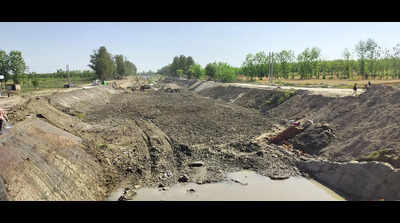
The project remains unfinished after nearly 5 years
Gurgaon: As Delhi battles acute water shortages, a major Haryana irrigation project aimed at improving water conveyance in the Yamuna basin remains unfinished years after its scheduled completion.The Haryana govt approved the Remodelling of Augmentation Canal project in Dec 2017 at an estimated cost of Rs 489 crore. Passing through Yamuna Nagar and Karnal districts, the project was designed to increase the canal’s carrying capacity from 3,100 cusecs to 6,000 cusecs, strengthening the Western Yamuna Canal system. Work was to begin in 2018-19 and be completed by 2020-21. Nearly five years after that deadline, it remains incomplete.Sources familiar with the project said around Rs 350 crore has already been spent, though the irrigation department’s latest expenditure figures could not be independently verified.The delay has acquired significance amid a deepening water crisis in Delhi — residents in several localities are dependent on govt tankers arriving once every two days and private operators are charging up to Rs 5,000 per trip. The Wazirabad reservoir has fallen well below its normal level of 674.5 feet, affecting operations at key treatment plants.
The Wazirabad plant (131 MGD capacity) and Chandrawal plant (94 MGD) are together estimated to be producing 70-100 MGD less than normal due to reduced raw-water availability.
Of the 250-260 MGD normally reaching Wazirabad from Yamuna, only about 80 cusecs is reportedly being diverted through the Munak Canal system, with supplies curtailed elsewhere to compensate.Water experts estimate that significant quantities are lost through seepage and transmission in the Western Yamuna Canal network — sector estimates suggest losses of 600-800 cusecs in parts of the system.
Conserving even a fraction of these losses, they say, could improve availability during peak summer months.“The delay is very serious because it affects not only a canal project but the reliability of the entire downstream water-supply chain,” said Fawzia Tarannum, co-founder and strategic lead at GuruJal. She identified four cascading effects: reduced conveyance flexibility during summer stress and emergency releases; greater vulnerability to raw-water shortages; higher risk of losses and failure in partially upgraded infrastructure; and weakened climate resilience overall.Tarannum, however, said Delhi’s crisis cannot be attributed solely to the unfinished project. “Haryana must be accountable for time-bound completion and transparent flow reporting, but Delhi must simultaneously reduce distribution losses, revive local water bodies, recharge groundwater, regulate illegal borewells and reuse treated wastewater,” she said.Nitin Bassi, fellow at Council on Energy, Environment and Water (CEEW), said the capital’s water supply had fallen to about 70% of total demand of 1,250 MGD — a gap further widened by leakages and theft amounting to roughly 40% of supplied water.
He argued that a circular water economy, including reuse of treated wastewater for horticulture, landscaping and industrial cooling, was equally critical. “In many cities, reuse remains below 3% of total freshwater demand.
Ideally, it should be at least 20%, which would free up water for domestic use during summers,” he said.A senior irrigation department official said the project, once complete, would improve conveyance efficiency and help meet future water requirements.
“Work on the remaining components is being taken up,” the official said.The augmentation canal was also conceived to prepare the system for additional flows expected from upstream projects — Renuka, Kishau, Lakhwar and Vyasi dams — and to benefit districts across the Western Yamuna Canal command area including Karnal, Panipat, Sonipat, Rohtak and Hisar.The delay comes against the backdrop of the long-running Delhi-Haryana water dispute. Under the 1994 MOU among Yamuna basin states, Delhi was allocated 0.724 BCM annually for drinking purposes, with Supreme Court directions in 1995 and 1996 requiring Haryana to maintain uninterrupted flows. As recently as July 2024, the apex court directed the Upper Yamuna River Board to release an additional 150 cusecs to Delhi on humanitarian grounds.



 English (US) ·