

 2 days ago
7
2 days ago
7
ARTICLE AD BOX
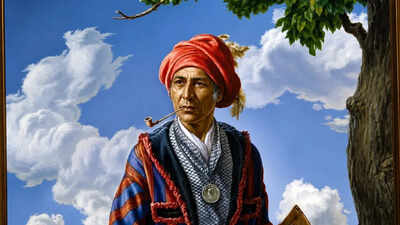
Long before the Cherokee language appeared in newspapers, schoolbooks or street signs, it existed almost entirely in speech. Stories, customs, and memory moved from one generation to another by voice, carried across families and communities without a standard written form.
That changed during the early nineteenth century through the work of one man whose determination altered the future of his people. His name was Sequoyah. He had never learned to read or write in English or any other language, yet he became the creator of one of the most successful writing systems ever devised by a single individual. The script he developed did far more than record words. It helped preserve identity during a period of upheaval, displacement and profound change.
How Sequoyah first imagined the Cherokee in writing
Sequoyah was born in the Cherokee homeland in what is now the state of Tennessee during the years before the American Revolution. He lived with a physical disability that affected his mobility and, over time, earned a living through skilled trades, including silversmithing and blacksmithing. These occupations required patience and precision, qualities that later shaped his life's most important work.As European settlers expanded into Cherokee territory, Sequoyah became fascinated by something he observed repeatedly: written communication.
Letters travelled across long distances. Documents preserved ideas. Marks on paper seemed to carry a person's voice beyond time and place. He could not read these symbols himself, but he understood their power. Gradually, he began to wonder why the Cherokee language, rich and expressive in speech, could not be represented in the same way.Many around him remained sceptical. Some considered the idea strange. Others feared that fixing spoken words onto paper interfered with traditions that had long relied on memory and oral teaching.
Sequoyah, however, remained committed to the idea, despite criticism and doubt.
The breakthrough that changed Cherokee forever
The path was far from straightforward. At first, Sequoyah attempted to create a symbol for every word in Cherokee. The idea soon proved impossible. The language contained far too many words for such a system to remain practical.His attention shifted instead to sound. He listened carefully to conversations, breaking spoken words into smaller units and recognising recurring patterns.
Slowly, he identified the syllables that formed the structure of the Cherokee language. Rather than creating letters that represented individual sounds, he designed symbols for entire syllables.Working over many years, largely on his own, Sequoyah eventually assembled a set of characters capable of expressing the full spoken language. Some symbols resembled letters found in English books he had seen, though their sounds and meanings were entirely different.
The shapes were familiar; the language they represented was uniquely Cherokee.
The moment Cherokee writing won believers
The new writing system did not gain immediate acceptance. National Geographic reports, there were accusations that Sequoyah had discovered some form of supernatural power. His young daughter, A-Yo-Ka, who had learned the symbols from him, became part of a public test designed to determine whether the script truly worked.The father and daughter were kept apart and were instructed to communicate using writing.
Their writings were read correctly, which showed that the symbols were indeed representing language and not any kind of trickery. However, doubts were still held by some of those present. Nevertheless, their curiosity overpowered their doubts.They started requesting Sequoyah to instruct them on the new syllabary, and its adoption took place very quickly amongst the Cherokee community.
A literacy revolution within the Cherokee Nation
Unlike writing systems adapted from foreign languages, Sequoyah's syllabary was designed specifically for Cherokee speech.
Native speakers found it comparatively easy to learn because the symbols reflected sounds they already used every day.Within only a few years, a large share of the Cherokee population could read and write their own language. This transformation occurred at a speed that surprised many outsiders. Literacy was no longer limited to a small group. Ordinary people began writing letters, recording information and preserving traditions in written form.The effect reached beyond education. Written Cherokee strengthened communication across communities at a time when political pressure from the United States government was intensifying.
The syllabary that survived the Trail of Tears
Among the most difficult times for the Cherokee were the 1830s. The signing of the Indian Removal Act resulted in the displacement of thousands of members of the tribe from the lands where they had been living. Those people were forced to leave for the western lands following the path that became known as the Trail of Tears.
During this process, many people died.Though the homes, properties, and belongings of the Cherokees were confiscated, the written language remained intact. The syllabary accompanied the people everywhere and served as something intangible and almost impossible to confiscate.In times when communication was extremely difficult because the tribes had been dispersed geographically, it became possible because of the knowledge of the written language.
The Cherokee Phoenix and a new era of publishing
The written language soon found a place in print. In 1828, the Cherokee Nation launched the Cherokee Phoenix, a newspaper printed in both English and Cherokee. It was the first bilingual newspaper of its kind in the United States.Articles, government announcements and public discussions appeared in two languages side by side. Readers who had recently become literate in Cherokee could now access news and political debates in their own language.









 English (US) ·