

 12 hours ago
4
12 hours ago
4
ARTICLE AD BOX
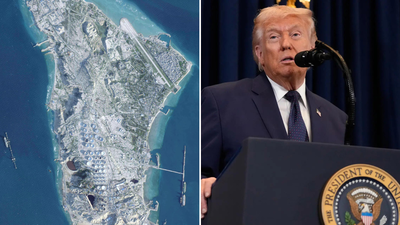
US President Donald Trump on Saturday announced that the United States had carried out strikes on Iran’s key oil export hub at Kharg Island. The US president said the operation targeted critical energy infrastructure linked to Iran’s oil trade.Trump said US forces had “obliterated” military facilities on the island, which sits in the Persian Gulf and handles the overwhelming majority of Iran’s crude shipments to the global market. While the strikes stopped short of targeting the oil infrastructure itself, the US president warned that the energy facilities could be hit next if Iran interferes with shipping through the Strait of Hormuz, one of the world’s most critical energy chokepoints.
Kharg Island has long been considered Iran’s economic lifeline, with analysts warning that any sustained attack on the territory could cripple the country’s oil exports and deal a devastating blow to its economy.Following the announcement, Iranian officials issued a stark warning, saying that any further attacks could lead to the destruction of oil and energy infrastructure across the region. The threat came amid rising tensions between Washington and Tehran after a series of military exchanges in recent days.
Iran’s oil lifeline
Kharg Island lies roughly 30 kilometres off the Iranian mainland in the Persian Gulf, near the port city of Bushehr. Despite its small size just around eight kilometres long the island plays an outsized role in Iran’s economy.Often described as Iran’s “oil lifeline”, Kharg handles around 90 percent of the country’s crude exports. Oil from major offshore fields such as Aboozar, Forouzan and Dorood is transported via subsea pipelines to the island, where it is stored and loaded onto massive tankers bound largely for Asian markets.Its geography makes it uniquely suited for this role. The waters surrounding the island are deep enough to accommodate supertankers, something that many Iranian ports along the shallow Gulf coastline cannot handle.Over the decades, Iran has turned Kharg into one of the world’s largest oil terminals. At peak capacity, the facilities there can load as much as seven million barrels per day, though current exports are closer to about 1.6 million barrels daily.Because so much of Iran’s export infrastructure is concentrated on this single island, analysts have long considered it a critical vulnerability. Any serious disruption could immediately choke off the majority of Iran’s oil revenues, which remain a central pillar of the country’s economy and a key source of funding for powerful institutions such as the Islamic Revolutionary Guard Corps.
Why the island is strategically sensitive
The United States and Israel had previously avoided striking Kharg directly, largely because of the enormous economic and geopolitical consequences such a move could trigger.Energy analysts warn that targeting the island’s oil infrastructure would almost instantly halt most of Iran’s crude exports. That could provoke a major retaliation from Tehran, particularly in the Strait of Hormuz, through which roughly a fifth of the world’s traded oil and liquefied natural gas normally passes.Iran has already demonstrated its ability to disrupt maritime traffic in the area. Missile and drone attacks in recent weeks have slowed shipping through the strait and raised fears of a wider energy crisis.Tehran has repeatedly warned that any attempt to damage its oil infrastructure would provoke an “eye for an eye” response, potentially including attacks on energy facilities in neighbouring Gulf states.That risk explains why the latest US strikes appear to have targeted only military installations on the island rather than its vast oil storage tanks and loading terminals. Trump himself acknowledged this calculation, saying he had deliberately chosen not to destroy the energy infrastructure.
A strategic prize in a wider war
Beyond its economic importance, Kharg Island also holds significant military and historical value. The island has been heavily fortified over decades and is guarded by Iran’s Revolutionary Guards.Its strategic location has made it a coveted asset for centuries. European powers including the Portuguese and the Dutch once attempted to control it because of its position along historic trade routes in the Gulf.In modern times, the island has endured repeated conflict. During the Iran–Iraq War in the 1980s, Iraqi forces repeatedly bombed Kharg in an attempt to cripple Iran’s oil exports. Although heavily damaged, the facilities were eventually rebuilt and expanded.Today the island remains a tightly controlled zone with limited civilian presence, dominated by oil terminals, pipelines and military installations.








 English (US) ·