

 6 days ago
10
6 days ago
10
ARTICLE AD BOX
Last Updated:January 31, 2026, 12:18 IST
Reasons that lead to delay in disposal of cases include availability of physical infrastructure, complexity of facts involved, nature of evidence & stakeholders' cooperation

Fast-track courts have collectively disposed of 3.66 lakh cases since the inception of the scheme and 2.45 lakh cases are pending.

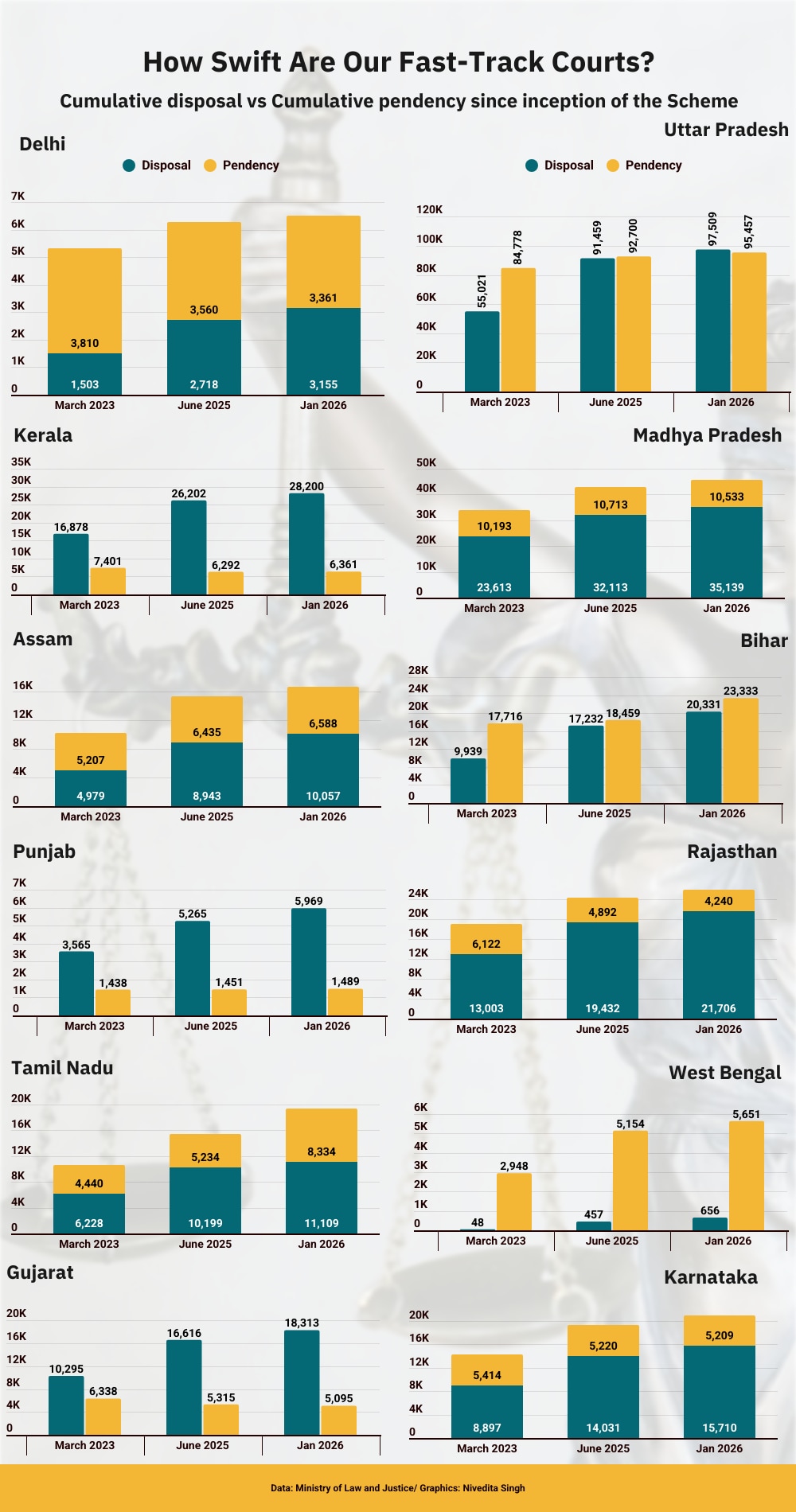
Data from the Ministry of Law and Justice show that till January 30, Delhi, with 11 functional POCSO courts, had 2,421 POCSO cases pending, while overall pendency in Fast Track Special Courts stood at 3,361 cases. Since 2019, a total of 6,516 cases has been transferred to FTSCs in the national capital.
As per the ministry dashboard, currently across India, 774 fast-track special courts are functional, including 398 exclusive POCSO Courts. The Fast Track Special Courts (FTSCs) are for expeditious trials relating to sexual offences. POCSO Courts, a part of FTSCs, deals only with cases under the Protection of Children from Sexual Offences (POCSO) Act.
These fast-track courts have collectively disposed of 3.66 lakh cases since the inception of the scheme and 2.45 lakh cases are pending in these across India, including 1.42 lakh POCSO cases.
“Justice Delayed Is Justice Denied"
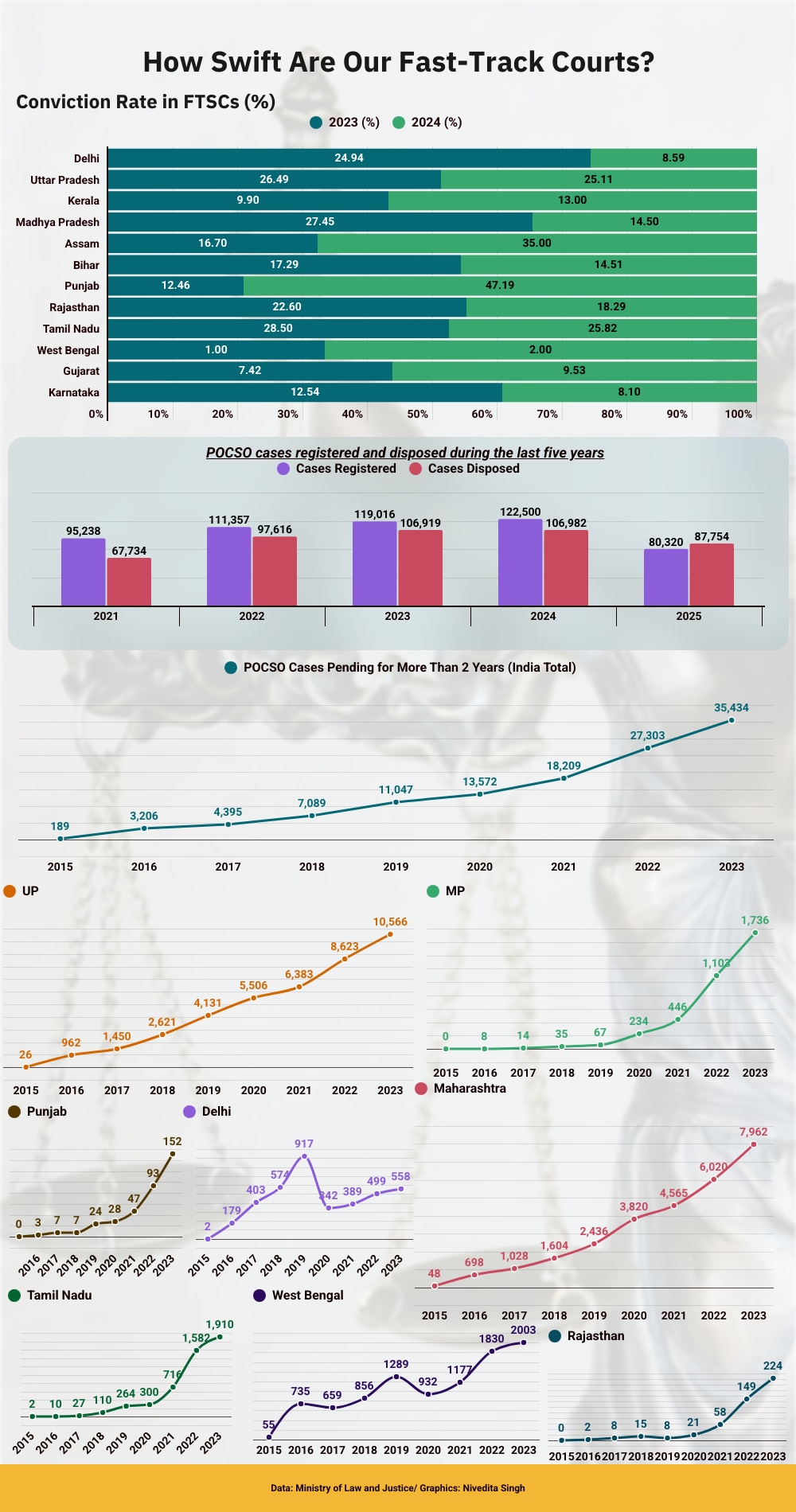
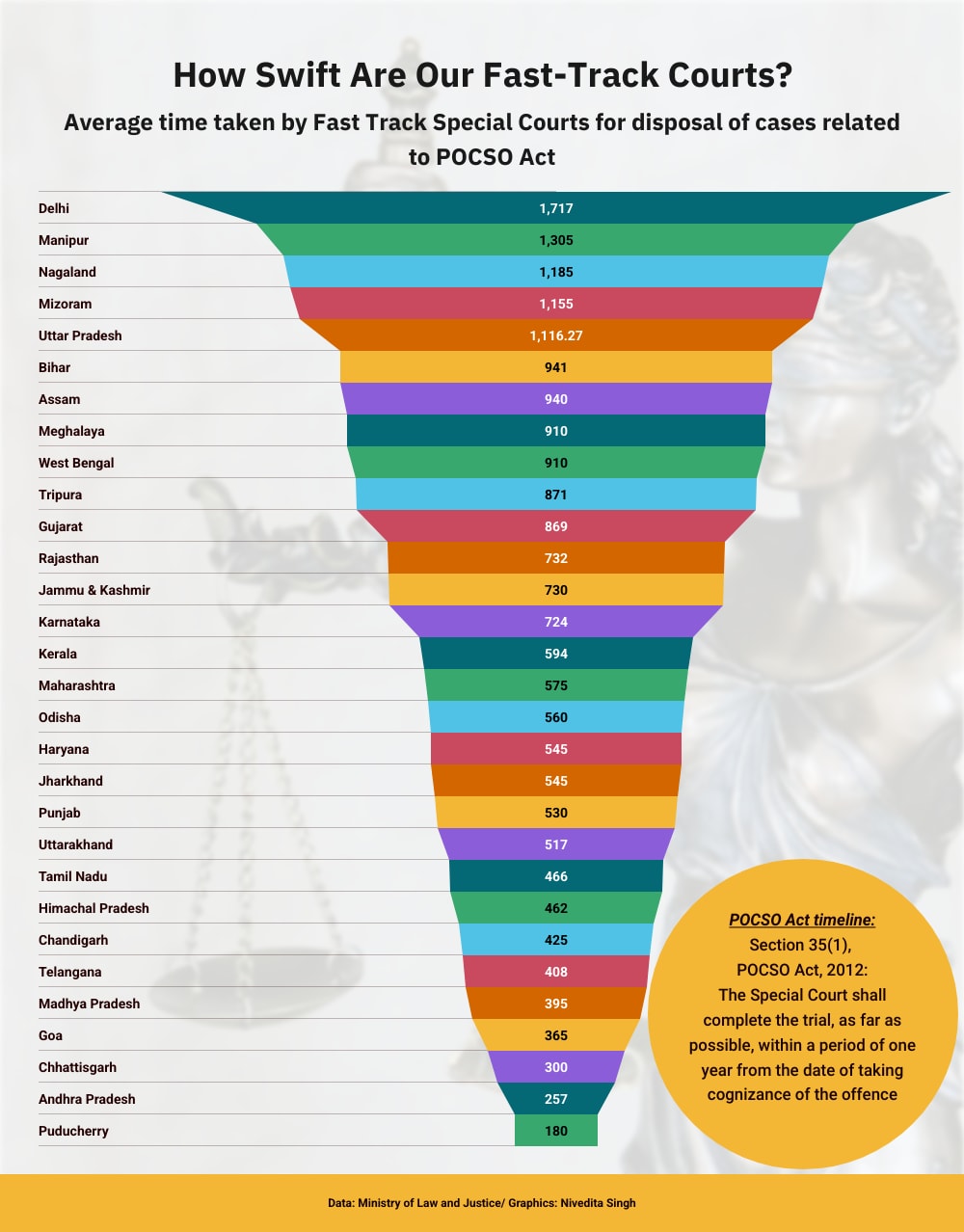
The ministry data, issued last year, shows that of the 30 states where exclusive POCSO courts are operational, Puducherry (180 days) and Andhra Pradesh (257 days) are clearing the cases fastest on average. Chhattisgarh (300 days), Goa (365) and Madhya Pradesh (395) were in the top five list.
On the other end of the spectrum was Delhi, which is taking 1,717 days to complete the trials in the POCSO cases on average. Only five states/UTs are taking more than 1,000 days of average time for trial. The list included Manipur (1,305 days), Nagaland (1,185 days), Mizoram (1,155) and Uttar Pradesh (1,116.27).
As per the Department of Justice data, there are no POCSO exclusive courts in Manipur and Nagaland and just one in Mizoram. However, they do have fast-track courts—two in Manipur, one in Nagaland and three in Mizoram. Delhi has 16 fast track courts and Uttar Pradesh has 218.
As per the National Judicial Data Grid figures up to December 2025, there are 35,434 cases filed under POCSO Act pending for over two years—up from 189 in 2015.
As per the POCSO Act, 2012, the evidence of the child should be recorded within a period of 30 days of the Special Court taking cognizance of the offence and the Special Court should complete the trial, as far as possible, within a period of one year from the date of taking cognizance of the offence.
The analysis also shows that between July 1, 2025, and January 30, fast-track courts disposed of about 32,000 cases in roughly seven months, translating to nearly 150 cases a day nationwide, according to ministry dashboard figures.
A third-party evaluation of the FTSCs by the Indian Institute of Public Administration showed that only 34.07 per cent of fast-track courts meet the scheme’s disposal benchmark of 41–42 cases per quarter and 165 annually, while nearly two-thirds fail to do so.
Citing conditions in Delhi’s courts, the report stated that in Tis Hazari, about 50 per cent cases were false, including consensual love affair cases. It also said getting the victims in the courtrooms takes a lot of time, as most of the victims migrate to other cities.
For Karkardooma, it stated that too many cases are assigned to one court and these courts are overburdened. It also said that in rape cases, examination of prosecution takes a lot of time and the investigation officers are filing the chargesheets invariably, even if the cases are false on most grounds.
In the case of Saket Court, the report listed challenges, including dearth of special public prosecutors in the FTSCs in the south district. It also listed that the public prosecutors do not have the basic facilities like internet, laptops, and support staff that can help them prepare the case.
The sessions court needs to be equipped with adequate court staff, like stenographers and the naib court (court staff), for more efficiency in work, it suggested.
Is a Speedy Trial Really Possible?
The POCSO courts in parts of India have delivered verdicts in a record time. In 2021 in Bihar, a POCSO court sentenced a man in just one day’s proceedings to life imprisonment for raping an eight-year-old girl. The Araria court fast-tracked the proceedings by recording witnesses, arguments, and counter-arguments; convicting the accused, and issuing the judgement in just one day.
In Delhi also, a man was convicted in April 2025—within seven weeks of the registration of the FIR and 11 days after the police filed chargesheet. The POCSO judge of Tis Hazari convicted the man for raping and impregnating a 16-year-old girl. The DNA of the man matched with the baby’s.
The Fast-Track Courts
The Union government launched the FTSCs scheme on October 2, 2019, establishing specialised courts nationwide for the expeditious disposal of rape and POCSO Act cases.
The FTSCs scheme was initially launched for one year and later extended until March 2023. It was further extended for three more years till March 31, 2026.
The total financial outlay for this period is Rs 1,952.23 crore, with Rs 1,207.24 crore as the Central Share, funded through the Nirbhaya Fund. A total of Rs 1,034.55 crore has already been released till 2024-25.
Several Factors Impacting Fast Disposal
The ministry, in one of its documents, cited that there are several reasons that lead to delay in disposal of cases in courts, including availability of physical infrastructure, complexity of facts involved, nature of evidence, cooperation of stakeholders—bar, investigation agencies, witnesses and litigants and proper application of rules and procedures.
“Other factors that lead to delay in disposal of cases include frequent adjournments and lack of adequate arrangement to monitor, track and bunch cases for hearing," it had said.
Citing the improvement in performance, the ministry also said in calendar year 2024, 88,902 new cases were instituted, while 85,595 cases were resolved by the fast-track courts, “underscoring the effectiveness of these fast-track courts in addressing case backlogs".
Despite marginal year-wise improvements, cumulative pendency continues to rise, as courts have not been able to consistently clear more cases than they receive.
In the last two weeks, News18 explained how cases of crime against children are on the rise and POCSO cases are a major driving factor.
Across the country, the cases of crime against children rose from one lakh in 2016 to 1.77 lakh by 2023. In terms of victims, the increase was from 1.11 lakh in 2016 to 1.86 in 2023.
POCSO cases rose from 36,022 in 2016 to 67,694 in 2023 and the number of POCSO victims climbed steeply from 36,321 in 2016 to 68,636 in 2023, highlighting the expanding scale of sexual violence against minors.
Fast Track Special Courts are a vital part of India’s judicial system, ensuring swift justice for victims of heinous crimes and protecting vulnerable groups and upholding justice through a responsive legal framework.
For survivors of sexual abuse and their families, prolonged trials mean years of uncertainty and re-traumatisation.
As pendency rises and trials stretch far beyond the one-year mandate, the question facing the justice system is no longer whether speedy trials are possible, but why they remain out of reach for so many children.
Handpicked stories, in your inbox
A newsletter with the best of our journalism
First Published:
January 31, 2026, 12:18 IST
News india How Fast Are Our Fast-Track Courts? Delhi Takes 1,717 Days For POCSO Trials Against One-Year Deadline
Disclaimer: Comments reflect users’ views, not News18’s. Please keep discussions respectful and constructive. Abusive, defamatory, or illegal comments will be removed. News18 may disable any comment at its discretion. By posting, you agree to our Terms of Use and Privacy Policy.
Read More







 English (US) ·