

 2 days ago
7
2 days ago
7
ARTICLE AD BOX
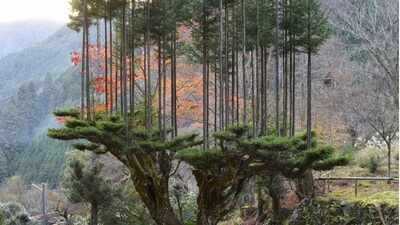
Even before sustainability became an international topic, the Japanese had found a smart way to grow high-quality wood without having to destroy a forest. This technique of growing high-quality cedar wood, called Daisugi, has been used since the 14th century.
It allows for the growth of many high-quality trunks of cedar wood from one tree without damaging it. Many consider Daisugi one of the first examples of sustainable forestry practices.The origin of the Daisugi method dates back to the Kitayama region close to Kyoto, where there was a great need for cedar wood but a lack of young saplings of cedar. Since foresters could not cut down fully grown trees and wait another few decades for the young ones to grow, they came up with a smart idea to solve both problems at once.
What is the principle behind the
Daisugi technique?In contrast to traditional forestry techniques, where a whole tree is felled to get the timber, Daisugi involves making a living cedar tree a constant source of wood. Expert foresters make cuts on the tree in such a way that almost all side branches are stripped off, leaving only the main stem. The result is that the tree produces a lot of vertical shoots from its top.The selected shoots are pruned manually every two or three years in such a way that only the most vigorous shoots are allowed to grow.
As the shoots take in all the necessary nutrients directly from the parent tree, they grow straighter, taller, and with almost no knots. After about 15-20 years, the grown shoots are cut off, and the parent tree continues to produce new shoots.As a Daisugi tree matures, however, it will be able to produce several stems at one time, reaching up to hundreds of stems produced throughout the tree's life. Because the mother tree remains alive, it continues to supply wood for decades and sometimes centuries.
Why did people invent Daisugi?
While this method enabled people to solve the problem of the lack of young cedars, there were other reasons for developing it. In the Muromachi period in Japan, people started to use more and more Sukiya-zukuri architectural style in building tea houses, temples, and the homes of samurai and noble families. These structures required straight, knotless cedar beams, which were sometimes difficult to find in nature.The method of Daisugi provided an excellent opportunity. The growth of the shoots was controlled meticulously and as a result, excellent timber of uniform quality could be achieved without clearing forests.
Why is Daisugi wood special?
Not only is the wood obtained via Daisugi technique praised because of its excellent appearance but also for its physical qualities. As the wood grows at a slow pace, the timber acquires a dense and uniform grain.
The historical research indicates that cedar trees, which have been grown using the technique of Daisugi, possess about 140 percent flexibility and 200 percent density and strength as compared to the traditionally grown cedar, thus being extremely resistant to bending.Besides, due to the lack of big knots, the timber is easy to manipulate and is highly suitable for construction purposes.
A lesson on sustainability that has lasted for centuries
One of the biggest strengths of Daisugi lies in its environmental effects. Because the parent tree stays alive, the forests maintain their canopies and there is no disturbance of habitat and erosion. Moreover, the living trees keep absorbing CO2 while generating new wood, making the whole process far more sustainable compared to traditional logging.Even though Daisugi has been superseded by modern approaches in most areas related to timber production, the method is preserved in some parts of Japan as an example of both old art and ecological awareness.









 English (US) ·