

 1 day ago
3
1 day ago
3
ARTICLE AD BOX
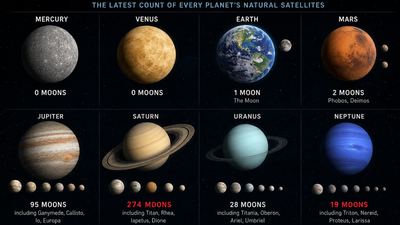
From the cratered companion that lights Earth's night sky to the hundreds of icy worlds circling the Solar System's giant planets, moons are among the most fascinating objects in space.
Over the past few decades, powerful telescopes and deep-space missions have transformed our understanding of these natural satellites, revealing hidden oceans, active volcanoes, methane lakes and even environments that could potentially support life. As astronomers continue to discover new moons using advanced observational techniques, the official tally keeps changing. So, how many moons does each planet actually have? Here's the latest scientifically accepted count, what makes these moons unique, and why they are helping researchers uncover the history and evolution of our Solar System.
Which planet has the most moons in the solar system
The race for the largest collection of moons has changed dramatically in recent years. Once considered the undisputed leader, Jupiter has now been overtaken by Saturn after astronomers confirmed dozens of previously unknown satellites.According to the NASA and recent astronomical discoveries, the current confirmed moon counts are:
| Planet | Confirmed moons | Interesting fact |
| Mercury | 0 | Too close to the Sun to retain a moon. |
| Venus | 0 | Has no natural satellite despite being Earth's twin in size. |
| Earth | 1 | The fifth-largest moon in the Solar System. |
| Mars | 2 | Phobos and Deimos are likely captured asteroids. |
| Jupiter | 95 | Home to the four famous Galilean moons. |
| Saturn | 274 | Holds the current record for the most known moons. |
| Uranus | 28 | Includes moons named after Shakespearean characters. |
| Neptune | 19 | Triton orbits in the opposite direction to the planet's rotation. |
"Moons are natural satellites that orbit planets or dwarf planets under the influence of gravity," says NASA.
The number of recognised moons changes as astronomers identify new objects and the International Astronomical Union confirms their orbits. Most recently, Saturn's tally increased significantly after astronomers identified dozens of faint irregular satellites using the Canada-France-Hawaii Telescope.
Why do some planets have hundreds of moons while others have none
The answer lies in gravity, planetary formation and location within the Solar System.Mercury and Venus have no moons. Scientists believe the Sun's powerful gravitational influence, combined with the planets' relatively small gravitational spheres of influence, makes it extremely difficult for them to capture or retain natural satellites.Earth has one unusually large moon compared with its own size. The prevailing Giant Impact Hypothesis suggests that Earth's Moon formed around 4.5 billion years ago after a Mars-sized body collided with the young Earth, ejecting debris that later coalesced into the Moon.Mars possesses two tiny moons; Phobos and Deimos, which scientists suspect were captured asteroids, although their exact origin remains under investigation.The four giant outer planets dominate the moon count because of their immense gravitational fields. These planets formed with extensive systems of orbiting material, allowing numerous regular moons to develop while also capturing many smaller objects over billions of years.Jupiter's largest satellites; Io, Europa, Ganymede and Callisto, were discovered by Galileo Galilei in 1610, providing the first evidence that not everything in the heavens revolves around Earth.Saturn's enormous collection includes tiny irregular moons only a few kilometres across, alongside Titan, the second-largest moon in the Solar System and the only moon known to possess a dense atmosphere.
Which moons are the most remarkable in the Solar System
Although hundreds of moons exist, a handful continue to dominate scientific research because of their extraordinary characteristics.Earth's Moon stabilises our planet's axial tilt, moderates long-term climate variations and drives ocean tides.
It also preserves a record of the Solar System's earliest history through its heavily cratered surface.Europa, one of Jupiter's Galilean moons, is believed to conceal a global salty ocean beneath its icy crust. NASA considers Europa one of the most promising locations to search for conditions suitable for life beyond Earth.Io is the most volcanically active world in the Solar System, with hundreds of erupting volcanoes powered by Jupiter's immense gravitational pull.As per NASA, Titan, Saturn's largest moon, possesses rivers, lakes and seas, not of water but of liquid methane and ethane. It is the only moon known to have a thick atmosphere.Enceladus, another moon of Saturn, ejects towering plumes of water vapour and ice particles from beneath its frozen surface. Measurements by NASA's Cassini spacecraft detected organic molecules and signs of hydrothermal activity, making it another compelling target in the search for extraterrestrial habitability.Triton, Neptune's largest moon, travels in a retrograde orbit, suggesting it was probably captured from the Kuiper Belt. It also displays active nitrogen geysers despite its frigid environment.As telescopes become more sensitive and future missions explore the outer Solar System, astronomers expect the list of confirmed moons to continue growing. Every newly discovered satellite offers another opportunity to understand how planets formed, how gravitational systems evolve and whether environments suitable for life may exist far beyond Earth.









 English (US) ·