

 1 hour ago
5
1 hour ago
5
ARTICLE AD BOX
Samrat Choudhary began his political journey with Lalu Yadav's Rashtriya Janata Dal (RJD), only to later join the Janata Dal (United) (JDU) and eventually the BJP. Although he lacked a natural connection with the saffron party, he quickly adapted to its working style and made efforts to fully understand the organisation.
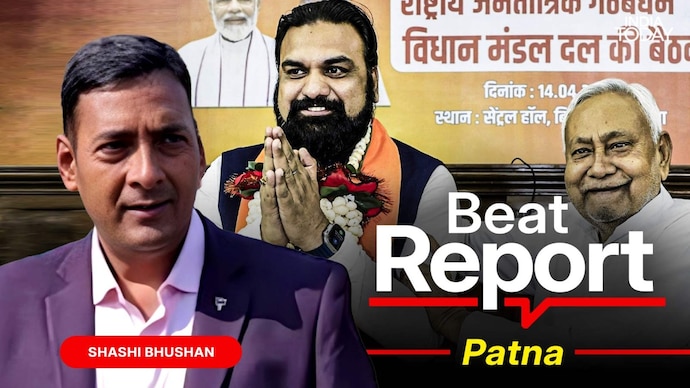
Bihar's Deputy CM Samrat Choudhary is set to take oath as the state's next Chief Minister. (Background photo: PTI)
Bihar's Deputy Chief Minister and Bharatiya Janata Party (BJP) leader Samrat Choudhary is set to take oath as the next Chief Minister of the state on Wednesday, a day after Nitish Kumar resigned from the top post to pursue a new inning as a Rajya Sabha MP. Once sworn in, Choudhary will have the distinction of being the first BJP CM of Bihar.
SAMRAT CHOUDHARY'S RISE
Choudhary began his political journey with Lalu Yadav’s Rashtriya Janata Dal (RJD), only to later join the Janata Dal (United) (JDU) and eventually the BJP. Although he lacked a natural connection with the saffron party, he quickly adapted to its working style and made efforts to fully understand the organisation. This is perhaps why, in a very short time, he rose to the position of the BJP's Bihar unit chief in 2023.
Choudhary was handed over the key leadership role at a time when Nitish was aligned with the RJD-led Mahagathbandhan. The working style of erstwhile BJP state president Nityanand Rai and in-charge Bhupender Yadav was considered one of the reasons behind the JD(U)'s breakup with the National Democratic Alliance (NDA).
Besides leading the BJP state unit, Choudhary was also made the Leader of Opposition in the Bihar Legislative Council. During this period, he strongly criticised Nitish for being aligned with the RJD. However, by January 2024, it seemed he had realised that the JD(U) supremo might return to the NDA fold. This is likely why he toned down his attacks, following the guidance of the BJP leadership.
HOW SAMRAT BECAME CLOSE TO NITISH
The JD(U) eventually rejoined the NDA in the last week of January 2024. Choudhary was made the Deputy CM of Bihar in the subsequent NDA government of Bihar. He was given the finance portfolio and, despite working closely with Nitish, he maintained a cautious distance – always appearing a step behind the CM. Choudhary seemed to understand the veteran leader's political manoeuvres well, knowing that trying to outshine him could harm both the alliance and his own career.
Slowly and gradually, the BJP leader earned Nitish's trust. Despite his government having two deputy CMs from the BJP, the chief minister appeared to rely more on Choudhary.
Political analysts believe that Choudhary became a preferred choice for Nitish partly because he fits into the "Lav-Kush" social equation. The JD(U) supremo, who belongs to the Kurmi community, had built a strong political bonhomie between Kurmis and Koeris (Kushwahas) to counter Lalu's vote bank. Being from the Kushwaha community, Choudhary naturally fit into this equation, making Nitish more comfortable with him.
The same caste equation is believed to have paved the way for the BJP to potentially secure the Chief Minister's post in Bihar. Both Nitish and the BJP understood that projecting Choudhary as a future CM face would help preserve the Lav-Kush optics.
SAMRAT CHOUDHARY'S PATIENCE PAID OFF
From January 2024 and until the Bihar Assembly elections of 2025, Choudhary worked steadily as Deputy CM and Finance Minister, without showing haste of any kind. While campaigning for the elections, he openly credited both Prime Minister Narendra Modi and Nitish Kumar for Bihar’s development.
After NDA's victory in the 2025 polls, he became the Deputy CM once again, but this time, with greater stature. Notably, Nitish, who had never assigned the home ministry to any minister other than himself, gave this particularly important responsibility to his preferred deputy. While initially there were widespread speculations that the allocation was due to pressure from the BJP, within just four months, Choudhary became an even more trusted confidante of the CM.
Political commentators believe that Choudhary had foreseen Nitish's declining health way back in January 2024 itself. It is possible that he convinced BJP's central leadership that the party could eventually secure its own Chief Minister in Bihar by continuing the alliance with the JD(U).
The supposed strategy apparently paid off. BJP benefited from Nitish's return to the NDA in the 2024 Lok Sabha elections, and later, the coalition returned to power in Bihar in 2025 under his leadership.
NITISH KUMAR'S RAJYA SABHA MOVE
Nitish, who had a rather infamous reputation for switching alliances to retain power, announced his decision to move to the Rajya Sabha earlier this year and gave his approval for Choudhary's elevation to the helm of the state government.
After the senior statesman's decision to contest Rajya Sabha polls became public, several BJP leaders emerged as potential CM candidates, including Choudhary and his co-deputy CM, Vijay Kumar Sinha. While names like Nityanand Rai and Sanjay Jaiswal also made the rounds, Choudhary surfaced as the undebated frontrunner, largely because of his good chemistry with Nitish and his party.
Union Home Minister Amit Shah had also hinted at elevating Choudhary to a bigger role. The BJP leadership also understood that the party needed a strong face with broader social appeal in order to counter Lalu and the RJD.
WHAT IF BJP WENT WITH SOMEONE ELSE?
Had the BJP chosen a candidate from an upper caste, things could have become way easier for the rival party. On the other hand, selecting someone from an extremely backward caste may not have generated the wider enthusiasm that the saffron party was expecting to see across caste lines.
Removing Nitish, a Kurmi leader, without a suitable replacement could have upset both Kurmi and Kushwaha communities by breaking the Lav-Kush equation. After weighing these risks, the BJP likely decided to move forward with Choudhary's name.
When Nitish arrived in Delhi for his Rajya Sabha swearing-in, the BJP also flew in its top faces there. On April 10, when he took the oath, Choudhary was present with him. Notably, no other major CM probable was seen alongside them – this was considered a strong signal in the Deputy CM's favour.
Later, during deliberations between the BJP and the JD(U) on the formation of a new Cabinet in Bihar, Choudhary was the sole representative from his party. This further reinforced the idea that he was about to succeed Nitish as the CM.
Although there was speculation about a surprise candidate, given the BJP's recent experiments in other states, the suspense ended when its legislative party officially approved Choudhary's name. He was then endorsed by the NDA legislature party as well.
- Ends
Published On:
Apr 15, 2026 08:39 IST
Tune In




 English (US) ·