

 1 hour ago
5
1 hour ago
5
ARTICLE AD BOX
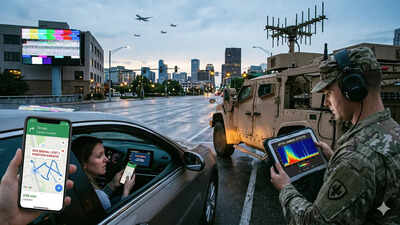
AI-generated photo for representational purpose
As the war between US-Israel and Iran continues in the Middle Eastern region, a report has said that GPS has been disrupted in the Persian Gulf. Ships traveling over land, aircraft flying in wave-like patterns, and food delivery riders appearing off the coast of Dubai — the war in the Middle East is exposing just how fragile satellite navigation really is.Ships are said to appear to sail over land, aircraft are flying in erratic wave-like patterns, and food delivery riders in Dubai are showing up off the coast in the middle of the sea. The conflict has essentially exposed how fragile the world’s satellite navigation systems really are. According to a report by CNBC, within hours of the first US and Israeli strikes against Iran on February 28, the warning signs were already visible in the data.
Vessels in the Persian Gulf were seen making sharp, polygonal turns. Analytics firm Kpler, which tracks maritime movements worldwide, said that it was monitoring the situation, and pointed that the navigation system under severe and growing stress. The report says that within the first 24 hours of the conflict, maritime intelligence firm Windward logged over 1,100 vessels across the Gulf experiencing GPS interference.
A week later, the figure jumped by another 55%.
Problem or deliberate signal jamming by ships
The reason, according to Clayton Swope, deputy director of the Aerospace Security Project at the Center for Strategic and International Studies, is that Gulf states are deliberately jamming satellite navigation signals to protect their infrastructure. The goal is to confuse the onboard systems of adversarial drones and missiles before they can reach their targets.To be clear, the report stresses, that GPS disruption in the Persian Gulf is not new. For years, oil tankers in the region have reportedly been caught manipulating their Automatic Identification System signals – the technology used to track ships at sea – to hide their movements and evade sanctions on Iranian oil exports.This practice, known as spoofing, involves faking location signals to obscure where a vessel actually is.
It has long been a tool of covert maritime operations, according to Ana Subasic, a trade risk analyst at Kpler. But what was once a background problem has become a full-blown crisis since hostilities broke out.The problem is that when a region is flooded with false GPS signals, everyone gets caught in it. Aircraft have been tracked flying in erratic, wave-like patterns that bear no resemblance to their actual flight paths. On the ground in Dubai, GPS malfunctions have caused food delivery riders to appear as if they are floating off the coast — out at sea, rather than on the city streets where they actually are.Similar disruptions were recorded across Europe after Russia's invasion of Ukraine in 2022, the report added.








 English (US) ·